
Let’s be honest—most corporate training fails for a very simple reason.
We throw information at people and hope it sticks. And then? They walk back to their desks, open their inbox, and forget 80% of what they just learned. If you’ve ever felt that frustration as a trainer, you’re not alone. This is exactly the problem Merrill’s Principles of Instruction were designed to solve.
Developed by instructional design expert David Merrill, these principles cut through the noise and answer one critical question:
👉 What actually makes learning stick and transfer to the real world?
In this guide, I’ll break down Merrill’s Principles of Instruction in a way that’s practical, actionable, and grounded in real training experience—not just theory.
In This Guide
- What Are Merrill’s Principles of Instruction?
- The 5 Core Principles (Deep Dive)
- From Theory to Practice: At a Glance
- How to Apply Merrill’s Principles in Your Training
- Merrill’s Principles Examples: Real Training Scenarios
- Merrill’s Principles vs Gagné’s Events of Instruction
- Why These Principles Work (The Psychology)
- Download: Merrill’s Principles of Instruction PPT
- Final Thoughts
- Frequently Asked Questions
What Are Merrill’s Principles of Instruction?
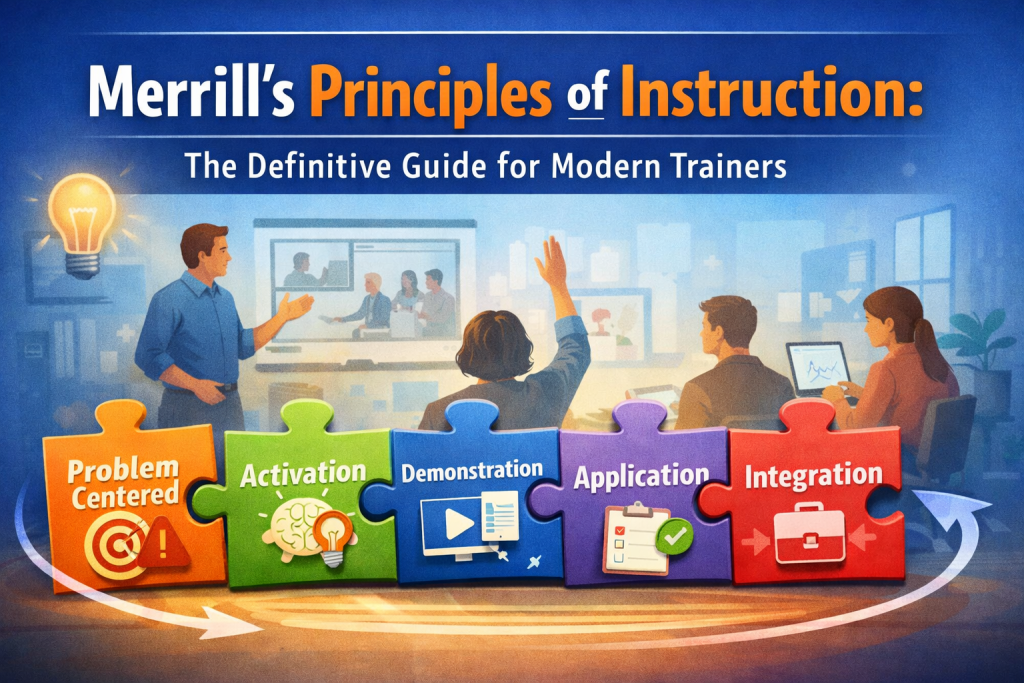
At its core, Merrill’s Principles of Instruction are five universal principles that underpin all effective learning experiences. Unlike models like ADDIE (which guide the process of instructional design), Merrill’s model focuses on what must happen within a learning experience for it to actually work.
The Big Idea
Learning is promoted when learners are engaged in solving real-world problems.
That’s the foundation. Everything else builds around it.
The Pebble-in-the-Pond Model
Merrill visualized this using a simple analogy. Drop a pebble into water, and ripples expand outward. In the same way, when you start with a real-world problem, everything else—content, practice, reflection—builds naturally around it. The problem isn’t just an example you use at the end of a module. It is the organizing structure for the entire learning experience.
The 5 Core Principles (Deep Dive)
Let’s break down each principle—not academically, but the way you’ll actually use it in your next training session.
1. The Problem-Centered Principle
In simple words, people learn better when they are solving a real problem, not just listening to theory. Learning is most effective when it is structured around real-world problems rather than abstract content.
What This Really Means
Most training starts the same way: agenda, learning objectives, then theory. The trainer stands at the front and explains concepts, assuming learners will connect the dots later.
Merrill flips this completely. Instead of teaching about something, you start by immersing learners in something. The problem is not a case study you analyze at the end. It is the starting point and organizing structure of the entire learning experience. Everything you teach exists because it helps solve that problem.
What This Looks Like in Training
Most trainers begin with a statement like, “Today we will learn about communication skills.” But learners are silently thinking: Why should I care?
The Problem-Centered Principle suggests starting differently. Instead, open with a scenario: “Your manager just told you your communication is unclear. You have a big presentation tomorrow. What will you do?”
Now learners are hooked. They’re already thinking about the problem. They’re invested.
Simple Example: Time Management
The old way: Teach time management techniques first. Walk through the Eisenhower Matrix, prioritization frameworks, and scheduling tools. Let learners practice with mock tasks. Finally, at the end, give them a real problem to solve.
The Merrill way: Start with a real problem. “You have ten tasks, three deadlines, and your boss just added another urgent request. What do you do first?” Now learners are immediately engaged in solving something that feels real. Only then do you introduce frameworks—as tools to help them solve the problem they’re already working on.
Advanced Application Techniques
To apply this principle effectively, try using progressive scenarios. Start with a simple situation, then add complexity as learners progress. This mirrors real life, where problems rarely stay simple.
Create “decision moments” by pausing during instruction and asking, “What would you do here?” This keeps learners mentally active.
Also consider role-based framing. Instead of saying, “Learn about leadership,” reframe it as, “You’re a new manager handling a disengaged team member. What do you do?” When learners see themselves in the problem, they engage more deeply.
Common Mistakes to Avoid
One common mistake is using generic examples like “Company X” that feel disconnected from learners’ reality. If the problem doesn’t feel authentic, engagement drops.
Another pitfall is solving the problem too quickly. If you jump to the answer before learners have a chance to wrestle with the problem, you lose the learning opportunity.
Finally, avoid treating the problem as a case study at the end. When the problem is an afterthought, it doesn’t structure the learning. It becomes just another example learners may or may not remember.
Expert Insight
When learners see themselves in the problem, attention is no longer something you have to manage. It happens automatically because the problem matters to them.
2. The Activation Principle
In simple words, people learn better when they connect new learning to what they already know. Learning is more effective when learners activate prior knowledge or experience before encountering new information.
What This Really Means
Learning is not about giving new information from scratch. It’s about building on what is already there. Most trainers assume learners are blank slates. They’re not. They come with past experiences, opinions, mistakes, and assumptions. Merrill says: use that. Don’t ignore it.
When you activate what learners already know, you create a hook for new information. The new material doesn’t arrive in a vacuum—it attaches to existing mental frameworks, making it easier to understand and remember.
What This Looks Like in Training
Most trainers jump straight into content: “Let’s understand the five steps of negotiation.” But learners are still mentally elsewhere—thinking about their morning, their inbox, or the meeting they just left.
The Activation Principle suggests starting differently. Instead, ask: “Think about the last negotiation you handled. What went well? What didn’t?” Now learners are thinking. They’re engaged. And they’re ready to learn because you’ve connected the topic to their lived experience.
Simple Example: Customer Service
The old way: Explain customer service principles first. Go through active listening, empathy statements, and de-escalation techniques—all before learners have any context.
The Merrill way: Start with activation. “Tell me about the most difficult customer you’ve ever handled. What made it challenging?” Then, as learners share their experiences, connect their answers to the concepts you were going to teach. Now the theory feels relevant because it speaks directly to their real challenges.
Advanced Application Techniques
Use experience sharing to kick off sessions. Ask learners to share real situations they’ve faced, then build discussion around those examples.
Prediction questions also work well. Before teaching a concept, ask: “What do you think is the best way to handle this?” This forces learners to draw on prior knowledge before receiving new information.
Emotional triggers can deepen activation. Asking “What frustrates you most about this situation?” creates a stronger connection than purely intellectual questions.
Common Mistakes to Avoid
Skipping activation to “save time” is a common error. Trainers often feel pressure to get to “the content,” but activation takes only a few minutes and dramatically improves retention.
Asking very generic questions like “What do you know about this topic?” is another pitfall. These questions often result in silence. Instead, ask about specific experiences: “When did this happen to you?”
Finally, not giving learners enough time to think or respond undermines activation. Silence can feel uncomfortable, but it’s necessary for genuine reflection.
Expert Insight
Activation is not a warm-up activity. It’s the foundation. If learners don’t connect with the topic early, the rest of the session will feel disconnected—no matter how good the content is.
3. The Demonstration Principle
In simple words, people learn better when you show them how something works instead of just explaining it. Learning is more effective when new knowledge is demonstrated clearly.
What This Really Means
Explaining tells. Demonstrating shows. And in training, showing always wins.
Learners need to see what “good” looks like, what “bad” looks like, and how something is actually done in practice. When you only explain, learners might understand the concept intellectually, but they won’t know what it looks like in action. Demonstration bridges that gap by providing a clear, tangible model they can emulate.
What This Looks Like in Training
Most trainers default to explaining concepts. For example, they might say, “You should give constructive feedback using the SBI model.” But learners are left wondering: What does that actually sound like in a real conversation?
The Demonstration Principle flips this. Instead of just explaining, you show. That might mean playing a recorded conversation, doing a live role-play in front of the group, or sharing a short video example. The goal is to make the abstract tangible.
Simple Example: Giving Feedback
The old way: Explain feedback models using slides and definitions. Walk through the steps. Maybe share a written example.
The Merrill way: Show a bad feedback conversation first. Ask learners what went wrong. Then show a good version of the same conversation. Ask: “What difference did you notice?” Now learners have a clear mental model to work from. They don’t just know what to do—they’ve seen how to do it.
Advanced Application Techniques
To make demonstration even more effective, try using a think-aloud approach. Walk learners through your decision-making process: “Here’s why I chose to start with this point instead of that one.” This reveals the thinking behind the action.
Comparing good versus bad examples side by side is another powerful technique. Let learners analyze both and articulate the differences themselves. This deepens their understanding.
And don’t limit yourself to one format. Different learners understand differently. Combine video, stories, and live demos to reach everyone.
Common Mistakes to Avoid
One common mistake is talking too much instead of showing. Trainers often feel the need to explain everything upfront, but this delays the moment when learners actually see the skill in action.
Another pitfall is using unrealistic examples. If your demonstration feels too polished or disconnected from the learner’s actual context, they may dismiss it as irrelevant. Use scenarios that mirror the real challenges they face daily.
Finally, avoid showing only “perfect” scenarios. Learners benefit from seeing mistakes and recoveries. When they see a skilled practitioner handle a difficult moment imperfectly, it becomes more relatable and less intimidating.
Expert Insight
If learners walk away saying, “I understand the concept, but I don’t know how to do it,” then your demonstration was not strong enough. A good demonstration leaves learners thinking, “I can see myself doing that.”
4. The Application Principle
In simple words, people learn best when they practice doing something themselves. Learning is reinforced when learners actively apply new knowledge.
What This Really Means
Learning is not complete until learners try it themselves.
Listening ≠ Learning.
Doing = Learning.
Too many training sessions are designed as information delivery events. The trainer talks, learners listen, and then everyone moves on. But listening alone doesn’t build skill. Application does. Until learners have attempted something themselves—made mistakes, received feedback, and tried again—they haven’t truly learned.
What This Looks Like in Training
Most sessions follow a predictable rhythm: explain concept, move to next slide, explain another concept, move to next slide. Learners sit passively through a firehose of information.
The Application Principle suggests a different rhythm. After explaining something, stop and let them practice. Even a few minutes of application can dramatically improve retention.
Simple Example: Conflict Management
The old way: Explain conflict resolution steps. Share a framework. Maybe show a diagram.
The Merrill way: Give learners a scenario: “Two team members are arguing about a project timeline. They’ve stopped speaking to each other, and work is stalled.” Then ask learners to role-play a solution. Let them try. Give feedback. Let them try again. Now they haven’t just learned about conflict management—they’ve practiced it.
Advanced Application Techniques
Use real-life scenarios that mirror situations learners actually face. The more authentic the practice, the more transferable the skill.
Provide immediate feedback during practice, not after. When learners make mistakes in the moment, you can correct them while the experience is fresh. Delayed feedback is less effective.
Also consider gradual difficulty. Start with a simple scenario, then increase complexity as learners build confidence. This prevents overwhelm while still challenging them appropriately.
Common Mistakes to Avoid
Too little practice time is a frequent issue. Trainers often allocate five minutes for application in a half-day session. Effective application requires enough time for learners to struggle, receive feedback, and try again.
Practice that feels unrealistic is another problem. If the scenarios don’t mirror real challenges, learners may not see the relevance and engagement drops.
Finally, providing no feedback during practice undermines the learning. Practice without feedback simply reinforces whatever approach learners already had—whether it worked or not.
Expert Insight
Practice is where confidence is built. Without application, learners may understand conceptually, but they won’t act when it matters. They’ll know what to do but won’t believe they can do it.
5. The Integration Principle
In simple words, learning is successful only when learners use it in real life. Learning is most effective when learners integrate new knowledge into their work.
What This Really Means
Training doesn’t fail in the classroom. It fails after the classroom.
If learners don’t apply what they learned, the training had no real impact. All the time, money, and effort invested leads to nothing if learners walk out the door and revert to their old habits.
Integration is about ensuring that what happened in the training room translates to real-world behavior change.
What This Looks Like in Training
Most sessions end with a simple question: “Any questions?” Learners say no, everyone leaves, and nothing changes.
The Integration Principle suggests a different ending. Instead of asking if there are questions, ask: “What will you do differently tomorrow?” Now learners leave with a clear commitment. They’ve already started thinking about application before the session ends.
Simple Example: Leadership Training
The old way: End with a summary of key points. Thank everyone for their time. Move on.
The Merrill way: Ask each learner to write down one leadership action they will take in the next week. Then have them share it with a partner. That partner becomes an accountability buddy. Now the learning doesn’t end when the session ends.
Advanced Application Techniques
Action planning is essential. But vague plans don’t work. Ask for specifics: “What exactly will you do? When will you do it? How will you know it worked?”
Peer accountability amplifies follow-through. When learners share their commitments with a colleague and agree to check in later, they’re far more likely to act.
Manager involvement can also make a difference. When learners discuss their action plans with their managers post-training, they create organizational support for new behaviors.
Common Mistakes to Avoid
Ending without reflection is a missed opportunity. The final moments of a training session are when learners are most likely to make commitments. If you fill that time with administrative tasks, you lose the chance to drive action.
No follow-up is another common failure. Training shouldn’t be a one-day event. A simple email one week later asking, “How did your action plan go?” can dramatically increase application.
Treating integration as optional is perhaps the biggest mistake. Many trainers view integration as “nice to have” if there’s time. But without integration, learning doesn’t transfer. It should be treated as essential.
Expert Insight
Integration is where training delivers ROI. Without it, even the most engaging sessions become forgettable experiences. The real value of training isn’t what happens in the room—it’s what happens after.
From Theory to Practice: Merrill’s Principles of Instruction at a Glance
The table below summarizes how Merrill’s Principles translate into practical training design. Each principle highlights a specific focus area and what the trainer needs to do to make learning effective.
The Problem-Centered principle emphasizes relevance, reminding trainers to start with real-world problems rather than abstract content. Activation focuses on prior knowledge, encouraging trainers to ask questions, facilitate discussions, and help learners recall their experiences. Demonstration shifts the focus to understanding by showing examples instead of just explaining concepts.
Application is about practice, where trainers create realistic scenarios for learners to try out new skills. Finally, Integration ensures transfer, pushing learners to apply what they’ve learned in their actual work environment.
Together, these principles reinforce a simple idea: effective training is not about delivering information, but about guiding learners through a structured experience that leads to real-world action.
| Principle | Focus | Trainer Action |
|---|---|---|
| Problem-Centered | Relevance | Start with real problems |
| Activation | Prior knowledge | Ask, discuss, recall |
| Demonstration | Understanding | Show examples |
| Application | Practice | Create scenarios |
| Integration | Transfer | Encourage real-world use |
How to Apply Merrill’s Principles of Instruction in Your Training
Applying Merrill’s Principles doesn’t require a complete redesign of your training. Instead, it requires a shift in how you think about learning.
Step 1: Start with the Task, Not the Content
Instead of opening with learning objectives or a slide deck, ask yourself: What should learners be able to do after this session? Build your session around that real-world task. The content exists only to help learners accomplish that task.
Step 2: Design the Flow
Once you know the task, design your session around the five principles. Begin with a realistic problem to create relevance. Then draw out learners’ past experiences to activate their thinking. From there, demonstrate the skill clearly using examples or scenarios. Then—and this is where most training falls short—give learners a chance to practice in a safe environment before they have to do it for real.
Step 3: Close with Accountability
The most critical step is ensuring learners actually use what they’ve learned. Close your session by asking them to commit to specific actions they will take in their role. If possible, build in accountability through peer discussions or follow-ups. A simple one-week check-in email can double the application rate.
When you consistently design using this flow—problem, activation, demonstration, application, integration—you move from simply delivering information to creating learning experiences that drive real behavior change.
Merrill’s Principles of Instruction Examples: Real Training Scenarios
Let’s make this even more concrete with real training scenarios.
Sales Training Example
Start with a problem: closing a hesitant client. Before diving into techniques, activate prior knowledge by asking, “What objections do you usually face?” Then demonstrate by playing a recorded sales call where a skilled rep handles objections effectively.
Next, give learners a chance to apply. Have them role-play a closing conversation in pairs. One person plays the client, the other plays the sales rep. Then switch.
Finally, drive integration by asking each learner to commit to using one technique in their next real sales call and to share the outcome with a peer.
Leadership Training Example
Start with a problem: handling underperformance on a team. Activate prior knowledge by having leaders share past experiences—what worked and what didn’t.
Demonstrate by showing a feedback conversation. It could be a video, a live role-play, or a recorded example. Then let leaders apply by practicing the conversation in pairs, taking turns playing the manager and the direct report.
For integration, ask each leader to plan a real feedback conversation they need to have in the coming week. They should write down who they’ll speak with, what they’ll say, and when they’ll do it. Then ask them to share their plan with a partner for accountability.
E-Learning Example
In a self-paced e-learning module, start with a problem scenario right on the first screen. Instead of listing objectives, present a challenge the learner might face tomorrow.
Use an interactive pre-quiz to activate prior knowledge. Ask questions that surface what learners already know about the topic before teaching anything new.
Demonstrate through a short video or animated scenario showing the skill in action. Then create scenario-based quizzes where learners must apply their knowledge by making decisions in realistic situations.
End with a reflection prompt that asks learners to commit to one action they will take back on the job. Even in e-learning, integration matters.
Merrill’s Principles vs Gagné’s Events of Instruction
This is a common comparison: Merrill’s principles vs Gagné’s events of instruction. Both are influential instructional design frameworks, but they serve different purposes.
| Merrill | Gagné |
|---|---|
| Focus on learning effectiveness | Focus on instructional sequence |
| Flexible principles | Structured steps |
| Problem-centered | Content-centered |
| Modern, learner-focused | More traditional |
My Trainer Perspective:
Use Gagné when you need structure—especially for designing lessons from scratch where you want a clear, step-by-step framework. Use Merrill when you want impact—especially when you’re evaluating existing training and asking, “Is this actually working?”
The best trainers often combine both. You can use Gagné’s nine events to structure your session while ensuring Merrill’s five principles are present throughout.
Why These Merrill’s Principles of Instruction Work (The Psychology)
One of the biggest strengths of Merrill’s Principles of Instruction is that they are not just theory—they are backed by how people actually learn. These principles align closely with some of the most powerful and proven learning theories in psychology.
Let’s break that down in a simple, practical way.
1. Problem-Based Learning
At its core, the brain is wired to solve problems. When learners are presented with a real-world challenge, their attention naturally increases because the situation feels relevant and urgent.
Instead of passively receiving information, learners shift into active thinking mode: “What would I do here?” “How do I solve this?”
This is exactly what the Problem-Centered Principle in Merrill’s model taps into.
👉 Why it works: When learning is tied to a problem, it becomes meaningful. And when learning is meaningful, it is remembered longer and applied more effectively.
2. Experiential Learning
Experiential learning is based on a simple idea: we learn best by doing, not by listening.
This connects directly with Merrill’s Application Principle (practice) and Integration Principle (real-world use).
When learners actively try something, they make mistakes, they adjust, and they improve. That process creates deeper learning than any lecture ever could.
But there’s one more layer—reflection. When learners pause and think, “What worked? What would I do differently?” that’s when real understanding happens.
👉 Why it works: Experience plus reflection equals long-term learning.
3. Cognitive Load Theory
The brain has limited capacity to process new information at once. If you overload learners with too much content, they shut down—or forget everything later.
This is where Merrill’s structured approach helps. Activation prepares the brain. Demonstration simplifies understanding. Application reinforces learning step by step.
Instead of dumping information, Merrill’s model breaks learning into manageable chunks, shows before asking learners to do, and builds complexity gradually.
👉 Why it works: It reduces confusion and helps learners focus on what really matters.
Bottom Line
Merrill’s Principles of Instruction work because they align with how the brain naturally learns—not how we traditionally teach.
- The brain learns through problems, not slides
- It learns through doing, not just listening
- It learns better when information is structured and connected
For trainers, this is the real takeaway:
👉 When you design training using these principles, you’re not just delivering content—you’re working with the brain, not against it.
And that’s why the learning actually sticks.
Final Thoughts About Merrill’s Principles of Instruction: What Great Trainers Do Differently
Let’s wrap this up simply.
- Problem-Centered → Start with real-world challenges
- Activation → Connect to what learners already know
- Demonstration → Show, don’t just explain
- Application → Let learners practice
- Integration → Drive real-world action
If you apply just these five consistently, your training will move from forgettable to transformational.
Final Note from a Fellow Trainer
After two decades in training rooms, one thing is clear:
People don’t remember what you taught.
They remember what they practiced and applied.
That’s exactly what Merrill’s First Principles of Instruction help you achieve. Now go build something that sticks.
Frequently Asked Questions about Merrill’s Principles of Instruction
Q1: Is Merrill’s Principles a replacement for ADDIE?
No. Think of it this way: ADDIE tells you how to design training. Merrill tells you what makes training effective. Use both together. ADDIE gives you the process; Merrill gives you the principles that ensure the process actually works.
Q2: Are these principles relevant for self-paced e-learning?
Absolutely. In fact, they’re even more important in self-paced learning. Without a live trainer to engage learners, e-learning can easily become passive. Merrill’s principles—especially problem-centered starts and application opportunities—are essential for keeping learners engaged and ensuring they actually learn.
Q3: Who is David Merrill?
David Merrill is a leading instructional design theorist who focused on identifying universal principles of effective instruction. His work synthesized decades of research into something trainers can actually use. The “First Principles of Instruction” framework, published in the early 2000s, remains one of the most influential models in the field.
![The Power of Storytelling in Corporate Training: Igniting Success and Inspiring Growth [2023]](https://trainercentric.com/wp-content/uploads/2023/06/storytelling-1024x576.jpg)