
A practical architecture for designing learning that actually transfers — from the room to the work that matters.
Introduction
Most corporate training fails — not because the facilitator was unprepared, not because the content was wrong, and not because the participants didn’t pay attention. It fails because the system around the training was never designed to make transfer happen. The BRIDGE Framework exists to fix that.
Here is a scenario that plays out in organisations every single week: a learning team designs a thoughtful, well-structured programme on, say, giving feedback effectively. They select a credible facilitator. They book a good room. The participants arrive. The session runs. Evaluations come back positive — people learned something, they felt engaged, they’d recommend it to a colleague.
Three weeks later, almost nothing has changed. The managers who attended are still having the same uncomfortable conversations — or, more precisely, still avoiding them. The investment in learning produced no measurable shift in behaviour.
The training didn’t fail. The system around the training failed.
This is the problem the BRIDGE Framework was built to solve. Developed as a transfer-focused design model, BRIDGE is built on a single central premise: effective training is never just about what happens inside the session. It is about what happens because of the session — at work, in real conversations, in decisions made weeks and months later.
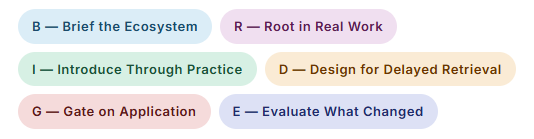
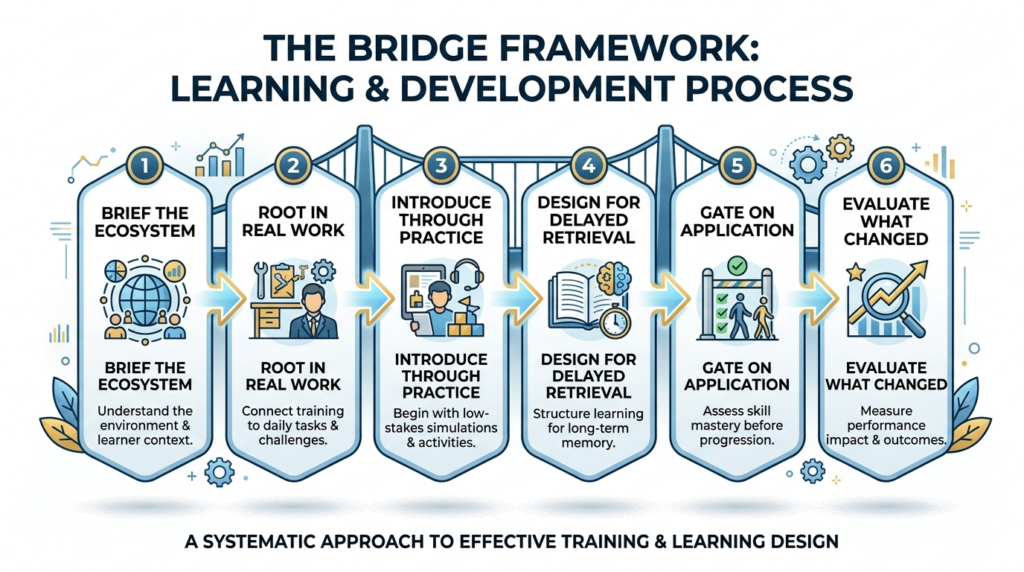
Each letter in BRIDGE represents a design phase. Together, they form a system-level architecture that treats transfer not as an afterthought but as the primary design goal from the very beginning.
The Six Phases of Bridge Framework at a glance

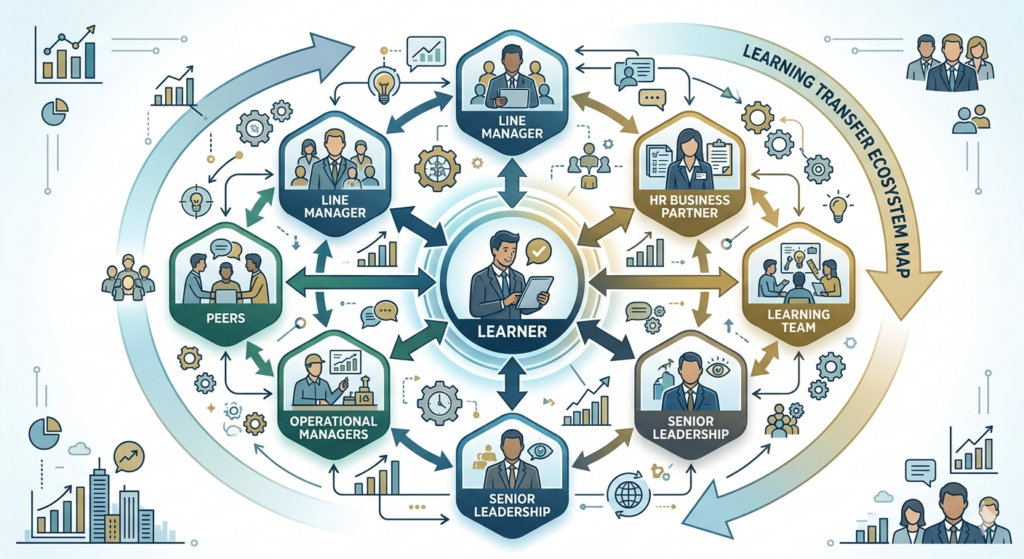
The first phase of the BRIDGE model is also its most counterintuitive. Before a single learning objective is written, before an activity is sketched, before the facilitator even opens a slide deck — you brief the ecosystem.
What does that mean in practice? It means having direct, substantive conversations with everyone who will influence whether the learning transfers. That includes the commissioning manager — the person who signed off on the training budget. It includes the line managers of the participants. It includes the HR business partner who may be tracking capability metrics. And it includes any operational leaders whose teams will be affected by the behaviour changes the programme is trying to produce.
Critically, this is not a logistics conversation. It is not an email about room bookings and joining instructions. The brief is a conversation about outcomes: What behaviour are we trying to change? Why does that behaviour matter to the business right now? What will each stakeholder do, concretely, to reinforce the new behaviour after the session ends? What organisational conditions might work against transfer — and how do we address them?
Most L&D practitioners will recognise a painful truth here: the ecosystem briefing is routinely skipped. The trainer gets briefed. The participants receive a joining instruction. And then everyone assumes the rest of the system will somehow support the learning. It rarely does — not because people don’t want to support it, but because they were never told what support was needed or why.
“Line managers are the single most powerful variable in transfer. Their behaviour in the weeks after a programme — whether they ask about it, create space to practise, or ignore it completely — predicts transfer outcomes more reliably than almost anything that happens in the session itself.”
By making ecosystem briefing a formal design phase, the BRIDGE model acknowledges what the research on transfer has consistently shown: the manager conversation before and after training matters more than the training itself. Building that conversation into the design architecture — not leaving it to chance — is the first structural move the framework makes.
| DESIGN PROMPT Before your next programme, map every person who influences whether the learning transfers. For each one, ask: what do they need to know, believe, and commit to doing before and after the session? Build that into your timeline as a non-negotiable phase. |

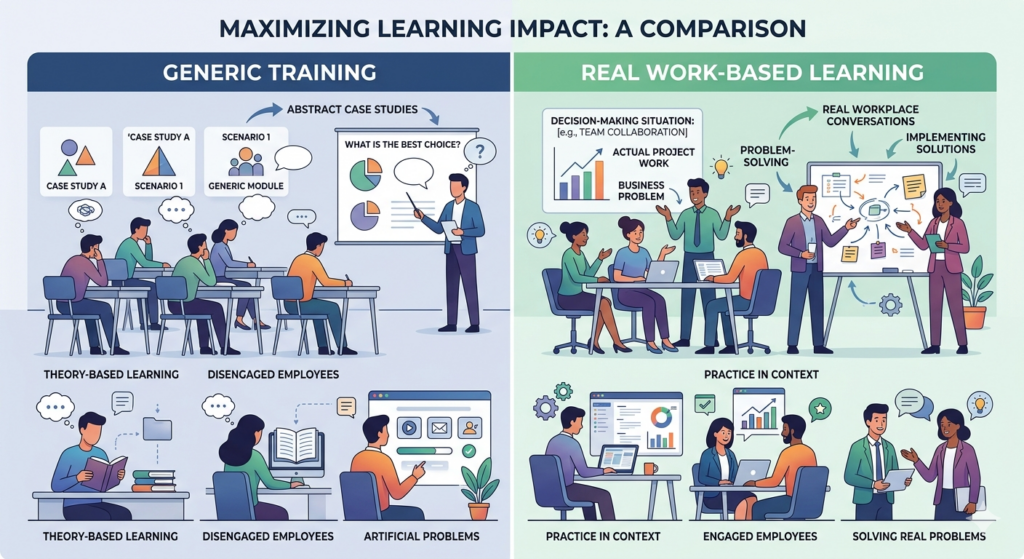
The second phase addresses the problem of abstraction. Training content — even well-designed content — has a stubborn tendency to drift towards the generic. Case studies from other industries. Scenarios from companies the participants have never worked for. Principles presented in their most universal form, stripped of the specific context that would make them immediately recognisable and usable.
The BRIDGE model insists on something harder and more valuable: every concept introduced in a session must be anchored to real tasks from participants’ actual roles. Not illustrative examples. Not simplified simulations. The genuine friction points, decisions, and conversations that participants will return to when the session ends.
This requires serious pre-work discovery before design begins. The L&D practitioner must understand the actual texture of the participant’s working life: What decisions do they make regularly, and where do those decisions tend to go wrong? What conversations produce the most anxiety, conflict, or missed opportunity? What situations consistently reveal a gap between intended and actual behaviour?
Gathering this material requires direct engagement with participants, their managers, and ideally with observed examples of real work. Surveys help. Focus groups help more. Sitting with a team for a morning — watching what actually happens, not just what people say happens — is worth more than either.
“The answers to these questions become the raw material for activities, scenarios, and reflection prompts. Not the inspiration for them — the material itself. The gap between training that feels relevant and training that doesn’t is usually the gap between this phase being done and not being done.”
When this phase is done well, participants spend the session working on problems they already recognise. The emotional engagement is qualitatively different. The question “how would I use this in my job?” — which otherwise has to be answered in the abstract — gets answered concretely and immediately, because the session was built from the job in the first place.
| DESIGN PROMPT For your next session, list five real situations participants face that are directly relevant to the capability you’re building. Every activity, scenario, and debrief prompt should trace directly back to one of those five situations. If an activity can’t be linked to a real situation your participants recognise, reconsider whether it earns its place. |

The third phase inverts one of the most deeply held assumptions in instructional design: that content should be explained before it is practised.
In the conventional model, the sequence runs: explain the concept, demonstrate the skill, give participants a chance to practise, then reflect and debrief. This sequence feels logical. It is also, for a specific category of complex skill development, less effective than the alternative the BRIDGE model proposes.
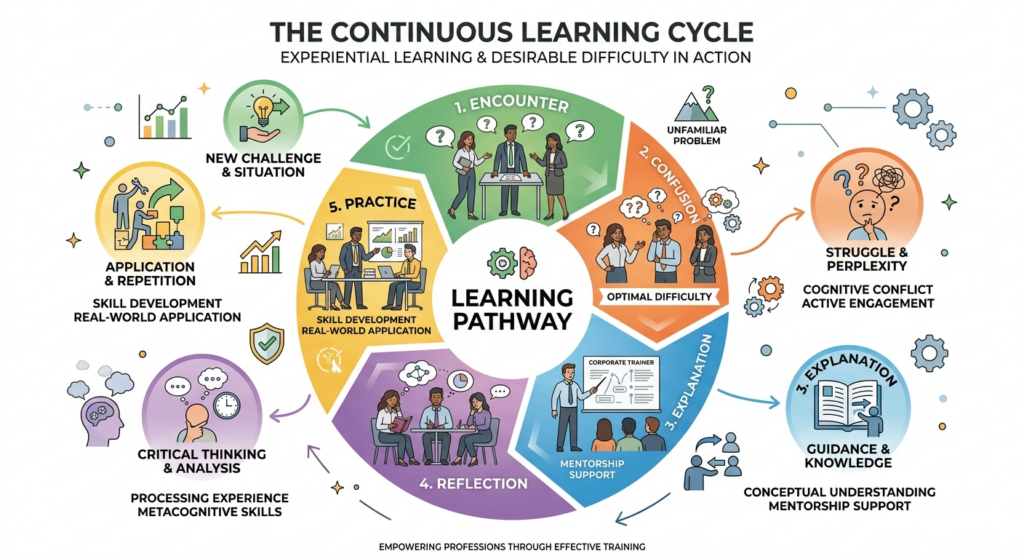
In the BRIDGE model, for concepts where experiential introduction is feasible, the sequence is reversed: participants encounter the concept in a situation that requires them to navigate it before they have been formally taught. They attempt something that requires the skill they don’t yet have. They experience the discomfort — and the partial insight — that comes from not quite knowing. Only then does the explanation arrive.
This is not chaos, and it is not cruel. It is a precise application of what cognitive science calls desirable difficulty. When learners are primed by the experience of attempting something without full information, their working memory is more receptive to the explanation that follows. The explanation lands on prepared ground. Concepts that might otherwise slide over participants become things they can feel — because they’ve already felt the shape of the problem the concept is designed to solve.
The full sequence in the BRIDGE model runs: encounter → confusion → explanation → reflection → practice. Confusion is not a failure state here. It is the mechanism. The slight discomfort of not quite knowing is precisely what makes the explanation stick.
“The sequence is: encounter, confusion, explanation, reflection, practice. This is the reverse of traditional instructional design. It only works for concepts where experiential introduction is genuinely feasible — not as a formula to apply everywhere, but as a powerful option for the right moments in a programme.”
| DESIGN PROMPT Identify one or two concepts in your next programme where you could introduce through experience rather than explanation. Design a situation where participants must navigate the concept before you explain it. Notice what changes in the quality of engagement during the debrief. |

One of the most persistent myths in learning design is that because participants performed well during a session — they remembered the framework, they answered the quiz correctly, they demonstrated the skill in the practice activity — they will retain and use the learning. They almost certainly won’t, at least not without deliberate structural support.
The science of memory is unambiguous on this point: a single retrieval event produces significantly less retention than multiple retrieval events spaced across time. This is the spacing effect, and it has been replicated in study after study across disciplines and contexts. A single quiz at the end of a session is not retrieval practice. It is a snapshot of immediate recall that will decay predictably within days.
The BRIDGE model takes this seriously by designing retrieval touchpoints as a structural feature of the programme — not as add-ons, bolt-ons, or afterthoughts. Specifically, the model specifies two to three retrieval events in the weeks following the session: a structured personal reflection at Day 7, a brief peer check-in at Day 14, and a manager conversation at Day 30.
These touchpoints are designed before the session begins, not after. They are communicated to participants during the session itself — so participants know they are coming and build them into their expectations — and to line managers before the session starts, so managers are prepared to play their part at Day 30.
The Day 30 manager conversation deserves particular attention. It is not a tick-box. It is a structured, purposeful conversation in which the manager asks: what did you commit to applying, did you try it, and what happened? This conversation is powerful precisely because it is known about in advance. The anticipation of being asked is itself a mechanism for transfer.
| DESIGN PROMPT Build a retrieval schedule into your programme design before you write the session content. Specify what each touchpoint involves, who facilitates it, and how the output will be used. Share this schedule with participants and their managers at the start of the programme, not the end. |

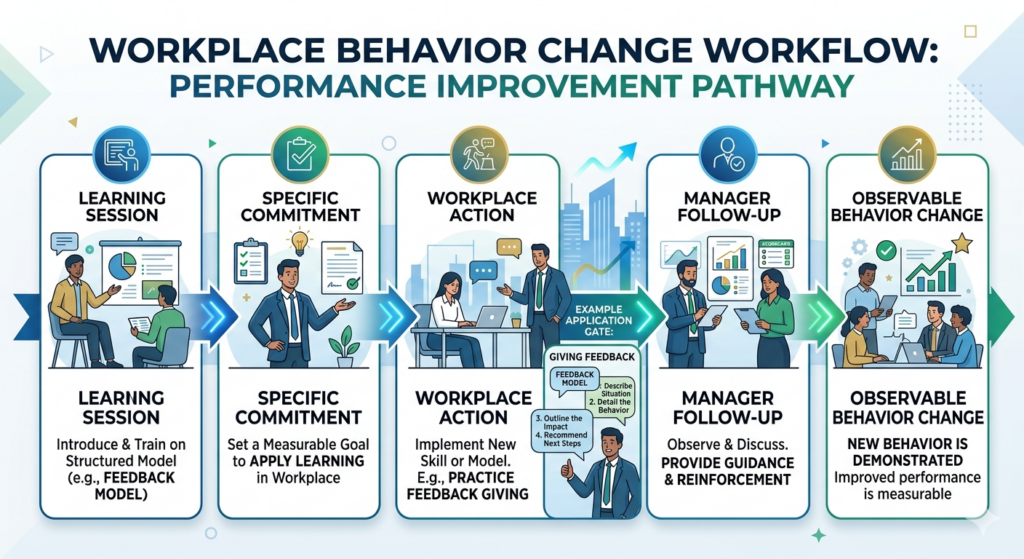
Phase five is where the BRIDGE model becomes most demanding — and, for many practitioners, most clarifying. It introduces the concept of the application gate: a specific, observable, behavioural action that each participant commits to completing before the programme is considered complete.
The word “specific” is doing a great deal of work in that sentence. Not “I will try to use the feedback model more.” Not “I commit to applying the principles from today.” A specific action: I will use the SBI model in my one-to-one with James on the 14th when I raise the issue of missed deadlines. The situation is named. The behaviour is described. The timeframe is concrete.
This specificity matters for several reasons. Vague commitments are easy to feel good about and easy to forget. Specific commitments create a mental representation of a concrete future moment — and that representation, when formed deliberately in session, functions as a kind of implementation intention that cognitive research has shown to significantly increase follow-through.
The gate is set during the session, checked at Day 30, and followed up in the manager conversation. Whether or not it was attempted, and what happened when it was, becomes the primary evidence for whether the programme produced transfer. This is a significant reframe: the measure of success is not what participants felt during the session. It is whether they did something differently in the real work.
There is something clarifying about the gate for participants too. It makes the learning concrete in a way that general reflection prompts do not. It closes the gap between the aspiration (“I want to give better feedback”) and the action (“I will give feedback to James on Tuesday using this approach”). And it gives participants something specific to bring to the Day 30 conversation — not a general impression of whether the training was useful, but a report on what they actually tried and what happened.
| DESIGN PROMPT Build application gate setting into your session design — not as a closing activity, but as a structured, supported moment with enough time for participants to identify a real, specific, named situation they can commit to. Pair each participant with an accountability partner, and share the gate format with managers before the session so they know what to ask about at Day 30. |

The final phase of the BRIDGE model addresses evaluation — but not the kind of evaluation most training programmes rely on. Not the end-of-session feedback form that measures how much participants liked the facilitator and whether the lunch was good. Not the immediate knowledge check that tells you whether people retained the content long enough to answer a quiz ten minutes after it was taught.
The BRIDGE model designs evaluation at the behaviour and results level, aligned to the upper levels of Kirkpatrick’s four-level framework. The central evaluation question is: “What did you do differently, and what happened as a result?”
This question is posed in two directions. Participants are asked it directly, typically at Day 30 or beyond, and their responses form one stream of evidence. Their line managers are asked the same question independently — what have you observed that is different, and what do you believe has changed as a result of the programme? — and their responses form a second stream.
Both streams are collated and reported back to the commissioning stakeholder as evidence of transfer. Crucially, this report includes not just what changed but what got in the way. What organisational conditions made transfer harder than it should have been? What non-training factors — workload, management behaviour, system constraints — prevented participants from applying what they learned? And what specific recommendations follow from that for addressing those barriers through means other than training?
This last element is significant. The BRIDGE model treats evaluation not as a retrospective judgement but as a diagnostic that feeds forward. If the programme didn’t produce transfer, the evaluation tells you why — and points towards what needs to change in the system, not just the session.
| DESIGN PROMPT Design your evaluation methodology at the same time you design the session — not after it runs. Specify what evidence of behaviour change you will collect, from whom, when, and how. Build the evaluation question into the programme from the start so participants know it’s coming and are primed to pay attention to their own behaviour in the weeks that follow. |
Why Most Programs Skip The Bridge Framework?
Reading through the six phases, a practitioner might reasonably ask: if this is what effective transfer design looks like, why isn’t everyone doing it?
The honest answer is that the BRIDGE model requires more from L&D practitioners — and more from the organisations that commission learning. The ecosystem briefing requires access to line managers who may not see why they need to be involved. The real-work discovery requires time and organisational goodwill that not every team has. The retrieval schedule requires a client who is willing to treat the programme as a multi-week system rather than a one-day event. The application gate requires facilitators who are comfortable making the learning feel high-stakes and specific. The evaluation requires a commissioning stakeholder who genuinely wants to know what changed — even if the answer is uncomfortable.
These are real constraints. They are also, in most cases, surmountable. The organisations that use BRIDGE principles consistently tend to find that the initial investment in ecosystem briefing and real-work discovery pays back many times over in programme relevance and participant engagement. The retrieval and gate elements tend to be well-received by participants once they understand the purpose. And the evaluation data — even when it reveals barriers — tends to strengthen the L&D team’s relationship with the business, because it demonstrates a commitment to actual outcomes rather than participant satisfaction scores.
Using BRIDGE as a Diagnostic Tool
Beyond programme design, the BRIDGE model has a second life as a diagnostic framework for auditing existing programmes that aren’t producing the results they should.
If you have a programme that participants consistently rate well but that isn’t producing visible behaviour change, running it against the BRIDGE checklist will usually locate the failure point quickly. Has the ecosystem been briefed, or are line managers surprised when participants return with new approaches and no support to practise them? Is the content rooted in real work, or is it generic enough that participants struggle to see immediate application? Are there retrieval touchpoints, or does the programme end on the day and hope for the best?
Almost every underperforming programme has a clear failure point in one or more of these six phases. The diagnostic use of the framework doesn’t require a full redesign. It requires identifying which phase is missing or weak, and making the specific structural intervention that phase calls for.
A session that is part of a system
The BRIDGE Framework does not promise a better session. That is not its aim. It promises a session that is part of a system — one designed to change what happens at work, not just what happens in the room.
For practitioners who are tired of watching well-designed programmes disappear without trace, and for organisations that are serious about the connection between learning investment and performance change, BRIDGE offers a coherent and practical architecture. Not a guarantee — transfer is always complex, always context-dependent. But a genuine improvement on the default, which is designing sessions in isolation and hoping the rest of the system cooperates.
![The Power of Storytelling in Corporate Training: Igniting Success and Inspiring Growth [2023]](https://trainercentric.com/wp-content/uploads/2023/06/storytelling-1024x576.jpg)