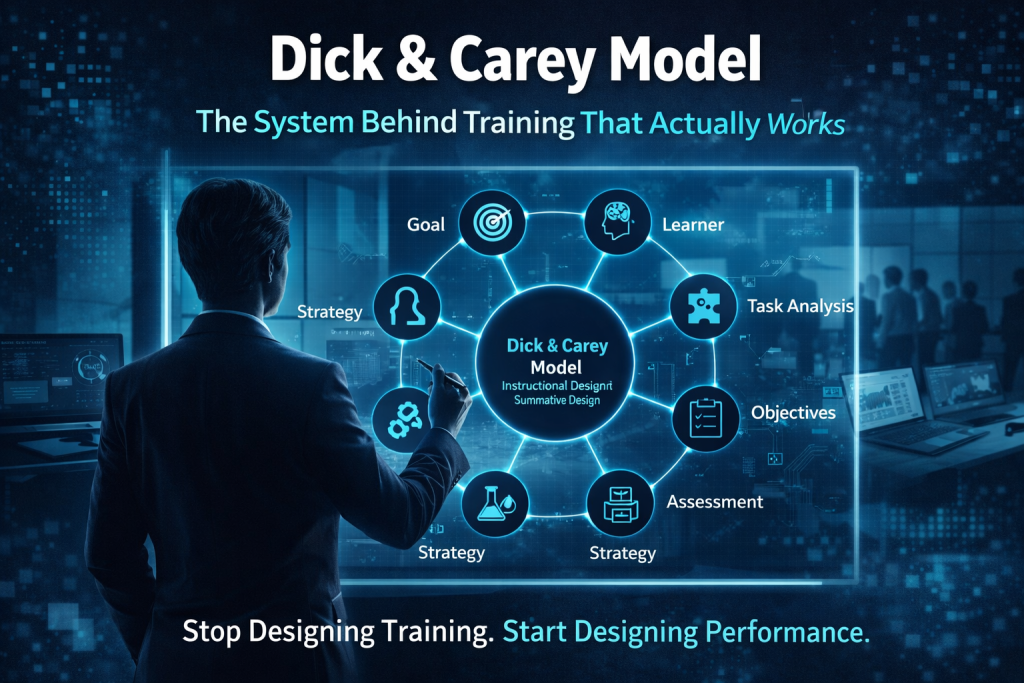
Dick and Carey Model of Instructional Design is the difference between training that looks impressive and training that actually changes performance.
You’ve probably been here:
You’re handed a vague mandate like, “Our managers need to improve feedback skills,” or “Sales needs better negotiation training.” You’re expected to design a program fast, roll it out across teams, and magically prove ROI. Where do you even begin?
This is exactly the kind of messy, high-stakes situation the Dick and Carey Model of Instructional Design was built for. It gives corporate trainers and L&D leaders a systematic, no-nonsense framework to diagnose performance gaps, design instruction with surgical precision, and validate whether learning actually works in the real world.
In this definitive guide, you’ll get:
- A clear definition of the model and its philosophy
- A practical breakdown of all 10 steps
- A real-world corporate training case study (new managers learning to give feedback)
- A brutally honest comparison with ADDIE and SAM
- Guidance on when this model is a smart choice—and when it’s overkill
This is not textbook theory. This is how serious L&D teams design training that survives contact with reality.
What is the Dick and Carey Model of Instruction Design? (A Definition)
The Dick and Carey Model of Instructional Design is a systems-based approach to designing instruction where every component—learners, objectives, assessments, content, delivery, and evaluation—is interconnected and aligned to a specific performance goal.
Unlike casual “build a deck and deliver a workshop” approaches, this model treats training as a performance system, not an event. Each step informs the next, and feedback loops ensure continuous improvement.
The model was developed by Walter Dick, Lou Carey, and James O. Carey, and popularized through their foundational textbook The Systematic Design of Instruction.
For corporate trainers, this matters because it forces discipline. It prevents you from jumping straight into content creation before you understand what problem you’re actually solving.
The Philosophy Behind the Dick and Carey Model of Instructional Design: A Systems Approach
At its core, the Dick and Carey Model of Instructional Design is grounded in reductionism—breaking a complex performance problem into smaller, manageable components so you can design instruction that actually works.
But don’t mistake “systematic” for “rigid.” This is not a dumb checklist. While the steps are presented linearly, the model is iterative. Data from evaluation loops back to refine objectives, content, assessments, and strategy.
Here’s the bold truth many L&D teams don’t want to hear:
If your training fails in the workplace, your design process was flawed. This model makes it painfully obvious where things break—because everything is connected.
What is the “Systems Approach” to Instructional Design?
The systems approach to instructional design treats learning as an interconnected system rather than a set of isolated training activities. Instead of designing content first, this approach aligns business goals, learner needs, instructional strategies, assessments, delivery methods, and evaluation into one coordinated process.
In the context of the Dick and Carey Model of Instructional Design, the systems approach means:
- Every component is connected
Objectives, assessments, content, and evaluation must all support the same performance outcome. If one piece changes, the rest must adapt. - Training is designed backward from performance
You start with the desired workplace behavior, then design assessments and instruction to support that outcome. - Feedback loops drive improvement
Data from formative evaluation is used to revise objectives, materials, and strategies—making the design process iterative, not one-and-done. - Learning is measured in real-world impact
Success is defined by performance on the job, not by course completion or smile sheets.
Why the Systems Approach Matters for Corporate Trainers
For corporate trainers and L&D leaders, the systems approach prevents a common failure mode:
great-looking training that fails to change workplace behavior.
When you apply a systems approach:
- You design training around performance gaps, not topics
- You align learning outcomes with business goals
- You reduce wasted training spend
- You create instruction that survives real-world constraints like time pressure, manager behavior, and workplace culture
Bottom line:
The systems approach forces L&D teams to stop designing courses in isolation and start designing performance systems. This is why the Dick and Carey Model of Instructional Design remains one of the most reliable frameworks for high-stakes corporate training.
The 10 Steps of the Dick and Carey Model of Instructional Design (In-Depth)
To make this real, we’ll use one consistent case study:
Designing a training program for new managers on giving effective feedback.
Step 1: Assess Needs to Identify Instructional Goal(s)
Goal: Translate a business problem into a clear instructional goal.
Process & Key Questions:
- What performance is missing today?
- Is this truly a skills issue—or a systems, incentives, or leadership problem?
- What should people be able to do differently after training?
Case Study:
Performance gap: New managers avoid difficult feedback conversations, leading to low team performance and engagement.
Instructional goal: Managers will conduct structured, timely, and constructive feedback conversations.
Step 2: Conduct Instructional Analysis
Goal: Break down the performance into component skills.
Process & Key Questions:
- What steps must a learner perform?
- What skills are cognitive vs procedural?
- Where do learners usually fail?
Case Study:
Sub-skills include: preparing feedback, structuring the conversation, handling defensiveness, and following up with action plans.
Step 3: Analyze Learners and Contexts
Learner Analysis:
- Prior leadership experience
- Comfort with conflict
- Attitudes toward feedback
Context Analysis:
- Learning context: virtual workshops + simulations
- Performance context: real feedback conversations in 1:1 meetings
Case Study:
New managers are time-poor and conflict-avoidant. Training must be short, practical, and psychologically safe.
Step 4: Write Performance Objectives
Goal: Define measurable outcomes.
Each objective includes:
- Behavior: What they will do
- Condition: Under what circumstances
- Criteria: How well
Case Study Objective:
Given a performance issue, the manager will conduct a feedback conversation using the SBI framework, achieving employee clarity and documented action steps.
Step 5: Develop Assessment Instruments
Goal: Design assessments before content.
Types:
- Pretests
- Practice tests
- Post tests
- Observation checklists and rubrics
Case Study:
Managers are assessed through simulated feedback conversations scored with a behavioral rubric.
Step 6: Develop Instructional Strategy
Goal: Design how learning will happen.
Decisions:
- Delivery: blended (virtual + practice labs)
- Sequencing: model → practice → feedback
- Activities: role-plays, reflection, peer coaching
Case Study:
Short learning bursts + live simulations + manager peer coaching circles.
Step 7: Develop and Select Instructional Materials
Goal: Build or curate learning assets.
Materials:
- Facilitator guides
- Scenario videos
- Learner job aids
- Conversation frameworks
Case Study:
Custom role-play scenarios based on real corporate situations.
Step 8: Design and Conduct Formative Evaluation
Goal: Test before scaling.
Types:
- One-to-One
- Small Group
- Field Trial
Case Study:
Pilot with 10 managers → refine scenarios and pacing.
Step 9: Revise Instruction
Goal: Fix what didn’t work.
Data informs revisions to objectives, assessments, strategy, and materials.
Step 10: Design and Conduct Summative Evaluation
Goal: Evaluate overall impact.
Case Study:
Measure changes in feedback quality, team engagement scores, and performance outcomes 60 days post-training.
Advantages and Disadvantages of the Dick and Carey Model of Instructional Design
Advantages
- Ruthlessly systematic
- Ideal for novice designers
- Excellent for complex, high-risk training
- Prevents “training theatre”
Disadvantages
- Time-consuming
- Heavy front-end analysis
- Slower than agile models
- Overkill for simple skills training
Dick and Carey Model of Instructional Design vs. Other Instructional Design Models
| Model | Best For | Strength | Limitation | Output Quality / Risk |
| Dick & Carey | Complex corporate training, leadership, compliance | Precision, alignment, performance focus | Slower, heavy upfront analysis | Low risk for complex projects |
| ADDIE | General ID projects | Familiar structure, flexible execution | Vague guidance, often poorly implemented | Medium risk (depends on execution quality) |
| SAM | Fast-moving environments, rapid prototyping | Speed, iteration, stakeholder buy-in | Weak analysis can lead to shallow learning | Higher risk if analysis is skipped |
The Dick and Carey Model of Instructional Design is essentially ADDIE on steroids—and that’s a good thing when failure is expensive.
Dick and Carey Model Templates & Tools
Practical application of the Dick and Carey Model of Instructional Design often requires more than theory. Experienced instructional designers use simple, repeatable templates and worksheets to execute key steps with speed and consistency—especially in corporate training environments where timelines are tight.
Commonly used Dick and Carey Model templates and tools include:
- Step 1 – Needs Assessment Worksheet
A structured template to diagnose performance gaps, root causes (skill vs system issues), stakeholders, and business outcomes before jumping into solution mode. - Step 5 – Assessment Instruments Template
Checklists, rubrics, and scenario-based assessment templates that map directly to performance objectives—ensuring tests measure real workplace behavior, not trivia. - Learner & Context Analysis Canvas (Step 3)
A one-page canvas to capture learner profiles, constraints, learning environment, and performance environment in one place. - Instructional Strategy Planner (Step 6)
A planning tool to design sequencing, activities, practice loops, and reinforcement mechanisms aligned to objectives and assessments.
Why Templates Matter for Corporate L&D Teams
Templates turn the Dick and Carey Model of Instructional Design from a conceptual framework into an operational system. They:
- Reduce design time without sacrificing rigor
- Create consistency across trainers and vendors
- Make instructional quality auditable and scalable
- Help L&D teams defend design decisions with evidence
Pro tip:
High-performing L&D teams build a small internal toolkit of Dick and Carey Model of instructional design templates and reuse them across leadership programs, onboarding journeys, and capability academies. This is how the model scales beyond one-off projects.
Conclusion
The Dick and Carey Model of Instructional Design is not trendy. It’s not flashy. And that’s exactly why it works.
If you’re designing large-scale leadership, compliance, or capability-building programs where failure has real business consequences, this model gives you the rigor most L&D teams skip—and later regret.
Is it right for you?
Use it when the problem is complex and the stakes are high. Skip it when you just need to teach a small tool or process update.
Explore more practical frameworks in Trainercentric Magazine, learn from industry voices in Leaders Talk, and consider contributing your own insights as a guest author to help raise the standard of corporate training across the industry.
![The Power of Storytelling in Corporate Training: Igniting Success and Inspiring Growth [2023]](https://trainercentric.com/wp-content/uploads/2023/06/storytelling-1024x576.jpg)