Introduction
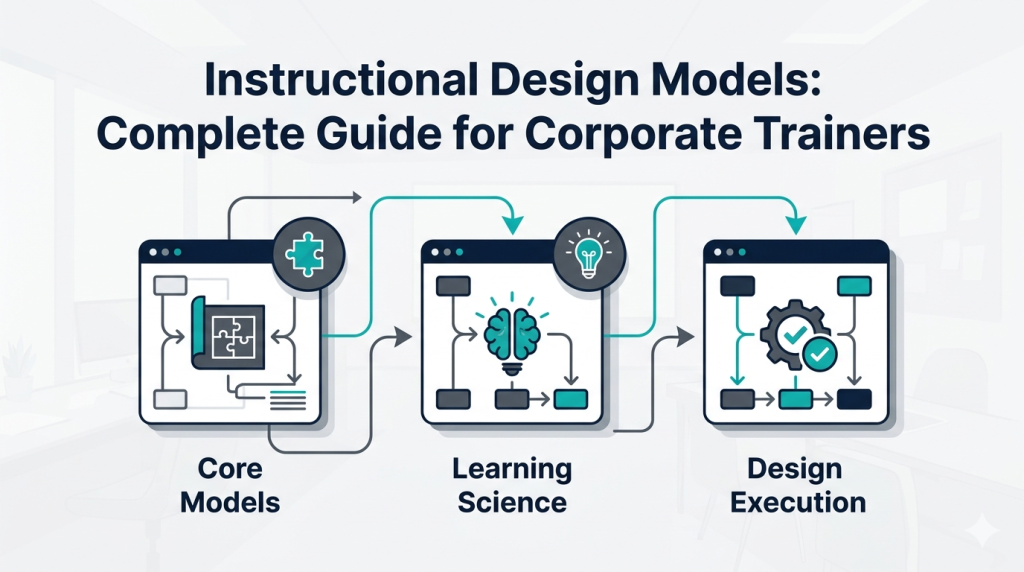
This guide is built to help you move from theory to execution—fast. It covers three pillars that every corporate trainer must master: Core Instructional Design Models → Learning Science → Design Execution. These pillars work together. Models give you structure, learning science ensures effectiveness, and execution turns plans into measurable business outcomes.
This guide is for corporate trainers, L&D managers, and instructional designers who are responsible for delivering results—not just content. Whether you’re building onboarding programs, leadership workshops, compliance training, or sales enablement, you’ll find practical frameworks you can apply immediately.
Use this as both a reference guide and an internal linking hub. When you’re designing a program:
- Start with a model (Part 1)
- Layer in learning science (Part 2)
- Execute with precision (Part 3)
You don’t need to memorize everything. You need to know what to use, when to use it, and how to execute it under pressure.
By the end of this guide, you will be able to:
- Select the right instructional design model
- Apply learning science principles effectively
- Execute end-to-end training design with confidence
Key Take Aways
**If You Read Nothing Else — Remember These Three Things**
1. **Start with ADDIE, then layer in SAM.** Structure + agility = results.
2. **Cognitive load is the hidden killer of corporate training.** Simplify every slide.
3. **Train only when there’s a performance gap.** TNA first. Always.
Free Download: Instructional Design Playbook
Before we go deeper: Download the complete Instructional Design Playbook (Free)
It includes frameworks, templates, and real-world examples you can apply immediately. All you need to do is fill up the form below and we will email it to you within 2-3 working days.
Part 1: Core Instructional Design Models
ADDIE Model
What it is: A structured, linear framework for designing training programs through five phases. Analysis, Design, Development, Implementation, and Evaluation are referred to as ADDIE. Since its initial introduction in the 1970s, the paradigm has been utilized by training specialists.
Core Steps:
- Analyze
- Design
- Develop
- Implement
- Evaluate
Best Use Case:
Best for large-scale, structured training programs where clarity and documentation matter.
Corporate Example:
A company designing a global onboarding program uses ADDIE to standardize content across regions.
Limitation:
Can be slow and rigid, especially in fast-changing environments.
The ADDIE model is a tested and real instructional design method that can be applied to develop skills training courses. Training experts can ensure that their training programs are effective according to the five stages of the ADDIE model and the needs of both the organization and the potential audience. Read our complete breakdown of the ADDIE model and how to apply it step-by-step.
SAM Model (Successive Approximation Model)
What it is: An iterative model focused on rapid prototyping and continuous improvement. This method of instructional designing, the acronym for SAM, is more than just a design methodology; it’s a paradigm shift that propels eLearning beyond conventional boundaries. Our mission is to empower educators and instructional designers to leverage it’s dynamic approach in crafting eLearning experiences that engage, educate, and evolve.
Core Steps:
- Preparation
- Iterative Design
- Iterative Development
Best Use Case:
Best for agile environments where speed and feedback matter.
Corporate Example:
A sales training team creates a prototype module, tests it with a pilot group, and refines it weekly.
Limitation:
Requires constant stakeholder involvement, which can slow decision-making.
Explore how to build training faster with our SAM model implementation guide for corporate teams.
Dick & Carey Model
What it is: A systematic model that views instruction as an interconnected system. The Dick and Carey Model of Instructional Design is a systems-based approach to designing instruction where every component—learners, objectives, assessments, content, delivery, and evaluation—is interconnected and aligned to a specific performance goal.
Core Steps:
- Identify instructional goals
- Conduct instructional analysis
- Analyze learners and context
- Write objectives
- Develop assessments
- Develop instructional strategy
- Develop materials
- Evaluate and revise
Best Use Case:
Best for high-stakes training like compliance or technical certifications.
Corporate Example:
A financial firm builds a regulatory compliance program with detailed assessments and validation steps.
Limitation:
Highly detailed and time-intensive.
It is especially helpful if you’re designing large-scale leadership, compliance, or capability-building programs where failure has real business consequences, this model gives you the rigor most L&D teams skip—and later regret. If you would need to know more about this topic, don’t miss our detailed Dick & Carey model walkthrough.
Gagné’s Nine Events of Instruction
What it is: A sequence of instructional events designed to optimize learning. Developed by Robert M. Gagné, this instructional design model is more than just a checklist—it’s a psychology-rooted blueprint that maps how humans truly learn. Despite being developed in the 1960s, Gagne’s framework is a game-changer for modern instructional designers, educators, and trainers.
Core Steps:
- Gain attention
- Inform objectives
- Stimulate recall
- Present content
- Provide guidance
- Elicit performance
- Provide feedback
- Assess performance
- Enhance retention
Best Use Case:
Best for structured classroom or eLearning modules.
Corporate Example:
A cybersecurity training module uses scenarios to gain attention, quizzes for recall, and simulations for practice.
Limitation:
Can feel formulaic if overused.
In this comprehensive guide to Gagne’s Nine Events of Instruction, we’re going to explore each of Nine Events—not as dry theory, but as practical, flexible tools that can help you craft learning that engages, sticks, and transfers into real-world action.
Bloom’s Taxonomy
Bloom’s taxonomy is one of the most effective framework that is designed to guide the trainers to create a framework to categorizer different kinds of learning into a simple one. Benjamin Bloom, one of the renowned educational psychologist created this framework in 1956 along with a group of corroborators. It was designed keeping the goal in mind that it will help the educators or trainers to design effective learning framework and assessments. In this comprehensive guide, we will explore the in-depth analysis of Bloom’s taxonomy.
Core Levels:
- Remember
- Understand
- Apply
- Analyze
- Evaluate
- Create
Best Use Case:
Best for writing learning objectives and assessments.
Corporate Example:
A leadership program moves from understanding feedback models to creating personalized coaching plans.
Limitation:
Doesn’t prescribe how to teach, only what level to target.
Struggling with objectives? This Bloom’s Taxonomy guide shows exactly how to write measurable outcomes. Here is why every corporate trainers should know about Bloom’s taxonomy.
Merrill’s Principles of Instruction
What it is: A problem-centered approach focused on real-world application.
Core Principles:
- Problem-centered
- Activation
- Demonstration
- Application
- Integration
Best Use Case:
Best for skill-based training.
Corporate Example:
Customer service training uses real complaints and role-play simulations.
Limitation:
Requires well-designed scenarios, which take effort.
Build skill-first training with our Merrill’s Principles practical application guide.
Kolb’s Reflective Cycle
What it is: A learning cycle based on experience and reflection. Developed by educational theorist David A. Kolb, this model provides a simple yet profound framework for understanding how adults learn from experience.
Core Steps:
- Concrete Experience
- Reflective Observation
- Abstract Conceptualization
- Active Experimentation
Best Use Case:
Best for leadership and behavioral training.
Corporate Example:
Managers reflect on a difficult conversation, learn frameworks, and test new approaches.
Limitation:
Not ideal for pure knowledge transfer.
This model is the cornerstone of experiential learning theory, which essentially states that “learning is the process whereby knowledge is created through the transformation of experience.” For trainers, this is a game-changer. It means our job isn’t just to transmit information, but to facilitate a cycle that turns doing into knowing. Improve behavioral training with our Kolb’s learning cycle explained with real examples.
VARK Learning Styles
What it is: A model categorizing learners into Visual, Auditory, Reading/Writing, and Kinesthetic. Developed by Neil Fleming, the VARK learning styles helps trainers understand how individuals prefer to receive and process information. Instead of assuming that one delivery method works for everyone, the VARK framework encourages trainers to design learning experiences that appeal to multiple modalities.
Core Types:
- Visual
- Auditory
- Reading/Writing
- Kinesthetic
Best Use Case:
Best used as a design variety guide, not a strict rule.
Corporate Example:
A training includes videos, discussions, PDFs, and simulations.
⚠️ Note: Learning styles are scientifically debated. Do not design training exclusively around them.
Limitation:
Can lead to oversimplification of learning.
The VARK learning styles model provides a practical framework for understanding how people prefer to learn. By incorporating visual, auditory, read/write, and kinesthetic elements, trainers can create sessions that resonate with every learner in the room. Not sure about learning styles? Read our evidence-based take on VARK in corporate training.
Honey & Mumford Learning Styles
What it is: A model identifying learner preferences based on behavior. The Honey and Mumford learning styles model emerged in the early 1980s as a practical adaptation of David Kolb’s Experiential Learning Theory.
Kolb’s model proposed that learning occurs through a continuous cycle of experience, reflection, conceptualization, and experimentation. While academically influential, Kolb’s framework focused heavily on internal cognitive processes, which made it somewhat abstract for everyday workplace application. Peter Honey and Alan Mumford sought to make this theory more accessible for managers and trainers.
Core Types:
- Activists
- Reflectors
- Theorists
- Pragmatists
Best Use Case:
Best for designing varied engagement strategies.
Corporate Example:
A workshop includes group activities, reflection time, theory explanation, and real-world application.
Limitation:
Similar to VARK, it risks labeling learners too narrowly.
Instead of focusing primarily on mental processes, they emphasized observable learning behaviors—how people actually approach learning situations in practice. Design for different learners using our Honey & Mumford model in action guide.
| Model | Best For | Time/Effort | Complexity |
| ADDIE | Structured programs | High | Medium |
| SAM | Agile training | Medium | Medium |
| Dick & Carey | Compliance/technical | Very High | High |
| Gagné | eLearning modules | Medium | Medium |
| Bloom | Objectives & assessment | Low | Low |
| Merrill | Skill-based learning | Medium | Medium |
| Kolb | Behavioral learning | Medium | Medium |
| VARK | Engagement variety | Low | Low |
| Honey & Mumford | Learning preferences | Low | Low |
Part 2: Learning Science Fundamentals
Adult Learning Principles (Andragogy)
Adult Learning Principle is the practice of involving adult learners in educational activities to gain new knowledge, skills, and behaviors. As more adults go back to school or try to improve their knowledge and abilities in the job, the field of adult learning has expanded dramatically in recent years. This is more or less applicable in corporate trainings as well where Adult Learning Principles are widely used.
Core Principles & Application:
- Self-directed learning → Give learners control (choice-based modules)
- Experience-based → Use case studies and discussions
- Goal-oriented → Start with clear outcomes
- Relevance-driven → Link content to job roles
- Practical focus → Prioritize application over theory
- Internal motivation → Show career impact
In case you need to dig deeper on Andragogy or the Adult Learning Principles, here is a comprehensive guide on this topic.
Malcolm Knowles’ 6 Assumptions
Malcolm Knowles was a renowned educator and advocate for adult learning. His work in the field of adult education emphasized the importance of understanding the unique characteristics of adult learners and tailoring instruction to meet their needs. Here are his principles about Adult Learning.
- Need to know → Explain why training matters (e.g., compliance risks)
- Self-concept → Allow autonomy (self-paced learning)
- Experience → Use peer learning discussions
- Readiness → Align training with job transitions
- Orientation → Focus on problem-solving
- Motivation → Tie learning to promotions or KPIs
Malcolm Knowles’ Adult Learning Principles provide a framework for understanding how adults learn. Here is a detailed guide on these Six Principles and how to apply them on your training content.
Cognitive Load Theory
Imagine a new hire signing into compliance training only to see slide after slide jampacked with bullet‑points—no visuals, no interaction, no breaks. By slide ten, their mind is wandering. They remember nothing. That’s what happens when we ignore how the brain learns. Cognitive load theory for trainers shows why learners disengage when overloaded—and how smart design can flip that, making training both efficient and engaging.
Types of Load:
- Intrinsic: Complexity of content
- Extraneous: Poor design
- Germane: Learning effort
7 Ways to Reduce Cognitive Load:
- Use simple slides (1 idea per slide)
- Avoid clutter (no excessive text)
- Use visuals with purpose
- Chunk content into modules
- Remove redundant information
- Use consistent design patterns
- Provide summaries and recaps
Pro tip: If your slide looks “impressive,” it’s probably overloaded. Simplify.
If you would like to know more about how cognitive load can impact your training outcome, here is a step by step guide on Cognitive Learning on how to make it work towards your advantage. Here is another article on how to control cognitive load during micro-learning session.
Neuroscience-Based Training
In today’s competitive corporate world, simply delivering training isn’t enough. Employees don’t just need information; they need transformation. This is where neuroscience based training steps in — a powerful approach that blends brain science with learning strategies to unlock true potential.
How Learning Works:
- Encoding → Storage → Retrieval
Practical Tactics:
- Spaced repetition → Reinforce learning over time
- Retrieval practice → Use quizzes, not just content
- Feedback loops → Immediate correction improves retention
Pro tip: Replace “review slides” with “answer questions.” Retrieval beats repetition.
Welcome to the Ultimate Guide to Neuroscience Based Training — your step-by-step playbook for designing learning experiences that stick, motivate, and transform. In this guide, we’ll break down the science of learning into practical strategies you can implement immediately — no PhD required.
The Concept of Learning
Concept of Learning is a lifelong activity that occurs continuously and is essential for both personal and professional development. In order to provide effective training programs for call center staff, a trainer must have a thorough awareness of the various learning theories. The three main theories of learning will be covered in this article, along with their relevance to call center training and the learning requirements for successful training.
- Learning: Acquisition of knowledge/skills
- Performance: Ability to apply it
- Transfer: Applying it on the job
Why It Matters:
Training success = transfer, not attendance.
If you are looking forward to know more about the topic, here is a comprehensive guide about the concept of leaning.
The 10 Types of Learners (Learner Personas)
As a trainer, if you are not aware of the types of learners in your class, it is very unlikely that your trainees are going to retain the knowledge for a very long time. For example, if you are the type of learner that learns by doing things yourself, giving you lectures for hours will not do any good. Here are a few common types.
- The Beginner → Needs structured guidance → Provide step-by-step instructions
- The Expert → Needs challenge → Add advanced scenarios
- The Skeptic → Needs proof → Use data and case studies
- The Busy Professional → Needs speed → Microlearning
- The Social Learner → Needs interaction → Group activities
- The Reflective Learner → Needs time → Journaling
- The Hands-On Learner → Needs practice → Simulations
- The Goal-Oriented Learner → Needs outcomes → Clear KPIs
- The Reluctant Learner → Needs motivation → Gamification
- The Leader → Needs strategy → Big-picture frameworks
If you would like to know more details about each of this learner personas and how to handle them, here is a comprehensive guide that might be very useful.
Part 3: Design Execution (From Theory to Training)
Overview of the Design Execution Workflow
In the realm of education and professional development, curriculum designers play a pivotal role in shaping effective learning experiences. If you aspire to become a curriculum designer or instructional designer, this comprehensive blog will guide you through the path to success.
5-Step Workflow:
- Identify need (TNA)
- Define objectives
- Design content
- Deliver training
- Evaluate impact
If you are interested in becoming a curriculum designer or e-learning content creator, here is a step-by-step guide that will help you understand the bits and bytes of the path to becomes an instructional designer.
Training Needs Analysis (TNA)
Training Need Analysis (TNA) is a systematic process that helps organizations identify the gap between their employees’ existing skills and the skills required to meet the business objectives. The primary purpose of TNA is to ensure that training initiatives are strategically aligned with the company’s long-term goals and individual employee development needs.
Three Levels:
- Organizational → Business goals
- Task → Job requirements
- Person → Skill gaps
Rapid TNA Templates:
- Template 1: Business Alignment
- What’s the business goal?
- What’s the current performance?
- What’s the gap?
- Template 2: Role-Based
- Key tasks
- Required skills
- Current skill level
- Template 3: Manager Input
- Top 3 issues
- Desired behaviors
- Urgency level
Pro tip: If the problem is not performance-related, training is the wrong solution.
If you are planning to conduct a Training Need Analysis for your organization, read the article to understand the facts of Training Need Analysis before you do anything. Once you understood the concept, here is a bonus downloadable Free Training Needs Analysis Excel Template.
Training Needs Identification (Performance Gap Analysis)
Training Needs Identification is the systematic approach of evaluating and analyzing the current proficiency levels of employees to determine the areas where additional training is necessary. It goes beyond a one-size-fits-all training strategy and instead aims to create tailored learning experiences that cater to the diverse needs of individuals within the organization.
Types of Gaps:
- Skill gap → “Can’t do”
- Knowledge gap → “Don’t know”
- Motivation gap → “Won’t do”
Diagnostic Questions:
- Skill → Can they demonstrate it?
- Knowledge → Can they explain it?
- Motivation → Do they care?
While often used interchangeably, Training Needs Identification (TNI) and Training Needs Analysis (TNA) refer to two distinct stages in the training process. TNI is the initial, broader step focused on pinpointing what gaps exist between current and desired performance levels — essentially identifying the areas where training might be required, often through simple observations, performance reviews, or management input. Here is a Comprehensive Guide on Training Needs Identification for your reference.
Lesson Plan Creation
A Lesson Plan is a structured outline or guide that educators use to organise and deliver a successful teaching session. It serves as a road map for a specific instructional period, detailing the objectives, content, teaching strategies, assessment methods, and resources to be used during the lesson.
4-Part Structure:
- Objective
- Content
- Activity
- Assessment
Reusable Template:
- Objective:
- Duration:
- Content:
- Activity:
- Materials:
- Assessment:
Creating an effective lesson plan is a cornerstone of successful teaching. Whether you’re an experienced educator or new to the profession, having a well-structured plan can greatly enhance the learning experience for your students. In this article about how to create a perfect lesson plan, we’ll explore the essential steps to craft the perfect plan that engages students, achieves learning objectives, and promotes a dynamic classroom environment.
Traditional lesson planning often consumes hours, leaving trainers stressed and participants disengaged. But what if you could craft an impactful session in just 15 minutes? That’s where the 15 minutes lesson plan comes in—a strategy that transforms how trainers prepare, deliver, and evaluate their sessions.
Writing Learning Objectives
Learning objectives are an essential component of any training. They explain what the students will be able to do after completing the course. This article will explain to you about the importance of learning objectives in course design as well as the A-B-C-D learning objective format.
ABCD Method:
- Audience
- Behavior
- Condition
- Degree
Examples:
- Remember → List 5 steps
- Understand → Explain a concept
- Apply → Use a tool
- Analyze → Identify root causes
- Evaluate → Assess performance
The foundation of any good learning experience is the development of effective learning objectives. That is why we have created this comprehensive guide on how to create that perfect learning objectives for your sessions.
Assessment Design (ALL Variants)
Diagnostic Assessments
Diagnostic Assessments are pre-training evaluations designed to gauge learners’ existing knowledge, skills, strengths, and weaknesses before any instructional activities begin. Unlike summative assessments that measure final learning outcomes, diagnostic assessments serve as a preliminary tool to inform trainers about what participants already know and where gaps exist.
A common example is a pre-test quiz administered before a training session, which might include questions covering the core topics to be taught. These assessments are typically used before training commences, allowing facilitators to tailor content, adjust difficulty levels, allocate resources efficiently, and avoid teaching material that learners have already mastered.
By identifying specific learning needs upfront, diagnostic assessments ensure that subsequent training is relevant, targeted, and efficient — ultimately saving time and improving overall training effectiveness.
Formative Assessments
Formative Assessments are ongoing checks integrated throughout the learning process to monitor learner progress and provide continuous feedback. Unlike diagnostic assessments that occur before training or summative assessments that evaluate final outcomes, formative assessments happen during training to help both instructors and learners understand how well the material is being absorbed in real time.
Common examples include interactive polls, short quizzes, exit tickets, think-pair-share activities, or quick hands-on demonstrations. These assessments are typically used during training sessions, allowing trainers to identify misunderstandings immediately, adjust instructional strategies on the fly, reinforce challenging concepts, and keep participants engaged.
Formative assessments are low-stakes and often ungraded, creating a safe environment where learners can make mistakes and improve without penalty. By providing timely feedback and ongoing insights, formative assessments help ensure that learning objectives are being met before moving on to more advanced topics, ultimately enhancing retention and mastery of the material.
Summative Assessments
Summative Assessments are final evaluations conducted at the conclusion of a training program to measure the overall extent of learner achievement and determine whether the stated learning objectives have been met.
Unlike diagnostic assessments that identify pre-training gaps or formative assessments that monitor ongoing progress, summative assessments provide a comprehensive, end-point snapshot of what participants have learned.
A common example is a certification test that learners must pass to demonstrate competence and receive official recognition of their skills or knowledge. These assessments are typically used at the end of training, serving as a formal checkpoint to evaluate overall effectiveness, assign grades or credentials, and inform decisions about advancement or qualification.
Summative assessments often take the form of final exams, practical demonstrations, capstone projects, or standardized tests — usually higher-stakes and more comprehensive than formative checks. By providing measurable, comparable data on learner outcomes, summative assessments help organizations verify return on investment, maintain quality standards, certify competency, and identify areas for future curriculum improvement based on aggregate performance results.
Ipsative Assessments
Ipsative Assessments are self-comparison evaluations that measure a learner’s progress by comparing their current performance against their own past performance, rather than against external benchmarks or the performance of others. Unlike diagnostic assessments that identify pre-training gaps, formative assessments that monitor ongoing progress, or summative assessments that evaluate final outcomes against fixed criteria, ipsative assessments focus entirely on individual growth and improvement over time.
A common example is personal progress tracking, such as a learner retaking a self-assessment after several weeks of study and seeing how their score has improved from the initial attempt, or maintaining a reflective journal that documents skill development across different stages. These assessments are typically used in development programs where the primary goal is personal growth, behavioral change, or long-term skill building — such as leadership development, fitness coaching, language learning, or therapeutic interventions.
Ipsative assessments reduce unhealthy competition and anxiety by shifting the focus from ranking against others to celebrating one’s own incremental achievements. By emphasizing self-competition and intrinsic motivation, ipsative assessments encourage learners to take ownership of their journey, recognize their own progress, identify areas needing continued effort, and build confidence through visible, personalized evidence of growth.
Authentic Assessments
Authentic Assessments are real-world evaluations that measure learners’ ability to apply knowledge and skills to practical, meaningful tasks that mirror actual challenges they would face in professional or everyday contexts. Unlike traditional assessments that often rely on multiple-choice questions or abstract problems, authentic assessments require learners to demonstrate competence through activities that replicate real-life scenarios, complete with their typical complexities, ambiguities, and constraints.
Common examples include project-based assignments, portfolio submissions, case study analyses, simulations, role-playing exercises, work samples, or hands-on demonstrations in a realistic environment. These assessments are typically used when the goal is to evaluate practical application rather than rote memorization — such as in vocational training, medical education, teacher certification, business simulations, or technical skill verification. For instance, rather than asking a trainee to identify the correct steps for customer conflict resolution on a written test, an authentic assessment would involve interacting with a simulated angry customer and resolving the issue in real time.
Authentic assessments often incorporate multiple criteria evaluated through rubrics, emphasize process alongside product, and may allow for revision and refinement just as real-world tasks do. By focusing on higher-order thinking, problem-solving, and transferable skills, authentic assessments provide more valid and meaningful evidence of a learner’s readiness to perform successfully beyond the training environment.
Assessment Design Decision Matrix
| Training Goal | Best Assessment Type(s) | Example |
| Knowledge check | Diagnostic, Formative | Quiz |
| Skill application | Performance-based | Role-play |
| Certification | Summative | Final exam |
| Behavior change | Ipsative | Self-tracking |
| Real-world readiness | Authentic | Simulation |
Conclusion
You now have the full system—models, science, and execution.
- Core models give you structure (start with ADDIE or SAM)
- Learning science ensures your training actually works
- Execution tools help you deliver measurable impact
If you take one action:
Start with ADDIE, layer in cognitive load principles, and execute with a strong TNA.
That alone will put you ahead of most corporate training programs.
Now the real question:
Which model will you apply first?
1. Which ID model is best for beginners?
Start with ADDIE. It’s structured and easy to follow.
2. Can I combine ADDIE and SAM?
Yes. Use ADDIE for structure and SAM for iteration.
3. Do learning styles still matter?
Ofcourse! Use them for variety, not strict design decisions.
4. How long does a TNA take?
Anywhere from 1 day to 4 weeks, depending on scope.
5. What’s the fastest assessment for a 1-hour training?
Use formative quizzes or polls.
6. Where do I start if I have no ID experience?
Start with TNA → Objectives → Simple content → Basic assessment.
Download the Instructional Design Playbook below absolutely free.
It contains:
Templates
Framework comparisons
Real corporate examples
Ready-to-use tools
👉 Download the Free Instructional Design Playbook by filling up the form below.
Start designing training that actually works.
![The Power of Storytelling in Corporate Training: Igniting Success and Inspiring Growth [2023]](https://trainercentric.com/wp-content/uploads/2023/06/storytelling-1024x576.jpg)