Have you ever delivered a training session where half the participants looked engaged while the other half seemed completely checked out? You prepared the slides. You shared examples. You asked questions. Yet somehow, the learning didn’t land evenly across the room.
Here’s the reality: people don’t learn the same way.
Some learners grasp ideas instantly when they see a diagram. Others need to talk it through. Some prefer reading detailed explanations, while others won’t truly understand until they try it themselves. This is where the VARK learning styles model becomes incredibly useful.
Developed by Neil Fleming, the VARK learning styles helps trainers understand how individuals prefer to receive and process information. Instead of assuming that one delivery method works for everyone, the VARK framework encourages trainers to design learning experiences that appeal to multiple modalities.
In this guide, you’ll learn:
- What the VARK learning styles model is and how it works
- The four VARK modalities and how to recognize them in learners
- Practical training strategies for each learning style
- Why multimodal learning is the norm in the workplace
- How VARK compares to other learning theories
- Common myths and criticisms of learning styles
- How corporate trainers can apply the VARK questionnaire in real training programs
If you’re a corporate trainer, instructional designer, HR leader, or educator, this guide will help you design learning experiences that reach every learner in the room.
What is the VARK Model (VARK Learning Styles)?
The VARK model is a framework that identifies four primary learning preferences based on how individuals prefer to receive and process information.
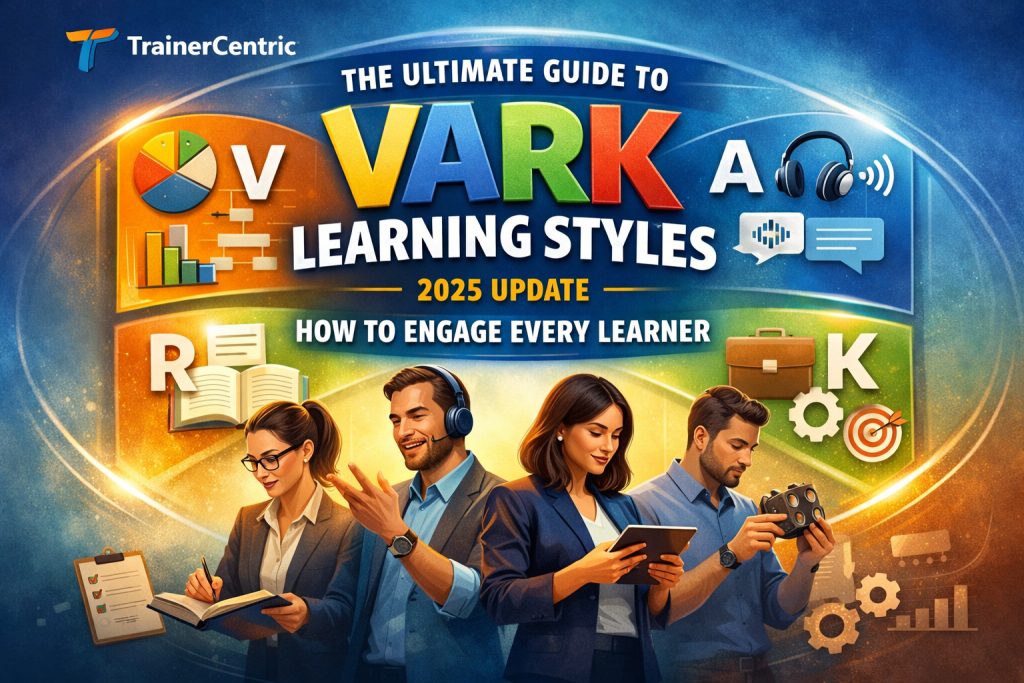
VARK stands for:
- V – Visual
- A – Aural (Auditory)
- R – Read/Write
- K – Kinesthetic
The model was developed in 1987 by Neil Fleming, a New Zealand educator who observed that learners process information differently depending on how it is presented.
To help individuals identify their preferences, Fleming created the VARK questionnaire, a short learning styles inventory that analyzes how people respond to different learning situations. The result is a VARK profile, which shows whether a learner prefers:
- One dominant modality
- Multiple modalities (multimodal learning)
- Or a balanced mix of all four
Importantly, the Fleming VARK framework does not claim that learners can only learn in one way. Instead, it highlights preferences, which trainers can use to design more engaging and inclusive learning experiences. For corporate trainers and instructional designers, the model offers a simple but powerful lens for improving training effectiveness.
The Four VARK Learning Styles Modalities
The core of the VARK learning styles framework lies in the four modalities.
Understanding each modality helps trainers answer three important questions:
- What does this learning preference look like?
- How can I recognize it in my learners?
- What training strategies work best?
Let’s break them down.
Visual (V) Learners
A common misconception is that visual learners simply like pictures. In reality, visual learners prefer information organized in patterns, relationships, and symbolic formats. They process ideas best when they can see how concepts connect.
Examples include:
- Charts
- Graphs
- Flow diagrams
- Concept maps
- Timelines
- Infographics
For visual learners, structure matters more than decoration.
How to Spot Visual Learners
In training sessions, visual learners often:
- Ask for diagrams instead of explanations
- Draw mind maps or sketches while taking notes
- Prefer slides with diagrams rather than dense text
- Quickly understand process flows and frameworks
You may hear them say things like:
- “Can you show that visually?”
- “Is there a chart or framework for this?”
Training Strategies for Visual Learners
If your audience includes visual learners, consider:
- Using process diagrams instead of bullet-heavy slides
- Creating mind maps to explain concepts
- Using flowcharts to show workflows
- Designing infographics for complex ideas
- Visualizing frameworks with models and matrices
Pro Tip for Trainers:
Replace text-heavy slides with concept diagrams. One well-designed visual can communicate more than ten bullet points.
Aural / Auditory (A) Learners
Auditory learners absorb information best through listening and speaking.
They learn effectively when information is discussed, explained verbally, or debated.
For them, learning happens through:
- Conversations
- Lectures
- Podcasts
- Storytelling
- Group discussions
Auditory learners often remember how something was explained, not just what was written.
How to Spot Auditory Learners
In training programs, auditory learners tend to:
- Ask many verbal questions
- Participate actively in discussions
- Prefer explaining ideas out loud
- Recall information from conversations or stories
You might hear them say:
- “Can you explain that again?”
- “Let’s talk through this.”
Training Strategies for Auditory Learners
To support auditory learners in corporate training:
- Facilitate group discussions
- Incorporate storytelling and case narratives
- Use podcasts or recorded lessons
- Encourage peer teaching
- Include Q&A segments
Powerful training tactic:
End each module with a 5-minute discussion prompt. Auditory learners consolidate knowledge through conversation.
Read/Write (R) Learners
Read/write learners prefer information presented as text. They process ideas through:
- Reading
- Writing
- Note-taking
- Lists
- Definitions
- Written explanations
These learners are often comfortable with manuals, articles, documentation, and research papers.
For them, learning becomes clearer when ideas are translated into words.
How to Spot Read/Write Learners
In training environments, read/write learners often:
- Take detailed notes
- Ask for written instructions
- Prefer documentation over slides
- Request handouts or reading materials
You may hear them say:
- “Is there a guide for this?”
- “Can I get the steps in writing?”
Training Strategies for Read/Write Learners
To support read/write learners:
- Provide training manuals
- Share step-by-step guides
- Offer reading lists or articles
- Include written exercises
- Encourage reflection journals
Simple improvement for trainers: Always provide a downloadable reference guide after training sessions. Many learners revisit written materials later to reinforce learning.
Kinesthetic (K) Learners
Kinesthetic learners learn through doing, experiencing, and practicing.
They prefer hands-on activities that simulate real-world situations.
For them, learning is most effective when it involves:
- Practice
- Experimentation
- Movement
- Real-life application
Kinesthetic learning is particularly powerful in corporate training environments, where learners need to apply skills on the job.
How to Spot Kinesthetic Learners
Kinesthetic learners often:
- Get restless during long lectures
- Ask for examples from real work scenarios
- Prefer activities over explanations
- Learn quickly once they practice the skill
They might say:
- “Can we try this?”
- “Let me see how it works.”
Training Strategies for Kinesthetic Learners
To support kinesthetic learners:
- Run simulations
- Use role-playing exercises
- Incorporate hands-on workshops
- Design scenario-based training
- Use case studies from real workplaces
Corporate training insight: Kinesthetic learners often thrive during experiential learning activities, such as simulations or role-play exercises.
The Multimodal Learner (The Secret Sauce)
Here’s something many trainers don’t realize:
Most people are not purely visual, auditory, read/write, or kinesthetic.
They are multimodal learners.
Multimodal learners prefer multiple learning modes, depending on the situation.
The VARK questionnaire identifies two types of multimodal learners:
Type One Multimodal Learners
These learners can switch between modalities easily.
They might read instructions first, watch a demonstration, and then practice.
They don’t strongly prefer one method over another.
Type Two Multimodal Learners
These learners prefer multiple inputs simultaneously.
For example:
- Reading instructions
- Watching a demonstration
- Practicing the task
All three together reinforce understanding.
Why Multimodal Learning Matters in Corporate Training
In the workplace:
- Teams have diverse learning preferences
- Knowledge must be applied quickly
- Training must be efficient and memorable
The most effective training sessions combine all four VARK modalities.
A great training design might include:
- A diagram explaining a concept (Visual)
- A story explaining its importance (Auditory)
- A reference guide (Read/Write)
- A practice activity (Kinesthetic)
This approach ensures that every learner connects with the material in some way.
VARK Learning Styles vs. Other Learning Styles Models
The VARK model is not the only learning framework available.
Two other popular models include:
VARK Learning Styles vs Kolb Learning Styles
Kolb’s model focuses on how people learn through experience, using four stages:
- Concrete Experience
- Reflective Observation
- Abstract Conceptualization
- Active Experimentation
While Kolb focuses on the learning cycle, VARK focuses on information intake preferences.
In practice, many trainers use both.
VARK Learning styles vs Honey & Mumford
Honey & Mumford identify four learner types:
- Activists
- Reflectors
- Theorists
- Pragmatists
This model focuses on behavioral learning approaches, while VARK focuses on sensory input preferences.
Why VARK is Popular in Corporate Training
The Fleming VARK model is widely used in corporate learning because it is:
- Simple
- Easy to explain
- Immediately actionable
Trainers can quickly adjust learning activities to address multiple modalities.
Common Myths and Criticisms of VARK Learning Styles
The concept of learning styles has sparked debate among researchers. Addressing these criticisms openly builds trust and credibility.
Myth 1: People Can Only Learn One Way
This is the most common misconception. The VARK model does not claim learners can only learn through one modality.
Instead, it highlights preferences, not limitations. People can learn through any method—but they may engage faster when information matches their preferred modality.
Myth 2: Learning Styles Guarantee Better Learning
Research suggests that simply matching teaching styles to learning styles does not automatically improve outcomes. However, varied instruction does improve engagement and comprehension.
A widely cited review from Psychological Science in the Public Interest found limited evidence for strict learning-style matching but emphasized the value of diverse instructional methods.
Myth 3: VARK is Only for Schools
Many assume learning styles only apply in K-12 education. In reality, the model is widely used in:
- Corporate training
- Medical education
- Higher education
- Professional development programs
The workplace is actually an ideal environment for multimodal learning design.
How to Use the VARK Questionnaire in Corporate Training
The VARK questionnaire for employees can be a powerful tool for improving training design.
It helps trainers understand how their audience prefers to learn.
Benefits of Using a Learning Styles Inventory
When organizations assess learning preferences, they often see:
- Higher training engagement
- Better knowledge retention
- Improved communication
- More inclusive learning environments
Practical Ways to Use the VARK Questionnaire
Corporate trainers can integrate the assessment into:
1. Employee Onboarding
New hires complete the VARK questionnaire to understand how they learn best.
2. Leadership Development Programs
Leaders learn how their team members absorb information.
3. Team-Building Workshops
Teams explore their learning differences and communication styles.
4. Instructional Design Planning
Training teams use results to design multimodal learning experiences.
Practical Implementation Example
A strong corporate training session might include:
- Visual: Process diagrams
- Auditory: Facilitated discussion
- Read/Write: Participant workbook
- Kinesthetic: Scenario-based activity
This design ensures maximum engagement across learning preferences.
Conclusion
Great trainers don’t just deliver information. They design learning experiences.
The VARK learning styles model provides a practical framework for understanding how people prefer to learn. By incorporating visual, auditory, read/write, and kinesthetic elements, trainers can create sessions that resonate with every learner in the room.
Remember:
The goal isn’t to teach one style. The goal is to design learning experiences that include them all.
When trainers combine modalities, they unlock the real power of learning—engagement, understanding, and application.
And that’s what great training is all about.
![The Power of Storytelling in Corporate Training: Igniting Success and Inspiring Growth [2023]](https://trainercentric.com/wp-content/uploads/2023/06/storytelling-1024x576.jpg)