You’ve just finished a two-day workshop on communication skills. You delivered great content, the slides were polished, and the coffee breaks were a hit. Yet, a week later, you wonder: How much of that information actually stuck?
We have all been there. As trainers and L&D professionals, we know that telling people how to do something is vastly different from them actually learning how to do it. Real learning doesn’t happen when information is passively received; it happens when experience is actively transformed.
This is where the Kolb Reflective Cycle comes into play. Developed by educational theorist David A. Kolb, this model provides a simple yet profound framework for understanding how adults learn from experience.
In this guide, we’ll break down the kolb reflective cycle in simple terms, walk through each stage with practical examples, and show you exactly how to use it to design training that actually changes behavior.
What is the Kolb Reflective Cycle?
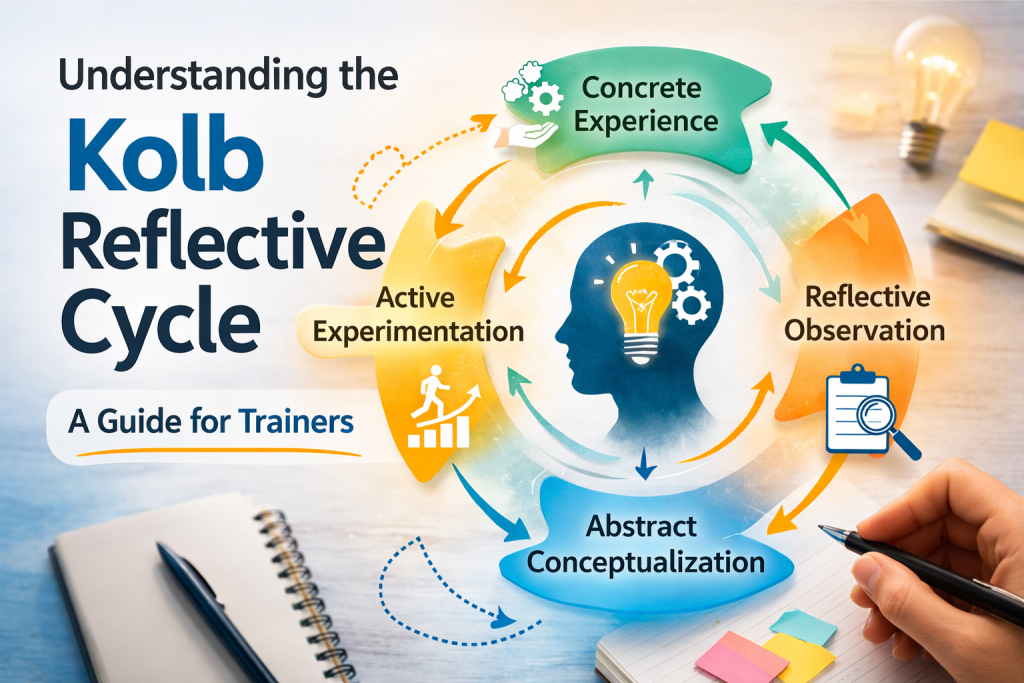
At its core, the Kolb Reflective Cycle is a four-stage process that describes how learning happens. Kolb argued that we learn best not by just reading a book or listening to a lecture, but by going through a continuous loop of experience, reflection, thinking, and action.
It is often referred to as the kolb reflective cycle because of its emphasis on reflection as a critical component of growth. However, it’s important to note that this isn’t just about “looking back.” It’s a holistic framework that combines experience, perception, cognition, and behavior.
This model is the cornerstone of experiential learning theory, which essentially states that “learning is the process whereby knowledge is created through the transformation of experience.” For trainers, this is a game-changer. It means our job isn’t just to transmit information, but to facilitate a cycle that turns doing into knowing.
Who Developed the Kolb Learning Cycle?
The Kolb learning cycle was created by David A. Kolb, an American educational theorist, who published his groundbreaking model in 1984 in his book, Experiential Learning: Experience as the Source of Learning and Development.
Kolb was heavily influenced by the giants of 20th-century learning theory, including John Dewey, who championed “learning by doing,” and Jean Piaget, who focused on how intelligence is shaped by experience. Kolb synthesized their work to create a practical model that remains a cornerstone of adult education today. He believed that effective learners need four different kinds of abilities—which brings us to the four stages of his cycle.
The 4 Stages of the Kolb Reflective Cycle
The beauty of the Kolb model is its simplicity. It is often visualized as a circle or a spiral, suggesting that learning is a continuous process. You can jump in at any stage, but for maximum learning, you ideally progress through all four.
Here are the four stages, broken down simply.
Concrete Experience
This is the “doing” phase. It’s the hands-on part of the learning process.
- Simple Explanation: You have an experience. You do something or something happens to you. This is the raw data of learning.
- Real-World Example: Imagine you are learning to use a new piece of project management software. You open the program and try to create a new project board, but you accidentally delete a task list.
- Training Example: In a sales training workshop, you pair up participants for a role-play exercise where one person has to sell a pen to the other. The act of doing the role-play is the Concrete Experience.
Reflective Observation
This is the “watching” or “reviewing” phase. Before jumping to conclusions, you take a step back to consider what just happened.
- Simple Explanation: You think about the experience from multiple perspectives. What worked? What didn’t? What did you notice?
- Real-World Example: After messing up the task list in the software, you stop and think, “Okay, I clicked on the ‘Board Settings’ and then hit ‘Delete.’ Maybe those two things are connected. I wonder if I missed a confirmation pop-up.”
- Training Example: After the sales role-play, the facilitator asks the participants to discuss their feelings. The “seller” might reflect, “I felt awkward when I started pushing the features too hard.” The “buyer” might add, “I felt pressured when they stood too close.” This observation of the event is critical.
Abstract Conceptualization
This is the “thinking” phase. You take your observations and form a theory or a conclusion. You learn from the experience by making sense of it.
- Simple Explanation: You draw conclusions and form a new idea or modify an existing one based on your reflection.
- Real-World Example: You conclude, “Right, I need to be more careful in the settings menu. Next time, I should watch the tutorial video before I start clicking around in a live project.”
- Training Example: The sales group discusses their observations and comes up with a principle: “We realized that asking open-ended questions to understand the ‘buyer’s’ needs first, rather than listing features, makes the conversation feel more natural and less pushy.” They have just conceptualized a new sales principle.
Active Experimentation
This is the “planning” or “trying out” phase. You take your new idea and test it in the real world to see if it works, which leads to a new concrete experience, and the cycle begins again.
- Simple Explanation: You apply what you have learned to a new situation. You test your hypothesis.
- Real-World Example: You start a new project in the software, but this time, you watch the tutorial first and proceed with caution around the settings, applying your new theory.
- Training Example: The facilitator gives the group a new, more complex sales scenario to role-play. This time, the “seller” consciously tries to ask open-ended questions to see if the new principle holds up in a different context.
Examples of the Kolb Reflective Cycle
To really understand how to apply this, let’s look at some concrete examples of kolb learning cycle in different professional settings.
Example 1: Leadership Development (Giving Feedback)
- Concrete Experience: A new manager gives their first piece of critical feedback to a direct report. The direct report becomes visibly defensive and shuts down.
- Reflective Observation: The manager thinks back on the conversation. “I noticed they crossed their arms as soon as I started talking. My voice felt tense. The feedback was accurate, but the delivery failed.”
- Abstract Conceptualization: The manager realizes that feedback should be specific and behavioral, not personal. They form a new idea: “Next time, I should use the SBI model (Situation, Behavior, Impact) to depersonalize the feedback.”
- Active Experimentation: In their next one-on-one, the manager uses the SBI framework and observes that the employee is much more receptive and engaged in problem-solving.
Example 2: Technical Skills Training (Coding Workshop)
- Concrete Experience: In a coding bootcamp, students are given a broken piece of code and asked to fix it (debugging).
- Reflective Observation: They look at the error messages and discuss with a peer where the code went wrong. “The loop stopped too early because we used the wrong variable.”
- Abstract Conceptualization: The student understands the logic behind loop termination conditions. They form a mental rule: “Always double-check the iterator in a ‘for’ loop.”
- Active Experimentation: The student writes a new, original piece of code that requires a loop, consciously applying the correct logic from the start.
How Trainers Can Use the Kolb Reflective Cycle
So, how do we move from knowing the model to embedding it in our work? Here is how to use the kolb cycle in the classroom or training room to create sticky learning experiences.
- Design for the Whole Cycle: Don’t just focus on the “Active Experimentation” (the activity). Deliberately build in time for the other three stages.
- Create the “Concrete Experience”: Start with a problem, a simulation, a case study, or a role-play. Let them grapple with the task before you give them the theory. This creates a “need to know.”
- Facilitate “Reflective Observation“: Don’t just move on after an activity. Use structured reflection techniques:
- Paired discussions: “Tell your partner one thing that surprised you.”
- Journaling: Give them 3 minutes to write down what they observed.
- Guided questions: “What was the most challenging moment in that exercise?”
- Guide “Abstract Conceptualization”: This is where you, the trainer, provide the bridge. After they’ve reflected, you can introduce the model, the theory, or the “best practice.” Instead of saying “Here’s how it’s done,” you can say, “Based on your experience, how does this principle connect?”
- Enable “Active Experimentation”: Give them a safe space to try again. This could be a follow-up case study, a personal action plan, or a commitment to try the new skill back at their desks next week.
Applying Kolbs theory in workplace training is powerful because it mirrors how we actually solve problems on the job—through trial, error, reflection, and adjustment.
Kolb Reflective Cycle vs Honey and Mumford Learning Cycle
If you’ve been in L&D for a while, you’ve likely also come across the work of Peter Honey and Alan Mumford. While based on Kolb’s work, their model is slightly different.
- Kolb’s Model is a learning cycle. It’s about the process of learning. You move through stages.
- Honey and Mumford’s Model is about learning styles. They identified four styles that correspond loosely to Kolb’s stages: Activists (Concrete Experience), Reflectors (Reflective Observation), Theorists (Abstract Conceptualization), and Pragmatists (Active Experimentation).
While Kolb focuses on the complete loop, Honey and Mumford focus on the individual’s preference for a particular stage. As a trainer, using both can be helpful: you can use Honey and Mumford to help learners understand their preferences, but you should always design your programs using Kolb’s cycle to ensure you are challenging learners to develop all four capabilities.
Criticism of Kolb’s Learning Cycle
No model is perfect, and it’s important to understand the criticism of kolb learning cycle to use it effectively.
- Oversimplification: Critics argue that the model is too neat. Real-life learning is often messy, non-linear, and emotional. We don’t always reflect logically before trying something new.
- Cultural Assumptions: The model is very individualistic and reflective, which aligns with Western educational values. In cultures that prioritize collective learning or rote memorization, the emphasis on personal reflection might not be the primary path to learning.
- The “Learning Style” Myth: Kolb’s work has sometimes been misused to label people as having a single “learning style” (e.g., “I’m an ‘Activist,’ so I don’t need to read the manual.”). Kolb himself argued that effective learners are those who can move fluidly through all stages, not just stick to their preferred one.
- Lack of Focus on Social Context: The model focuses heavily on the individual’s internal process and doesn’t always account for how social interaction and the learning environment shape the experience.
Why Kolb Reflective Cycle Still Matters Today
Despite its criticisms, the kolb reflective model remains a bedrock of modern Instructional Designing. Why?
Because in a world of information overload, experience is our filter. We are moving away from “sheep-dip” training (where everyone gets the same content at the same time) towards more agile, personalized, and on-the-job learning.
Kolb’s model validates what great trainers have always known: people need to do, to mess up, to think, and to try again. It provides a simple, memorable framework to ensure our training programs are not just events, but catalysts for continuous growth. It’s why we use simulations, why we facilitate after-action reviews, and why we encourage action learning sets.
Whether you are in corporate training, coaching, or classroom education, the cycle provides a timeless reminder that experience alone isn’t the best teacher—reflection on experience is.
Conclusion
The Kolb reflective cycle is more than just an academic theory; it is a practical toolkit for anyone dedicated to helping others grow. By understanding the four stages—Concrete Experience, Reflective Observation, Abstract Conceptualization, and Active Experimentation—you can transform your training from a passive information dump into a dynamic learning journey.
Next time you design a workshop, don’t just ask “What will I tell them?” Instead, ask “What will they do, how will they reflect on it, what will they conclude, and how can they practice it again?”
Embrace the cycle, and watch your learners truly come alive.
![The Power of Storytelling in Corporate Training: Igniting Success and Inspiring Growth [2023]](https://trainercentric.com/wp-content/uploads/2023/06/storytelling-1024x576.jpg)