
You assign a project. Clear instructions. A deadline. Even a rubric.
Three days later, a learner raises their hand and asks, “What are we supposed to do?”
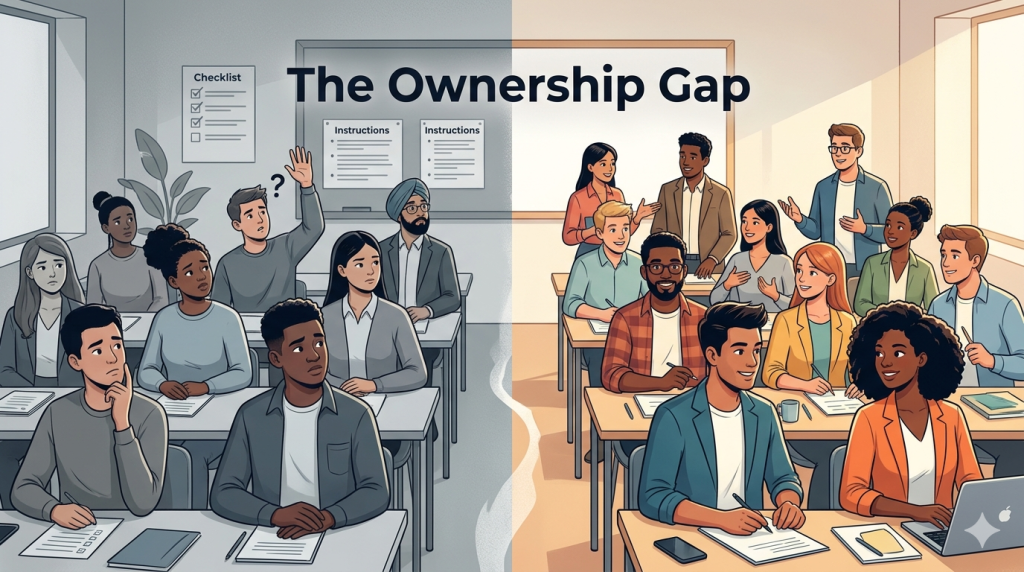
If that moment feels painfully familiar, you’ve encountered what we call the Ownership Gap—the disconnect between what learners are expected to do and what they actually take responsibility for. At its core, the Ownership Gap is the space between assigned responsibility and assumed responsibility.
And the consequences are real.
For educators and trainers, it leads to burnout, constant chasing, and frustration. For learners, it results in surface-level understanding, poor retention, and disengagement. In fact, much of the lack of student accountability in the classroom stems not from laziness, but from systems that unintentionally encourage passivity.
Many try to solve this with rewards or punishments. More grades. More reminders. More pressure. But those approaches rarely work long term.
In this article, you’ll discover:
- What the Ownership Gap really looks like in practice
- The five root causes behind the lack of student accountability in the classroom
- Seven proven, actionable strategies to build real ownership
- A practical example you can adapt immediately
Let’s start by understanding the gap itself.
What Is the Ownership Gap?
The Ownership Gap is the difference between learners doing what they’re told and learners taking initiative for their own progress.
In classrooms, it shows up like this:
- Students wait for step-by-step instructions
- Assignments are completed at the last minute
- Questions focus on “What do I do?” instead of “How can I improve?”
In corporate training, it looks like:
- Employees attend sessions but don’t apply learning
- Learners depend entirely on facilitators for direction
- Follow-through disappears once training ends
This is not just disengagement—it’s a systemic lack of student accountability in the classroom and beyond.
Compliance vs Ownership
Understanding this distinction is critical:
| Mode | Mindset | Behavior | Question | Motivation |
| Compliance | Doing the minimum required | Following instructions without thinking | “What am I supposed to do?” | Fear, grades, rewards |
| Ownership | Driving progress independently | Asking better questions | “What needs to be done?” | Taking responsibility for outcomes |
Ownership fuels student agency, self-regulation, and long-term growth. Compliance, on the other hand, creates dependency.
Interestingly, research and field observations suggest that experienced educators can identify lack of student accountability in the classroom up to five times faster than novice teachers. Why? Because they recognize subtle signs—hesitation, deflection, and over-reliance on instructions.
The gap isn’t about intelligence. It’s about habits.
And habits are shaped by systems.
5 Root Causes of the Accountability Crisis
To fix the Ownership Gap, we must first understand why it exists. The lack of student accountability in the classroom is rarely about attitude—it’s about design.
1. The Culture of Learned Helplessness
Over time, learners internalize a simple belief: “Someone else will tell me what to do.”
This is learned helplessness.
It develops when:
- Instructions are always provided
- Mistakes are quickly corrected by the teacher
- Independence is never required
As a result, learners stop initiating action. They wait.
This directly contributes to the lack of student accountability in the classroom, as students begin to equate learning with being guided, not thinking.
2. Over-Scaffolding and Helicopter Teaching
Support is essential—but too much support removes the need for effort.
Helicopter teaching happens when educators:
- Break tasks into overly detailed steps
- Provide answers before struggle occurs
- Intervene too quickly
While well-intentioned, this reduces student ownership of learning.
Without productive struggle, learners don’t build self-regulation or problem-solving skills. They become dependent on external guidance.
3. Extrinsic Reward Addiction
Grades. Badges. Praise.
These tools can motivate—but overuse creates dependency.
When learners rely on external rewards:
- They focus on outcomes, not learning
- They avoid risk
- They disengage when rewards disappear
This explains why students lack motivation even in interesting subjects.
Without intrinsic motivation, accountability collapses.
4. Vague Expectations Without Shared Ownership
“Do your best.”
“Complete the assignment.”
These aren’t clear expectations—they’re assumptions.
When success criteria are unclear:
- Learners guess what matters
- Effort becomes inconsistent
- Accountability becomes subjective
Without co-creation, learners don’t feel responsible for the outcome.
This ambiguity fuels the lack of student accountability in the classroom.
5. No Consequences for Avoidance
If nothing happens when learners avoid responsibility, avoidance becomes the default.
This doesn’t mean punishment. It means natural consequences.
For example:
- Missing deadlines with no impact
- Poor effort still receiving passing grades
- No requirement to revise or improve
When passivity has no cost, passivity wins.
The High Cost of Low Accountability
The lack of student accountability in the classroom affects more than just performance—it reshapes the entire learning ecosystem.
For Learners
- Shallow understanding
- Poor retention
- Limited transfer of knowledge
Without ownership, learning stays surface-level. There is no metacognition—no reflection on thinking.
For Educators and Trainers
- Constant chasing and reminders
- Emotional exhaustion
- Growing frustration
This creates a blame culture in education, where teachers feel responsible for outcomes learners aren’t owning.
For Organizations
- Skill gaps persist
- Training ROI declines
- Employees fail to apply learning
In corporate environments, this translates to wasted investment and stalled growth.
7 Proven Strategies to Close the Ownership Gap
Closing the Ownership Gap requires intentional design. Here are seven practical strategies to address the lack of student accountability in the classroom and beyond.
1. Replace Compliance with Co-Creation
Instead of dictating everything, involve learners in defining success.
How to apply:
- Ask: “What does a great project look like?”
- Co-create rubrics together
- Let learners define quality indicators
Example:
A teacher invites students to design the rubric for a presentation. Students identify clarity, creativity, and evidence as key criteria.
This builds student ownership of learning immediately.
2. Teach Metacognition Explicitly
Learners don’t naturally reflect—they need to be taught.
Use reflection routines:
- What did I do well?
- What challenged me?
- What will I do differently next time?
Example:
At the end of each session, learners write a 2-minute reflection.
This builds self-regulation and awareness—key drivers of accountability.
3. Use Accountability Partners, Not Just Teachers
Accountability doesn’t have to come from authority.
How to apply:
- Pair learners for weekly check-ins
- Use peer feedback sessions
- Create small accountability groups
Example:
In a training program, participants share weekly progress with a partner.
This shifts responsibility from teacher to peer network.
4. Shift from Grading to Feedback Loops
Grades end learning. Feedback extends it.
How to apply:
- Provide feedback before grading
- Allow revisions
- Focus on improvement, not judgment
Example:
Students submit a draft, receive feedback, and improve before final submission.
This encourages effort and ownership.
5. Design Generative, Not Reproductive, Tasks
Reproductive tasks = repeat what was taught
Generative tasks = create something new
Examples:
- Instead of summarizing, design a solution
- Instead of answering, build a model
Generative tasks require thinking, which drives accountability.
6. Implement Choice Boards and Voice
Give learners control.
How to apply:
- Offer 3–4 ways to complete a task
- Let learners choose format or topic
- Use choice boards
Example:
Students can present learning via:
- A video
- A report
- A live presentation
Choice increases intrinsic motivation and reduces the lack of student accountability in the classroom.
7. Let Safe Failure Happen
Failure is feedback.
How to apply:
- Use low-stakes assignments
- Allow missed deadlines to have small consequences
- Encourage retries
Example:
A student misses a checkpoint and must present incomplete work.
This builds resilience and responsibility.
Real-World Example: Closing the Gap
A middle school teacher noticed a severe lack of student accountability in the classroom. Students constantly asked for instructions and avoided independent work.
Instead of adding more structure, she removed some.
She introduced:
- Co-created rubrics
- Weekly reflection routines
- Peer accountability groups
- Choice-based assignments
At first, students resisted.
However, within six weeks:
- Questions shifted from “What do I do?” to “Is this a strong approach?”
- Assignment completion improved
- Engagement increased significantly
Most importantly, learned helplessness dropped by nearly 60% (based on observed behaviors like reduced dependency and increased initiative).
The shift wasn’t dramatic—it was deliberate.
Conclusion
The Ownership Gap is not a learner problem—it’s a design problem. The persistent lack of student accountability in the classroom is often the result of systems that prioritize control over autonomy, answers over thinking, and compliance over ownership. The good news, however, is that ownership can be taught. By shifting from instruction to co-creation, building metacognition, and designing for choice and accountability, you don’t just improve outcomes—you fundamentally transform how learners see themselves. They move from being passive recipients of information to active drivers of their own growth. Start small. Begin with just one of the seven strategies this week. Because when learners take ownership, everything changes.
![The Power of Storytelling in Corporate Training: Igniting Success and Inspiring Growth [2023]](https://trainercentric.com/wp-content/uploads/2023/06/storytelling-1024x576.jpg)