Corporate training is at a crossroads. For years, organizations have invested heavily in learning programs—yet struggled to translate those efforts into measurable performance outcomes. Completion rates look good. Feedback scores are positive. But behavior change? Business impact? Still inconsistent.
This is exactly why the deep learning framework in corporate training is gaining momentum in 2026. It shifts the focus from delivering content to driving capability, from knowledge transfer to behavior transformation, and from training events to learning ecosystems.
If you’re an L&D leader, HR professional, or corporate trainer, this guide will help you understand, implement, and scale a deep learning framework effectively.
What is a Deep Learning Framework in Corporate Training?
A deep learning framework in corporate training is a structured approach to designing learning experiences that ensure:
- Long-term retention
- Real-world application
- Continuous reinforcement
- Measurable performance improvement
Unlike traditional models that prioritize information delivery, this framework emphasizes learning depth—where employees not only understand concepts but can apply them confidently in their roles.
Why Organizations Are Shifting to Deep Learning Frameworks
The limitations of traditional training are becoming impossible to ignore:
- Learners forget most content within days
- Training rarely translates into workplace behavior
- ROI remains difficult to measure
- Engagement drops after sessions
This has led to a fundamental shift toward experience-driven learning. Organizations adopting a deep learning framework in corporate training are seeing:
- 2–3x higher knowledge retention
- Faster skill application
- Improved employee engagement
- Stronger alignment with business KPIs
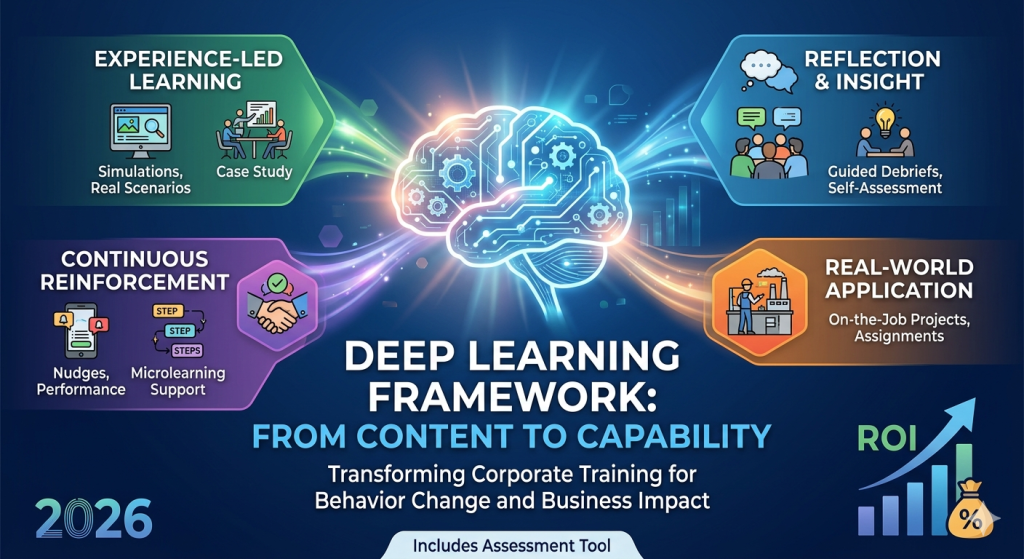
The 4 Core Pillars of a Deep Learning Framework
1. Experience-Led Learning
Start with real-world problems, not theory.
Instead of teaching concepts first, immerse learners in:
- Simulations
- Case studies
- Scenario-based challenges
This builds relevance and activates prior knowledge.
2. Reflection and Insight
Learning doesn’t happen during activity—it happens during reflection.
Build structured reflection into your programs through:
- Guided debriefs
- Peer discussions
- Self-assessment prompts
This is a critical component of any deep learning framework instructional design.
3. Real-World Application
Without application, learning fades quickly.
Embed:
- On-the-job assignments
- Action learning projects
- Real business challenges
This ensures that the deep learning framework in corporate training directly impacts performance.
4. Continuous Reinforcement
One-time training is outdated.
Sustainable learning requires:
- Microlearning nudges
- Coaching touchpoints
- Performance support tools
- Follow-up interventions
Reinforcement transforms learning into habit.
How to Implement Deep Learning in Training Programs (5-Step Model)
If you’re wondering how to implement deep learning in training programs, here’s a practical roadmap:
Step 1: Define Behavioral Outcomes
Start with clarity:
- What should employees do differently?
Avoid vague goals like “improve communication.” Instead:
- “Deliver structured feedback using XYZ model”
Step 2: Design Real-World Scenarios
Build learning around actual workplace challenges.
Example:
- Handling difficult client conversations
- Managing team conflict
- Leading high-stakes meetings
Step 3: Shift to Active Learning
Replace passive formats with:
- Role plays
- Group problem-solving
- Simulations
Step 4: Integrate Reflection Loops
After every activity:
- What worked?
- What didn’t?
- What will you do differently?
Step 5: Build Reinforcement Systems
Create a 30-60-90 day plan:
- Nudges
- Coaching
- Peer accountability
This step is where most programs fail—and where the deep learning framework in corporate training truly differentiates itself.
Deep Learning Framework ROI for HR
One of the biggest advantages of this approach is measurable impact.
Key ROI Metrics:
- Performance improvement
- Reduced error rates
- Faster onboarding
- Increased productivity
- Higher employee retention
A strong deep learning framework ROI for HR connects learning outcomes directly to business metrics.
For example:
- A sales training program using deep learning principles may increase conversion rates by 20%
- Leadership training may reduce team attrition
Case Study: Deep Learning Framework Reduced Training Decay by 40%
Let’s look at a real-world deep learning framework case study corporate example:
The Challenge:
A global organization noticed that employees forgot most of their training within weeks.
The Solution:
They redesigned their program using a deep learning framework in corporate training:
- Introduced scenario-based learning
- Added reflection sessions
- Implemented 60-day reinforcement
The Result:
- 40% reduction in knowledge decay
- 30% improvement in on-the-job application
- Higher engagement scores
This demonstrates how structured learning design can drive tangible outcomes.
Deep Learning Framework Instructional Design Principles
To build effective programs, your deep learning framework instructional design should include:
- Learner-centric design
- Contextual relevance
- Iterative learning cycles
- Feedback mechanisms
- Real-time application
Instructional designers must move from “content creators” to experience architects.
Deep Learning Framework vs Microlearning: Which Wins?
This is a common question.
Microlearning:
- Short, focused content
- Great for reinforcement
Deep Learning Framework:
- Holistic learning journey
- Focuses on behavior change
The truth? It’s not either/or.
Microlearning works best within a deep learning framework in corporate training as a reinforcement tool.
Deep Learning Framework Vendor Comparison
As adoption grows, many organizations are exploring tools and partners.
When evaluating a deep learning framework vendor comparison, consider:
- Customization capabilities
- Integration with LMS/LXP
- Analytics and reporting
- Reinforcement features
- Scalability
Avoid platforms that only deliver content without enabling behavior change.
Deep Learning Framework Consulting for HR
For organizations looking to accelerate transformation, deep learning framework consulting for HR can help:
- Audit current training programs
- Redesign learning journeys
- Train internal L&D teams
- Implement measurement frameworks
Consulting ensures faster and more effective implementation.
Deep Learning Framework Platform Pricing
Pricing varies depending on:
- Platform features
- Number of users
- Customization level
- Support and consulting
When evaluating deep learning framework platform pricing, focus on value over cost.
Ask:
- Does this platform improve performance?
- Can it demonstrate ROI?
The Future of Corporate Training
The future belongs to organizations that can learn faster and apply better.
The deep learning framework in corporate training is not just a methodology—it’s a strategic advantage.
It enables:
- Continuous capability building
- Agile workforce development
- Measurable business impact
Final Thoughts
If your training programs are not driving behavior change, it’s time to rethink your approach.
The deep learning framework in corporate training provides a proven path to:
- Deeper engagement
- Stronger retention
- Real-world application
- Tangible ROI
Start small. Audit your current programs. Redesign one learning journey.
Because in today’s workplace, learning that doesn’t translate into action is no longer enough.
![The Power of Storytelling in Corporate Training: Igniting Success and Inspiring Growth [2023]](https://trainercentric.com/wp-content/uploads/2023/06/storytelling-1024x576.jpg)