Most corporate training fails—not because the content is bad, but because the approach is wrong.
Organizations often default to a one-size-fits-all model where learning is assigned, scheduled, and enforced. That’s push based learning. On the other hand, modern workplaces are increasingly embracing pull learning strategies, where employees seek out knowledge when they need it.
Here’s the truth: neither model works in isolation.
The most effective L&D leaders understand that the real power lies in blending push and pull learning—aligning structure with autonomy to create a system that drives both compliance and curiosity.
What You’ll Learn:
- The difference between push vs pull learning
- When to use each approach in corporate training
- Why push learning doesn’t work alone anymore
- The benefits of pull learning for engagement and retention
- A practical framework for blending push and pull learning
- Actionable steps to implement self directed learning corporate training
What is Push Learning in Corporate Training?
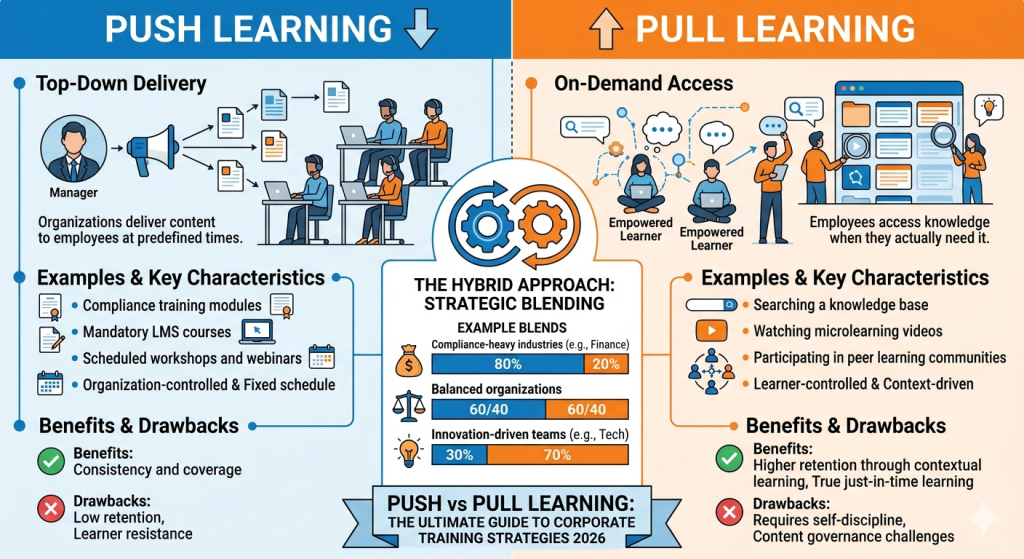
Push learning is a top-down training approach where content is delivered to employees at predefined times, regardless of immediate need.
Common Examples:
- Compliance training modules
- Mandatory LMS courses
- Scheduled workshops and webinars
- Annual certification programs
Key Characteristics:
- Organization-controlled
- Fixed schedule
- Standardized content
- Limited learner autonomy
Push learning ensures consistency and coverage. It’s designed to guarantee that everyone receives the same information.
Best Use Cases:
- Regulatory compliance
- Onboarding programs (Internal Link Placeholder: Corporate Onboarding Best Practices)
- Safety training
- Company-wide policy updates
Pro Tip: Use push learning when the cost of not knowing something is high—like compliance or safety.
What is Pull Learning in Corporate Training?
Pull learning flips the model. Instead of pushing content, organizations create systems where employees can access knowledge on-demand, when they actually need it.
Common Examples:
- Searching a knowledge base for answers
- Watching microlearning videos before a task (Internal Link Placeholder: Microlearning in Corporate Training)
- Participating in peer learning communities
- Accessing curated content libraries
Key Characteristics:
- Learner-controlled
- On-demand access
- Context-driven learning
- Personalized pathways
This approach aligns closely with self directed learning corporate training, where employees take ownership of their development.
Best Use Cases:
- Problem-solving in real time
- Leadership development
- Technical skill building
- Continuous professional development
Pro Tip: Pull learning works best when learning is tied to immediate application.
Push vs Pull Learning: Key Differences (Comparison Table)
| Factor | Push Learning | Pull Learning |
| Control | Organization-driven | Learner-driven |
| Timing | Scheduled | On-demand |
| Engagement Type | Passive consumption | Active discovery |
| Learner Role | Recipient | Seeker |
| Motivation | Extrinsic (mandatory) | Intrinsic (need-based) |
| Best For | Compliance, onboarding | Skill-building, problem-solving |
| Tools/Platforms | LMS, webinars, classroom training | LXP, knowledge bases, search tools |
Why Push Learning Alone Fails in Modern Workplaces
According to ATD’s research on learning transfer, learners retain only 10-20% of push-style training without reinforcement. Relying solely on push based learning is one of the biggest reasons corporate training programs underperform.
Here’s why:
- Low Retention
Employees forget most training quickly without application - Learner Resistance
Mandatory training feels like a checkbox exercise - One-Size-Fits-None
Ignores individual needs and roles - No Contextual Application
Learning without relevance doesn’t stick - Violates Adult Learning Principles
Adults need autonomy and relevance
The Hybrid Approach: How to Blend Push and Pull Learning
The real question isn’t push vs pull learning—it’s how to combine them effectively.
The Ideal Blend
- 80/20 → Compliance-heavy industries
- 60/40 → Balanced organizations
- 30/70 → Innovation-driven teams
Real-World Scenarios:
1. Compliance Training (80% Push, 20% Pull)
- Push: Certification modules
- Pull: Quick-reference guides
2. Leadership Development (40% Push, 60% Pull)
- Push: Structured programs
- Pull: Coaching, podcasts
3. Technical Upskilling (30% Push, 70% Pull)
- Push: Foundational courses
- Pull: Tutorials, communities (Internal Link Placeholder: Upskilling vs Reskilling Guide)
Pro Tip: Push builds awareness. Pull drives performance.
Common Mistakes to Avoid When Transitioning to Pull Learning
Shifting from push based learning to pull learning strategies is not just a technology upgrade—it’s a mindset shift. And this is where many organizations get it wrong.
Here’s a deeper look at the most common mistakes—and how to avoid them.
Abandoning All Push Learning
One of the biggest misconceptions in the push vs pull learning debate is assuming that pull should completely replace push.
That’s a mistake.
Push learning still plays a critical role in:
- Compliance and regulatory training
- Onboarding and foundational knowledge
- Standardization across the organization
When organizations eliminate push entirely, they often create:
- Knowledge gaps
- Inconsistent understanding
- Compliance risks
What to do instead:
Adopt a blended model. Use push for “must-know” content and pull for “need-to-know” or “nice-to-know” learning.
Pro Tip: Think of push learning as the “curriculum” and pull learning as the “performance support system.”
No Governance
In a pull-driven environment, content can quickly become chaotic without clear ownership and quality control.
Common issues include:
- Outdated or inaccurate content
- Duplicate resources across platforms
- Inconsistent formats and standards
This erodes trust. And when employees don’t trust the content, they stop using the system altogether.
What to do instead:
Establish a governance framework that includes:
- Content ownership (who creates and maintains content)
- Review cycles (quarterly or biannual audits)
- Quality standards (format, tone, accuracy)
Pro Tip: A pull learning ecosystem without governance is just a content dump.
Lack of Leadership Buy-In
You can build the best self directed learning corporate training system—but if leadership doesn’t support it, adoption will fail.
Employees take cues from leaders. If leaders:
- Don’t use the platform
- Don’t encourage learning
- Don’t allocate time for development
Then pull learning becomes “optional”—and therefore ignored.
What to do instead:
Secure leadership alignment early by:
- Linking pull learning to business outcomes (productivity, performance, retention)
- Training leaders to model learning behaviors
- Embedding learning into performance conversations
Pro Tip: If leaders don’t “pull” learning themselves, no one else will.
Poor Content Discoverability
Pull learning only works if employees can find what they need—fast.
If your system has:
- Weak search functionality
- Poor tagging or metadata
- No personalization
Then even high-quality content becomes invisible.
This leads to frustration and eventual disengagement.
What to do instead:
Design for discoverability:
- Use strong tagging and categorization
- Implement AI-based recommendations
- Optimize search with keywords aligned to real user queries
Pro Tip: In pull learning, discoverability matters more than content volume.
The Benefits of Pull Learning for Employee Engagement
The benefits of pull learning go far beyond convenience. When designed well, it fundamentally changes how employees engage with, apply, and retain knowledge—turning learning from an event into a daily workflow habit.
1. Higher Retention Through Contextual Learning
People remember what they use. In pull learning strategies, employees seek out information to solve real problems, which makes the learning stick.
Instead of abstract knowledge, they gain contextual understanding—and that dramatically improves retention.
2. True Just-in-Time Learning
Traditional training often delivers content too early (forgotten) or too late (ineffective).
Pull learning fixes this by enabling employees to:
- Access knowledge at the moment of need
- Apply it immediately
- Reinforce learning through action
This is where learning directly impacts performance.
3. Stronger Learner Autonomy and Motivation
When employees control what, when, and how they learn, motivation shifts from external pressure to internal drive.
This aligns perfectly with self directed learning corporate training, where:
- Learners feel ownership
- Engagement increases naturally
- Learning becomes proactive, not reactive
4. Scalable Across Roles, Teams, and Geographies
A well-designed pull ecosystem doesn’t need to be recreated for every role.
Instead:
- A single knowledge base can serve multiple functions
- Content can be reused and repurposed
- Global teams can access consistent, relevant resources
This makes pull learning highly efficient and cost-effective at scale.
5. Builds a Culture of Continuous Learning
Perhaps the most powerful impact of pull learning is cultural.
It encourages employees to:
- Ask questions
- Find solutions independently
- Share knowledge with peers
Over time, learning becomes embedded in daily work—not something “extra” or separate.
How to Implement Pull Learning in Your Organization (5 Steps)
Transitioning from push based learning to effective pull learning strategies requires more than just new tools—it demands a structured, intentional shift in how learning is designed and accessed.
Here’s a proven, practical framework you can start implementing immediately:
Step 1: Audit Your Current Push-Heavy Content
Start by reviewing your existing training ecosystem.
Identify:
- What is truly mandatory (compliance, onboarding)
- What is optional but currently pushed
- What content is underutilized or redundant
Flag content that can be converted into on-demand, self-service resources.
This step helps you reduce noise and create space for self directed learning corporate training.
Pro Tip: If a course isn’t time-sensitive, it’s a strong candidate for pull learning.
Step 2: Build a Searchable Knowledge Base
Pull learning only works if employees can find answers quickly.
Create a centralized repository that includes:
- FAQs
- Step-by-step guides
- Short video tutorials
- Job aids and templates
Ensure:
- Strong search functionality
- Clear tagging and categorization
- Mobile accessibility
Think of this as your organization’s “Google for learning.”
Step 3: Curate External and Internal Resources
You don’t need to create everything from scratch.
Curate high-quality content from:
- YouTube
- LinkedIn Learning
- Industry blogs and publications
- Internal best practices
Organize content into:
- Role-based playlists
- Skill-based pathways
- “Start here” collections
This is where blending push and pull learning becomes powerful—push the pathway, enable pull within it.
Pro Tip: Curation beats creation when speed and relevance matter.
Step 4: Enable Employee-Generated Content
Your best learning resources are often already inside your organization.
Encourage:
- Subject Matter Experts (SMEs) to share insights
- High performers to document workflows
- Teams to contribute quick tips and lessons learned
Formats can include:
- Short videos
- Checklists
- Templates
- Discussion threads
Peer-generated content is often more:
- Practical
- Contextual
- Trusted
Step 5: Measure Pull Engagement Metrics
Traditional metrics like completion rates don’t reflect the success of pull learning.
Instead, track:
- Search queries (what employees are looking for)
- Content views and time spent
- Saves, shares, and repeat visits
- Time-to-solution
High engagement in these metrics indicates that your pull learning strategies are working.
Pro Tip: If employees are actively searching and returning, your learning ecosystem is healthy.
By following these steps, you can gradually shift from a rigid training model to a dynamic, learner-driven ecosystem—one that supports performance in real time and scales across your organization.
Conclusion
The push vs pull learning debate misses the point entirely.
Neither approach is inherently better. Push learning provides structure, consistency, and compliance coverage. Pull learning drives engagement, retention, and real-world application.
The organizations winning at L&D aren’t choosing one over the other. They’re strategically blending both based on context—push for what employees *must* know, pull for what they *need* to know in the moment.
**Your next step:** Download the Push vs Pull Training Assessment Template below to evaluate your current L&D strategy. Identify exactly where you’re over-relying on push—and where pull can unlock higher engagement.
*Ready to build a future-ready learning ecosystem? Start with the assessment.
![The Power of Storytelling in Corporate Training: Igniting Success and Inspiring Growth [2023]](https://trainercentric.com/wp-content/uploads/2023/06/storytelling-1024x576.jpg)