
You’ve collected happy sheets. You’ve tested knowledge retention. Your CFO still asks: “So what did we actually get for the ₹1.6 crore we spent on leadership training?”
If that question makes you uncomfortable, you’re not alone. Most L&D teams can show reaction scores and learning gains all day long. Very few can translate those into business credibility.
This is where Level 5 Evaluation earns its keep. It’s the missing link between “great training” and “worth the investment.” It comes from Jack Phillips and the Phillips ROI Model, which extends Kirkpatrick’s work into something finance leaders understand: money.
You don’t need a PhD in analytics to use it. You need a practical way to connect training to results your CEO cares about. This article gives you that mental model, minus the academic fluff.
What is Level 5 Evaluation?
Level 5 Evaluation is the stage in training evaluation where you calculate the financial return on investment (ROI) of a learning program. In simple terms, it answers this question:
Did the business get more value back than it spent on this training?
The five levels look like this:
- Level 1: Reaction
- Level 2: Learning
- Level 3: Application
- Level 4: Impact
- Level 5: ROI (Return on Investment)
Kirkpatrick stopped at Level 4. He helped us show that training can influence business outcomes.
Jack Phillips took the next logical step. He added Level 5 Evaluation to convert those outcomes into financial terms and calculate ROI as a percentage. This is the point where L&D stops being a “cost centre” conversation. It becomes a business performance conversation.
And yes, you don’t need to apply Level 5 Evaluation to every workshop. But when the program is expensive or strategic, this level changes how leadership sees you.
The Phillips 5 Level ROI Model Explained
The Phillips ROI Model is not just “Kirkpatrick plus money.” It’s a full evaluation process that forces discipline before you even run the program.
It includes four stages:
- Evaluation Planning
You decide upfront what success looks like. You define business measures before delivery begins. For a trainer’s perspective it could be throuhput or the first pass rate at the end of the training session. - Data Collection
You gather reaction, learning, application, and impact data. Nothing new here. The difference is you plan how you’ll use this data later. - Data Analysis
You isolate the effects of training from other factors. You convert impact data into monetary values. You compare benefits against total costs. - Reporting
You report results in language business leaders understand. You show ROI, not just participation rates.
Phillips didn’t reject Kirkpatrick’s work. He built on it. The Phillips ROI Model assumes Levels 1–4 still matter. They just don’t close the credibility gap on their own.
Phillips ROI vs Kirkpatrick: What’s the Difference?
Here’s where the confusion usually sits. Both models are useful. They serve different leadership conversations.
Phillips ROI Model vs Kirkpatrick Model
| Dimension | Kirkpatrick Model | Phillips ROI Model |
| Focus | Learning effectiveness | Business value of learning |
| Output | Reaction, learning, behavior, results | Adds financial ROI on top of business results |
| Difficulty | Easier to implement | More rigorous and data-heavy |
| Business Relevance | Good for L&D reporting | Strong for CFO, CEO, and budget conversations |
Kirkpatrick answers:
“Did the training work?”
Phillips answers:
“Was the training worth the investment?”
That difference changes the room. One keeps L&D informed. The other protects L&D budgets. This is why Phillips ROI vs Kirkpatrick isn’t a rivalry. It’s an evolution of accountability.
The Chain of Impact: Why Training ROI Doesn’t Happen by Accident
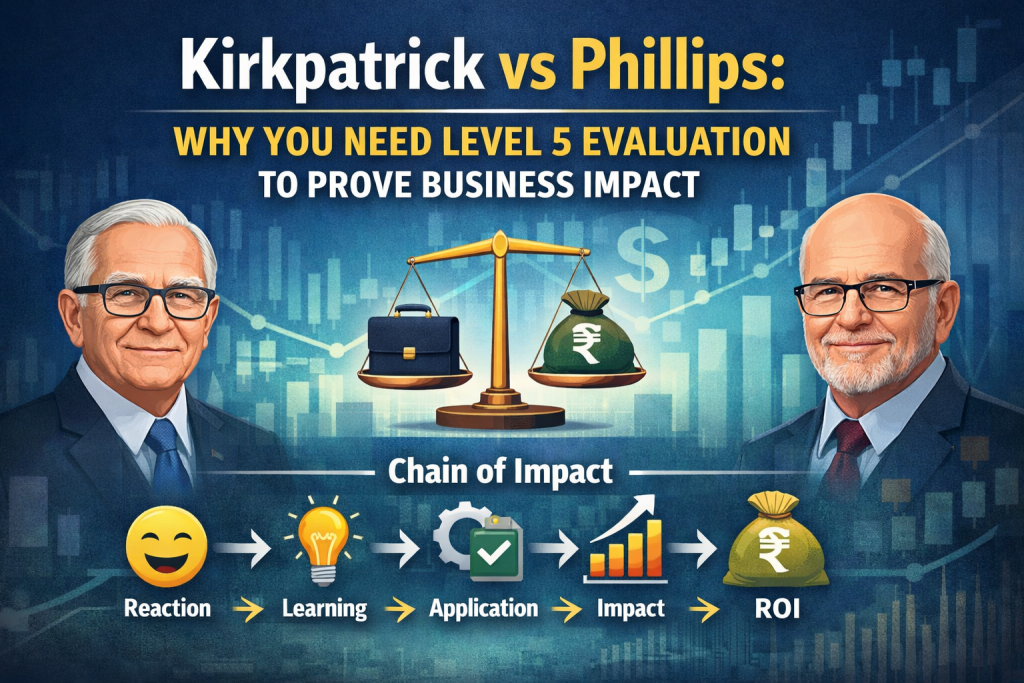
One of the most misunderstood ideas in ROI work is the Chain of Impact. The Chain of Impact explains how training creates business value in stages. You don’t jump from a great workshop to financial ROI overnight.
Here’s the sequence:
The Chain of Impact: From Reaction to ROI
Reaction → Learning → Application → Impact → ROI
Each link depends on the previous one. If people liked the training but didn’t learn, the chain breaks.
If they learned but didn’t apply, the chain breaks. If they applied but the process blocked results, the chain breaks.
This is why Level 5 Evaluation is not just math. It forces you to design programs for transfer and performance. You can’t calculate ROI if you skipped application support. You can’t show ROI if managers never reinforced behaviors. You can’t show ROI if your business metrics were vague from day one.
When leaders say, “Training doesn’t show ROI,” what they often mean is, “Your Chain of Impact was broken somewhere.”
How to Calculate Level 5 Evaluation (Simplified)
Let’s keep this practical.
The basic formula for Level 5 Evaluation is:
ROI % = (Net Program Benefits / Program Costs) × 100
Where:
- Program Benefits = Monetary value of business impact
- Net Benefits = Program Benefits – Program Costs
- Program Costs = Design, delivery, tools, time, logistics
Example (simplified):
- Reduced attrition saves ₹80 lakhs annually
- Total leadership program cost = ₹40 lakhs
Net Benefits = ₹80L – ₹40L = ₹40L
ROI % = (₹40L / ₹40L) × 100 = 100% ROI
That’s a language your CFO understands.
Two practical realities you need to handle:
1. Isolating the effect of training
You don’t claim full credit for every improvement. You use manager estimates, control groups, or trend analysis to isolate how much of the impact came from training.
2. Converting data to money
Some measures are easy to monetize. Revenue, cost reduction, time saved.
- Others require proxies.
- Fewer escalations.
- Lower rework.
- Improved productivity.
You’re not chasing perfect math. You’re building a credible business case.
Should Your Organization Use Level 5 Evaluation?
Not every program deserves a full ROI study. Using Level 5 Evaluation everywhere will burn your team out.
Use it when:
- The program is high-cost
- The initiative is strategic
- Leadership is questioning budget value
- The outcome links directly to business KPIs
- The program is likely to be scaled
Examples:
- Leadership development
- Sales performance programs
- Frontline productivity initiatives
- Customer experience transformation
Skip full ROI when:
- The training is compliance-driven
- The program is low-cost
- The goal is awareness, not performance
- The business impact is indirect or long-term
In those cases, Levels 1–4 are often enough.
The power move is selective application. Use Level 5 Evaluation where credibility matters most.
Conclusion
You don’t need more smile sheets. You need business conversations.
Level 5 Evaluation closes the gap between learning activity and business credibility. It helps you move from “people liked the program” to “the program paid for itself.”
The Phillips ROI Model gives you a disciplined way to get there. The Chain of Impact reminds you that ROI is built, not calculated at the end. The comparison of Phillips ROI vs Kirkpatrick shows you when each approach belongs in your toolkit.
If you want leadership to see L&D as an investment, you have to speak the language of returns.
Ready to move beyond smile sheets? Start by mapping your next program’s Chain of Impact before you design a single slide.
![The Power of Storytelling in Corporate Training: Igniting Success and Inspiring Growth [2023]](https://trainercentric.com/wp-content/uploads/2023/06/storytelling-1024x576.jpg)