
Organizations invest billions of dollars every year in leadership development. Workshops are delivered, frameworks are taught, and leaders leave training programs with new models for decision-making, communication, and team management.
Yet when high-pressure situations arise—crisis meetings, operational failures, or urgent business challenges—leadership under pressure behave in ways that look remarkably similar to how they behaved before training. Communication becomes directive, decision-making becomes reactive, and teams become cautious rather than collaborative.
This gap between what leaders know and what they actually do under pressure is one of the most overlooked challenges in leadership development. Until organizations address how stress changes leadership behavior, even the most sophisticated leadership training programs will struggle to create real impact.
This article explores the science behind leadership under pressure, why leadership behaviors collapse during stress, and how leaders can train themselves to remain effective when the stakes are highest.
Why Pressure Changes Leadership Behavior
Leadership is fundamentally a cognitive activity. It requires judgment, emotional regulation, perspective-taking, and the ability to balance short-term and long-term decisions.
But pressure changes how the brain works.
When leaders face intense stress, the brain shifts from deliberate thinking to faster, emotion-driven processing. The prefrontal cortex—responsible for reasoning and strategic thinking—becomes less active, while the amygdala, which processes threat, becomes more dominant.
This shift has several immediate consequences.
- First, attention narrows. Leaders focus on the most immediate threat rather than the broader system.
- Second, working memory declines. Complex problems feel harder to analyze.
- Third, decision-making becomes reactive rather than reflective.
This neurological shift explains why leaders who normally communicate thoughtfully may suddenly become directive or impatient when pressure rises.
In other words, the problem is not a lack of leadership knowledge. It is the physiology of stress.
The Leadership Reset Problem
To understand why leadership training often fails under pressure, we must recognize a simple psychological principle.
Behavior under stress is governed by habit, not intention.
Many leadership programs focus heavily on concepts:
- Coaching leadership
- Psychological safety
- Strategic thinking
- Emotional intelligence
Leaders understand these ideas intellectually. They may even agree with them strongly.
But when pressure hits, they revert to behaviors that feel fastest and most familiar.
These habits are often built over years.
For example, many leaders were promoted because they were excellent problem solvers. They learned to jump in quickly, fix issues, and drive execution.
However, leadership at higher levels often requires different behaviors—coaching, delegating, and developing others.
Under pressure, leaders revert to what once made them successful: solving problems themselves.
This phenomenon is often described as behavioral regression under stress.
It is one of the primary reasons leadership development initiatives struggle to create lasting change.
What Happens to Leaders Under Pressure?
When leaders face intense pressure, several predictable changes occur:
- Stress hormones increase
- Cognitive bandwidth decreases
- Decision making becomes reactive
- Communication becomes directive
- Teams become cautious or defensive
As a result, many leaders revert to familiar habits instead of applying leadership frameworks they learned in training programs.
What Research Reveals About Leadership Under Stress
Research in organizational psychology confirms that leadership behaviors change significantly under stress.
Studies show that positive leadership behaviors such as transformational leadership often decrease during stressful periods, while negative behaviors such as controlling or abusive leadership may increase.
From the employee perspective, this creates a damaging pattern: leadership becomes inconsistent.
A manager who normally encourages discussion may suddenly shut down debate during crises.
A leader who usually empowers employees may start micromanaging during tight deadlines.
This inconsistency has consequences.
Employees experience higher levels of strain and uncertainty when leadership behavior fluctuates dramatically between calm and stressful situations ( A Research Says)
In simple terms, employees begin to feel as though they are working for “two different leaders.”
Trust declines, communication deteriorates, and team performance suffers.
The Hidden Skill Behind Leadership Under Pressure
When examining leaders who perform well under pressure, one capability consistently emerges as critical: self-regulation.
Self-regulation is the ability to recognize internal emotional reactions and manage them before they influence behavior.
Leadership under pressure who lack this skill often react instinctively to stress. They become defensive, angry, or controlling without realizing it.
Leaders who possess strong self-regulation skills pause before responding and choose a more deliberate course of action.
Leadership experts note that the most effective leaders under pressure are those who can regulate their internal state rather than allowing stress to dictate their behavior.
This ability creates several advantages:
- clearer decision-making
- more thoughtful communication
- greater trust from teams
- better strategic judgment
Self-regulation does not eliminate pressure. Instead, it creates space between stimulus and response.
That space is where leadership happens.
Why Experience Matters More Than Intelligence During Stress
One of the most influential theories explaining leadership performance under pressure is Cognitive Resource Theory.
This theory proposes that stress disrupts rational thinking and analytical problem-solving. When stress is low, a leader’s intelligence contributes strongly to performance. But when stress is high, experience becomes more important.
In leadership under pressure situations, experienced leaders rely on patterns they have seen before.
They recognize signals faster and avoid overanalyzing.
Less experienced leaders may struggle because the cognitive resources required for analytical thinking are impaired by stress.
This insight explains why scenario-based training is so powerful. By exposing leaders to realistic challenges in advance, organizations build experiential memory that leaders can draw on during crises.
The Neuroscience of Leadership Under Pressure Collapse
The neurological effects of stress are profound.
Stress triggers the release of cortisol, a hormone that prepares the body to deal with threats.
While cortisol can sharpen focus in short bursts, excessive levels impair executive functioning.
Research shows that elevated cortisol disrupts planning, cognitive flexibility, and long-term memory retrieval.
This is why leadership under pressure may:
- interrupt others frequently
- make short-term decisions
- overlook alternative perspectives
- become emotionally reactive
In extreme cases, stress leads to what psychologists call cognitive tunneling—a state where attention becomes fixated on a single problem while ignoring other important factors.
For leadership under pressure, this can result in poor decisions that affect entire organizations.
Leadership Behavior: Calm vs Pressure
| Environment | Leader Mindset | Typical Leader Behavior | Team Response | Risk to Performance |
| Calm Environment | Strategic and reflective | Leaders think long-term, encourage discussion, and consider multiple perspectives before making decisions. | Teams feel safe to contribute ideas and challenge assumptions. | Low risk. Innovation and collaboration flourish. |
| Moderate Pressure | Focused and task-driven | Leaders prioritize speed and efficiency. Communication becomes more directive, but collaboration still exists. | Teams become more execution-focused and slightly cautious. | Moderate risk. Some creativity is lost, but productivity remains strong. |
| High Pressure | Defensive and reactive | Leaders rely on instinct and past habits. Decision-making speeds up and consultation decreases. | Teams hesitate to speak up and begin waiting for instructions. | High risk. Blind spots increase and mistakes become more likely. |
| Extreme Pressure | Survival-oriented | Leaders attempt to control outcomes tightly. Communication narrows and urgency dominates conversations. | Teams withdraw, avoid risks, and focus only on protecting themselves. | Very high risk. Communication breaks down and performance drops significantly. |
The leadership Pressure Loop
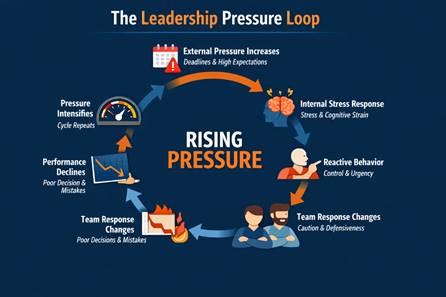
To understand why leadership under pressure struggle during crises, it helps to examine the cycle that pressure creates. When external pressure increases—through tighter deadlines, higher expectations, and greater stakes—leaders begin to experience an internal stress response. The body releases stress hormones, which reduces cognitive capacity and narrows thinking.
As a result, reactive behaviors emerge, with leaders falling back on familiar habits such as excessive control, urgency-driven decisions, or even avoidance. These behaviors quickly influence how the team responds, often making employees more cautious, defensive, or hesitant to share ideas. Over time, this shift in dynamics leads to declining performance, as communication breaks down and rushed decisions create new problems.
These outcomes then cause pressure to intensify, reinforcing the cycle and pushing leaders even deeper into reactive patterns. Breaking this loop requires leaders to develop intentional practices that help them stay aware, regulate their responses, and maintain effective leadership behaviors even in high-pressure situations.
The Organizational Cost of Poor Leadership Under Pressure
When leadership under pressure, lose clarity, the impact spreads quickly through teams.
Employees take cues from leaders’ emotional states. If leaders appear reactive or uncertain, teams become anxious and hesitant.
This effect creates several organizational risks.
First, decision-making slows down. Employees wait for direction rather than acting independently.
Second, trust erodes. Team members may avoid sharing bad news or challenging ideas.
Third, morale declines. Employees feel unsupported when leadership becomes inconsistent.
Over time, these dynamics can significantly reduce productivity and engagement.
In extreme cases, leadership breakdown during crises can cause reputational damage, financial loss, and talent attrition.
Practical Strategies for Leading Under Pressure
Leadership under pressure is not purely a personality trait.
It is a trainable capability.
Below are several practices that research and leadership development programs consistently identify as effective.
1. The Strategic Pause
One of the simplest yet most powerful leadership under pressure habits is pausing before reacting.
Even a brief pause can allow the brain’s prefrontal cortex to regain control over emotional impulses.
Instead of responding immediately to a stressful situation, effective leaders take a moment to gather information and consider options.
This practice reduces reactive decision-making and improves judgment.
2. Cognitive Reframing
Pressure often triggers catastrophic thinking.
Leadership under pressure may interpret setbacks as evidence that everything is failing.
Cognitive reframing involves deliberately shifting perspective.
For example, instead of asking:
“Why is this going wrong?”
A leader might ask:
“What information is this situation giving us?”
This simple shift encourages problem-solving rather than blame.
3. Scenario-Based Preparation
Organizations often train leadership under pressure through lectures and discussions.
However, research suggests that scenario-based training is more effective for preparing leaders for real crises.
Simulations expose leaders to high-pressure situations before they occur.
This builds experiential memory, allowing leaders to respond more effectively during actual crises.
4. Emotional Awareness
Leadership under pressure often believe they must suppress emotions.
In reality, awareness of emotional signals is more valuable than suppression.
By recognizing early signs of stress—such as impatience, frustration, or physical tension—leaders can intervene before those emotions influence behavior.
5. Team Decision Structures
Leadership under pressure does not mean making every decision alone.
High-performing leaders create decision structures that distribute responsibility.
For example:
- defining clear roles during crises
- establishing escalation protocols
- encouraging dissenting viewpoints
These systems prevent reactive decision-making and improve organizational resilience.
Building Resilient Leadership Systems
Organizations often focus on developing individual leaders.
However, leadership under pressure is also influenced by organizational systems.
Teams perform better when they operate within clear structures and psychological safety.
Leaders who create these conditions enable their teams to remain effective even during uncertainty.
Some practices that support resilient leadership include:
- transparent communication during crises
- clear decision-making frameworks
- cross-functional collaboration
- regular reflection after high-pressure events
These practices transform pressure into learning opportunities.
The Pressure Reset Framework for Leadership under Pressure
How Leaders Can Stay Effective When Pressure Spikes
If the Leadership under Pressure Loop explains why leaders struggle during crises, the next question is obvious: how can leaders interrupt this cycle before it damages team performance? The answer lies in developing intentional practices that allow leaders to recognize and regulate their reactions in high-pressure situations. This approach can be summarized in what we call the Pressure Reset Framework.
| Stage | What Happens Under Pressure | Effective Leadership Practice | Practical Action |
| 1. Awareness | Leaders often do not realize when stress begins to influence their behavior. | Recognize early signals of pressure and emotional escalation. | Pause briefly before responding to a high-stakes situation. Ask yourself: “What is actually happening here?” |
| 2. Regulation | Stress narrows thinking and increases urgency-driven decisions. | Regulate emotional reactions before making decisions. | Slow down communication. Take a breath, gather facts, and avoid immediate reactive responses. |
| 3. Reframing | Pressure creates tunnel vision and short-term thinking. | Reframe the situation from a broader leadership perspective. | Ask: “What outcome matters most for the team and the organization?” |
| 4. Intentional Action | Leaders default to old habits such as micromanagement or control. | Choose deliberate leadership behaviors instead of instinctive reactions. | Involve the team in problem-solving and encourage open discussion. |
| 5. Reinforcement | Without reflection, the same patterns repeat in the future. | Strengthen positive behaviors through reflection and learning. | After the situation, review what worked and what could improve. |
The Future of Leadership Development
The modern workplace is becoming increasingly complex.
Rapid technological change, economic volatility, and global uncertainty mean leaders will face pressure more frequently than ever before.
Traditional leadership development programs often emphasize inspiration and vision.
While these qualities are valuable, they are insufficient for navigating high-stakes environments.
Future leadership development must focus more on:
- stress regulation
- decision-making under uncertainty
- crisis leadership
- resilience and adaptability
Organizations that invest in these capabilities will be better prepared for disruption.
The Leadership Pressure Threshold Model
The core idea behind this model is simple: leadership effectiveness does not decline gradually under pressure. Instead, leaders often cross a psychological threshold where their behavior shifts suddenly from thoughtful leadership to instinctive reaction.
| Pressure Level | Leader Thinking Mode | Typical Behavior | Impact on the Team |
| Low Pressure | Strategic thinking | Leaders analyze information, encourage discussion, and consider long-term consequences. | Teams feel psychologically safe and contribute ideas openly. |
| Rising Pressure | Focused execution | Leaders begin prioritizing speed and efficiency. Communication becomes more directive. | Teams shift toward execution but remain collaborative. |
| Pressure Threshold (Critical Point) | Cognitive narrowing | Stress hormones increase and leaders feel urgency to act quickly. Reflection decreases. | Teams begin to hesitate and wait for instructions. |
| High Pressure | Reactive leadership | Leaders revert to familiar habits such as micromanaging, controlling decisions, or avoiding difficult conversations. | Teams become defensive, quiet, and risk-averse. |
| Extreme Pressure | Survival mode | Decisions are rushed, communication narrows, and collaboration collapses. | Performance drops and mistakes increase. |
Frequently Asked Questions
Why do leaders struggle under pressure?
Leaders struggle under pressure because stress activates the brain’s threat response. This reduces cognitive flexibility and increases reliance on familiar habits, which often leads to reactive leadership behaviors rather than thoughtful decision-making.
Why does leadership training fail in real situations?
Many leadership programs focus on models and concepts rather than behavior under stress. When pressure increases, leaders revert to automatic habits rather than newly learned frameworks.
How can leaders improve performance under pressure?
Leaders can improve performance under pressure by practicing emotional regulation, developing decision frameworks, building trust with their teams, and rehearsing crisis scenarios before real situations occur.
What skills are most important for leadership during crisis?
The most important leadership skills during crisis include:
1. emotional regulation
2. clear communication
3. prioritization under uncertainty
4. rapid decision-making
5. maintaining psychological safety
![The Power of Storytelling in Corporate Training: Igniting Success and Inspiring Growth [2023]](https://trainercentric.com/wp-content/uploads/2023/06/storytelling-1024x576.jpg)