
The Death of Traditional Icebreakers is no longer a dramatic phrase—it is a lived reality inside corporate training rooms in 2026. What once felt friendly, inclusive, and energizing now feels forced, awkward, and sometimes even insulting to modern participants.
Corporate trainers across industries are quietly noticing the same pattern: the moment an icebreaker begins, energy drops instead of rising. Eye contact disappears. Smiles turn polite. Participation becomes mechanical. And trust? It doesn’t grow—it stalls.
This article exists so you never have to rely on outdated icebreakers again. By the end of this piece, you will understand why traditional icebreakers are dying, what has replaced them, and exactly how to design opening experiences that work for today’s corporate learners—without gimmicks, cringe, or resistance.
Why The Death of Traditional Icebreakers Was Inevitable
Traditional icebreakers were created in a time when training rooms were psychologically different spaces. Participants were less vocal, authority was assumed, and engagement was easier to manufacture through novelty. Today’s learners walk in with experience, opinions, exposure to multiple learning formats, and a strong internal filter that instantly evaluates whether something is worth their attention. When trainers ask participants to introduce themselves with a fun fact or describe themselves using an animal, it triggers silent resistance rather than warmth.
Adult learning research challenges the myth that forced participation builds engagement, aligning with principles of Andragogy that emphasize autonomy and self-direction. The problem is not the activity itself. The problem is what it communicates. It signals that the trainer has not fully understood the maturity, pressure, and context of the audience. This is one of the strongest reasons behind the Death of Traditional Icebreakers in corporate training.
1. Learners Are No Longer Passive
Modern professionals walk into training rooms with:
- Context
- Opinions
- Prior exposure
- Limited patience
They don’t need “warming up.” They need relevance.
2. Psychological Safety Is Not Built Through Forced Fun
Contrary to popular belief, asking people to:
- Share personal facts
- Perform playful tasks
- Speak without context
does not create safety. It creates exposure without trust.
3. Experience Has Replaced Novelty
In earlier decades, novelty alone created engagement. In 2026, novelty without purpose feels manipulative.
This is the foundation of The Death of Traditional Icebreakers.
What Counts as a Traditional Icebreaker Today
Before we move forward, let’s be brutally clear about what is dying. Most trainers don’t realize they are still using traditional icebreakers because they feel harmless. Activities like asking participants to share one personal detail, participate in quick energizers, or speak without context were designed to reduce anxiety. In reality, they now increase it. Participants are asked to expose themselves before trust is built. They are asked to perform before relevance is established. They are asked to participate before they understand why they should care.
This reversal of psychological order is fatal. Trust must come before participation, not the other way around. The Death of Traditional Icebreakers is rooted in this mismatch.
Classic Examples That No Longer Work
- “Introduce yourself and share one fun fact”
- “Describe yourself in one word”
- “Two truths and a lie”
- “What animal best represents you?”
- “Let’s do a quick energizer to loosen up”
These are not neutral activities anymore. They carry baggage.
The Hidden Damage Caused by Traditional Icebreakers
The Death of Traditional Icebreakers is not just about boredom. It’s about unintended harm. The most dangerous effect of traditional icebreakers is not boredom. It is credibility loss. Senior professionals decide very early whether a trainer is worth listening to. When the opening feels childish or disconnected from real challenges, participants downgrade the trainer internally. Once that happens, no amount of excellent content can fully recover authority.
Another hidden issue is false engagement. People speak, laugh, and comply, but they do not invest cognitively. Trainers often mistake movement and noise for involvement. In reality, meaningful engagement is happening less, not more. This is why many programs feel “good” in the room but fail to create impact afterward.
1. They Signal Low Maturity
Senior professionals instantly judge the seriousness of a trainer within the first 10 minutes. A weak icebreaker can permanently downgrade credibility.
2. They Create Surface-Level Participation
People speak—but they don’t engage. The difference matters.
3. They Alienate Introverts and Analytical Thinkers
Not everyone processes socially or verbally on command.
4. They Delay Value Delivery
Participants are mentally asking: “When will this actually start?”
The Real Purpose Icebreakers Were Supposed to Serve
To understand what replaces them, we must understand their original intent. Despite their decline, the original intention behind icebreakers was valid. They were meant to lower anxiety, encourage participation, create rapport, and set the tone for interaction. The Death of Traditional Icebreakers does not mean these goals are irrelevant. It means the approach to achieving them must evolve.
Traditional icebreakers aimed to:
- Reduce anxiety
- Encourage participation
- Build rapport
- Set tone
- Create connection
The Death of Traditional Icebreakers does NOT mean these goals are irrelevant. It means the methods are outdated.
What Replaces Icebreakers in 2026
The smartest trainers no longer “break ice.” They create traction.
The most effective trainers no longer try to break ice. They create traction. Instead of asking participants to reveal something about themselves, they invite participants to recognize something about their reality. This subtle shift changes everything. Engagement starters replace icebreakers by focusing on relevance rather than personality.
An engagement starter might open with a problem participants already recognize but haven’t verbalized. When a trainer names a shared frustration or challenge accurately, heads nod instinctively. No one is forced to speak, yet everyone is involved. This is the professional alternative that defines the Death of Traditional Icebreakers.
Welcome to the Era of Engagement Starters
Engagement starters:
- Respect intelligence
- Create relevance
- Invite participation without pressure
- Build trust indirectly
This shift defines The Death of Traditional Icebreakers.
Engagement Starter #1: Immediate Relevance Anchors
What It Is
You start with a problem participants already recognize. One of the strongest engagement techniques in modern training is relevance anchoring. Instead of starting with who people are, trainers start with what people face. When participants hear their reality reflected accurately, trust forms organically. They feel seen without being exposed.
This approach also establishes authority without dominance. The trainer is not asking for attention. They are earning it by demonstrating understanding. This is why relevance-driven openings outperform traditional icebreakers consistently in 2026.
Example
“By the end of today, you’ll know exactly why most training looks good on paper but fails after Day One. Before we begin—how many of you have seen that happen?”
Hands go up. Heads nod. Engagement begins.
Why It Works
- No forced sharing
- No personal exposure
- Instant credibility
Engagement Starter #2: Silent Cognitive Engagement
Silence is underused—and powerful. Another major shift following the Death of Traditional Icebreakers is the acceptance of silence. Traditional facilitation often treats silence as a problem to fix. Modern facilitation uses silence intentionally. Giving participants time to think before inviting responses respects cognitive processing styles and reduces performance anxiety.
When participants speak after reflection rather than pressure, contributions are deeper and more thoughtful. Engagement becomes intellectual instead of performative.
Technique
- Ask a question
- Give 30 seconds of quiet thinking
- Then invite voluntary sharing
Example
“Think of the last training you attended that genuinely changed how you worked. What made it different?”
This respects autonomy and thinking styles.
Engagement Starter #3: Reality Check Openings
Reality beats playfulness in 2026 with the Death of Traditional Icebreakers. Trainers who open sessions by naming uncomfortable truths immediately differentiate themselves. When a facilitator acknowledges that training often looks good but fails to translate into behavior, participants lean in. This honesty creates alignment rather than resistance.
Example
“Most organizations spend money on training but hope behavior changes magically. Today, we’ll talk about why that gap exists.”
You’re not entertaining. You’re aligning.
The Psychology Behind The Death of Traditional Icebreakers
This shift is rooted in adult learning science. Adult learning science has long suggested that adults are self-directed, goal-oriented, and relevance-driven. Traditional icebreakers ignore these principles by prioritizing social comfort over cognitive alignment. In today’s environment of constant distraction and pressure, learners protect their attention fiercely. Anything that feels unnecessary is filtered out immediately thus the Death of Traditional Icebreakers.
Authority has also changed and it prolonged the Death of Traditional Icebreakers. Trainers are no longer granted automatic credibility. Authority is conditional and must be earned early. Traditional icebreakers delay this process instead of accelerating it.
Adults Resist Artificial Socialization
Adults bond through:
- Shared problems
- Mutual respect
- Meaningful dialogue
Not games.
Between meetings, notifications, and pressure, learners don’t want additional emotional labor. Trainers no longer get authority by default. It must be earned immediately.
How Senior Trainers Open Sessions in 2026
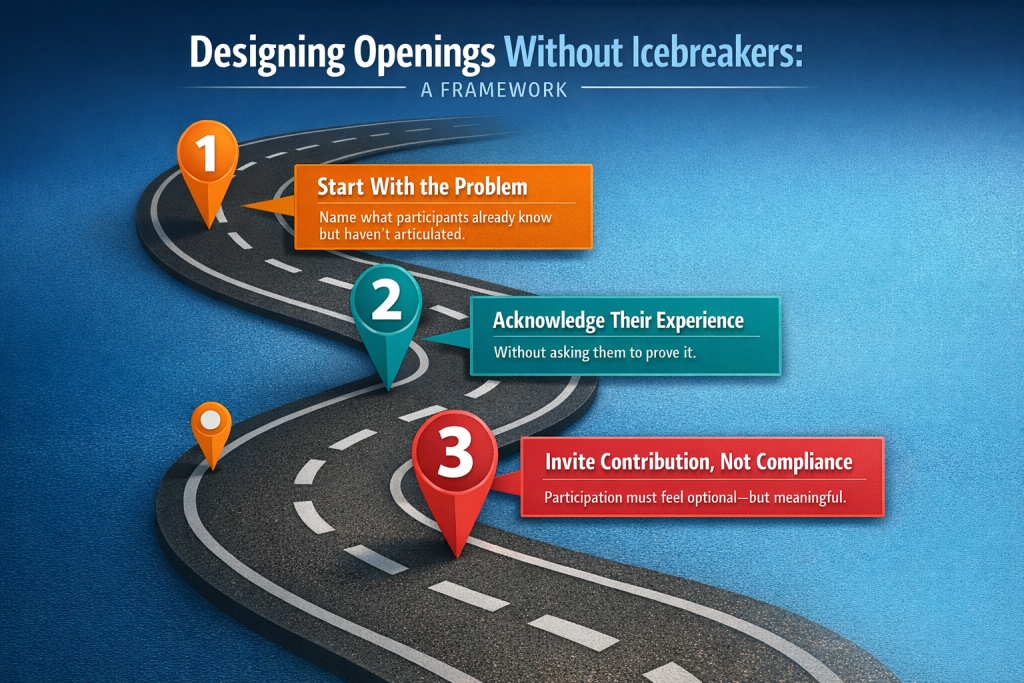
Senior trainers rarely use icebreakers. Senior trainers open sessions with clarity rather than cleverness. They establish credibility subtly, often by naming patterns participants recognize. They establish relevance by connecting the session to real outcomes. They establish psychological safety by making participation meaningful rather than mandatory.
Without bragging.
Without overselling.
Without forcing vulnerability.
This triad replaces traditional icebreakers entirely.
The Role of Context Setting in Modern Training
Context setting is not an introduction. It’s a contract. Context setting is not an introduction or agenda walkthrough. It is a psychological contract between the trainer and the participants. When done well, it answers unspoken questions about value, expectations, and relevance.
This approach respects adult learners and prevents the silent disengagement that traditional icebreakers often trigger.
What Context Setting Does
- Aligns expectations
- Reduces resistance
- Signals respect
- Frames participation
This is the professional successor to icebreakers.
The Death of Traditional Icebreakers in Corporate Training Rooms
In 2026, disengagement rarely looks disruptive. It looks polite, quiet, and compliant. Traditional icebreakers accelerate this form of disengagement by signaling low relevance early. Trainers who recognize this shift stop trying to energize rooms and start trying to align minds.
Why Fun Is No Longer Equal to Engagement
Fun without purpose feels juvenile to experienced professionals. Engagement today is defined by mental involvement, not emotional stimulation. Trainers who confuse the two unintentionally undermine their own effectiveness.
Designing Openings Without Icebreakers
Designing strong openings now requires understanding participant reality, sequencing trust correctly, and inviting contribution without forcing it. Trainers who master this no longer worry about breaking ice because no ice exists to begin with.
The Future of Engagement in Corporate Training
The decline of traditional icebreakers signals a maturation of the training profession. Trainers are moving away from performance and toward facilitation. Learners are no longer audiences but thinking partners. Training rooms are becoming spaces for reflection, dialogue, and behavioral insight.
This evolution is healthy. It raises the standard for everyone involved.
The Death of Traditional Icebreakers marks a maturation of the training profession.
- Trainers are no longer performers.
- Learners are no longer audiences.
- Training rooms are no longer stages.
They are thinking spaces.
Final Word for Corporate Trainers
If you are still relying on traditional icebreakers in 2026, it does not mean you are outdated. It means you were never shown a better alternative. The Death of Traditional Icebreakers is not a loss. It is an upgrade.
After understanding this shift, trainers no longer need tricks to engage rooms. They need clarity, relevance, and respect. And once those are present, engagement follows naturally. If you are still relying on traditional icebreakers in 2026, it’s not because you are outdated—it’s because no one taught you a better way.
Now you have one. And after reading this, you genuinely don’t need to read another article on icebreakers again.
![The Power of Storytelling in Corporate Training: Igniting Success and Inspiring Growth [2023]](https://trainercentric.com/wp-content/uploads/2023/06/storytelling-1024x576.jpg)