
Have you ever wondered why some training sessions energize you while others leave you completely disengaged?
In many organizations, two employees can attend the exact same workshop and walk away with very different experiences. One may feel inspired and ready to act, while the other may feel overwhelmed or unconvinced. The difference often lies not in the content—but in how people prefer to learn.
This is where the Honey and Mumford learning styles model becomes highly valuable.
Developed by Peter Honey and Alan Mumford, two influential thinkers in workplace learning and management development, the model identifies four distinct learning preferences that influence how individuals engage with training, reflection, theory, and application.
Their framework is operationalized through the Learning Styles Questionnaire (LSQ), a practical diagnostic tool widely used in corporate training, management development programs, and personal development planning (PDP).
In this comprehensive guide, we will:
- Explain the Honey and Mumford learning styles in depth
- Explore how the Learning Styles Questionnaire (LSQ) works
- Examine how the model connects to experiential learning theory
- Compare Honey and Mumford vs Kolb
- Show practical ways trainers, managers, and individuals can apply the model in the real world
- Download a pdf containing 60 sample questionnaire of Honey and Mumford Learning Styles
By the end, you will not only understand the theory—you will know how to use it to design better learning experiences and develop stronger learning agility by using the sample questionnaire of Honey and Mumford Learning Styles
The Origins of the Honey and Mumford Model
The Honey and Mumford learning styles model emerged in the early 1980s as a practical adaptation of David Kolb’s Experiential Learning Theory.
Kolb’s model proposed that learning occurs through a continuous cycle of experience, reflection, conceptualization, and experimentation. While academically influential, Kolb’s framework focused heavily on internal cognitive processes, which made it somewhat abstract for everyday workplace application.
Peter Honey and Alan Mumford sought to make this theory more accessible for managers and trainers.
Instead of focusing primarily on mental processes, they emphasized observable learning behaviors—how people actually approach learning situations in practice. Their work resulted in two major contributions:
- Four learning style categories
- The Learning Styles Questionnaire (LSQ) for identifying learning preferences
The model quickly gained popularity in corporate learning and development (L&D) because it translated complex educational psychology into practical tools for workplace training and instructional design.
Today, the framework is widely used in:
- Management development programs
- Corporate training workshops
- Coaching and leadership development
- Personal development plans (PDPs)
- Educational settings
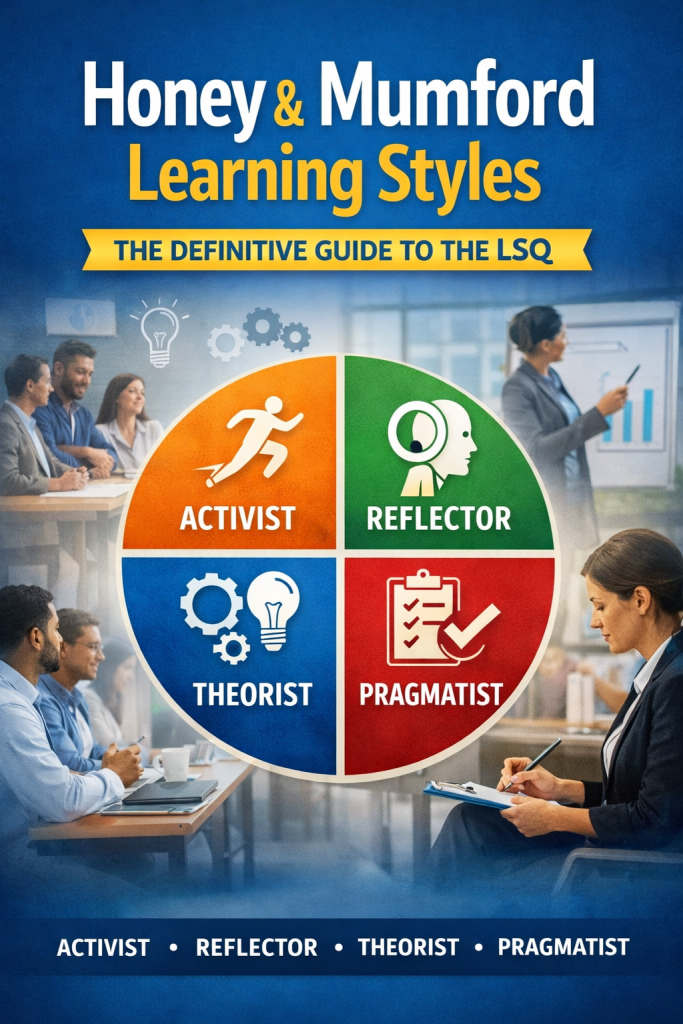
The Four Honey and Mumford Learning Styles (Detailed Breakdown)
The four Honey and Mumford learning styles represent learning preferences rather than fixed personality traits. Individuals typically display a dominant style, but effective learners develop the ability to use all four approaches.
These styles are identified using the Learning Styles Questionnaire (LSQ). Understanding each style helps trainers design more inclusive learning experiences and helps individuals improve their learning agility.
1. The Activist
The Honey and Mumford learning styles Activist thrives on new experiences, challenges, and hands-on activities. Activists learn best by doing rather than thinking. They enjoy workshops that include simulations, role-plays, problem-solving exercises, and interactive discussions.
Core Characteristics
- Open-minded and enthusiastic
- Enjoy new challenges
- Thrive in group activities
- Prefer action over reflection
- Comfortable taking risks
A Day in the Life
Imagine a leadership workshop where participants are asked to simulate a difficult negotiation scenario. The Activist immediately volunteers for the role-play, eager to try the scenario and experiment with different approaches. For them, learning happens through participation.
Potential Blind Spots
Activists can sometimes:
- Rush into activities without preparation
- Skip reflection or analysis
- Lose interest during long lectures or theory discussions
- Become bored once novelty fades
Key insight: Activists benefit greatly from structured reflection after action.
2. The Reflector
The Honey and Mumford learning styles Reflector prefers to observe, analyze, and think carefully before acting. Reflectors are often the most thoughtful participants in a training environment. They learn best when they have time to review experiences, consider multiple perspectives, and draw their own conclusions.
Core Characteristics
- Thoughtful and cautious
- Strong observers
- Prefer listening before speaking
- Gather information before making decisions
- Comfortable reviewing data and evidence
A Day in the Life
In a strategy workshop, the Reflector quietly listens to group discussions and takes detailed notes. Later, when asked for their perspective, they provide a well-considered insight that integrates multiple viewpoints.
Potential Blind Spots
Reflectors sometimes struggle with:
- Decision delays
- Overanalyzing situations
- Hesitating to participate without full information
- Missing opportunities for experimentation
Key insight: Reflectors benefit from structured opportunities to test ideas earlier.
3. The Theorist
The Honey and Mumford learning styles Theorist seeks logic, structure, and conceptual clarity. Theorists enjoy models, frameworks, and systems that explain how things work. They often ask questions such as:
- Does this make logical sense?
- What framework explains this concept?
Core Characteristics
- Logical and analytical
- Systematic thinkers
- Prefer structured learning
- Interested in models and frameworks
- Value intellectual rigor
A Day in the Life
During a management development session on leadership styles, the Theorist is fascinated by the underlying models explaining leadership behavior. They enjoy connecting the material to broader theories in workplace psychology and organizational behavior.
Potential Blind Spots
Theorists may:
- Become uncomfortable with ambiguity
- Dismiss emotional or subjective insights
- Overemphasize theory at the expense of action
- Struggle with unstructured activities
Key insight: Theorists benefit from connecting theory to real-world experimentation.
4. The Pragmatist
The Honey and Mumford learning styles Pragmatist focuses on practical application. Their primary question is simple:
“How can I use this immediately?”
Pragmatists thrive when learning produces clear, actionable solutions to real-world problems.
Core Characteristics
- Practical and results-oriented
- Interested in solutions and tools
- Enjoy experimenting with ideas
- Prefer real-world case studies
- Seek quick application
A Day in the Life
After attending a productivity seminar, the Pragmatist immediately begins testing the suggested time-management techniques at work. If a concept produces results, they adopt it quickly.
Potential Blind Spots
Pragmatists may:
- Become impatient with theoretical discussions
- Reject ideas that lack immediate application
- Focus narrowly on short-term solutions
- Miss deeper conceptual insights
Key insight: Pragmatists benefit from understanding the theory behind effective practice.
The Honey and Mumford Learning Cycle
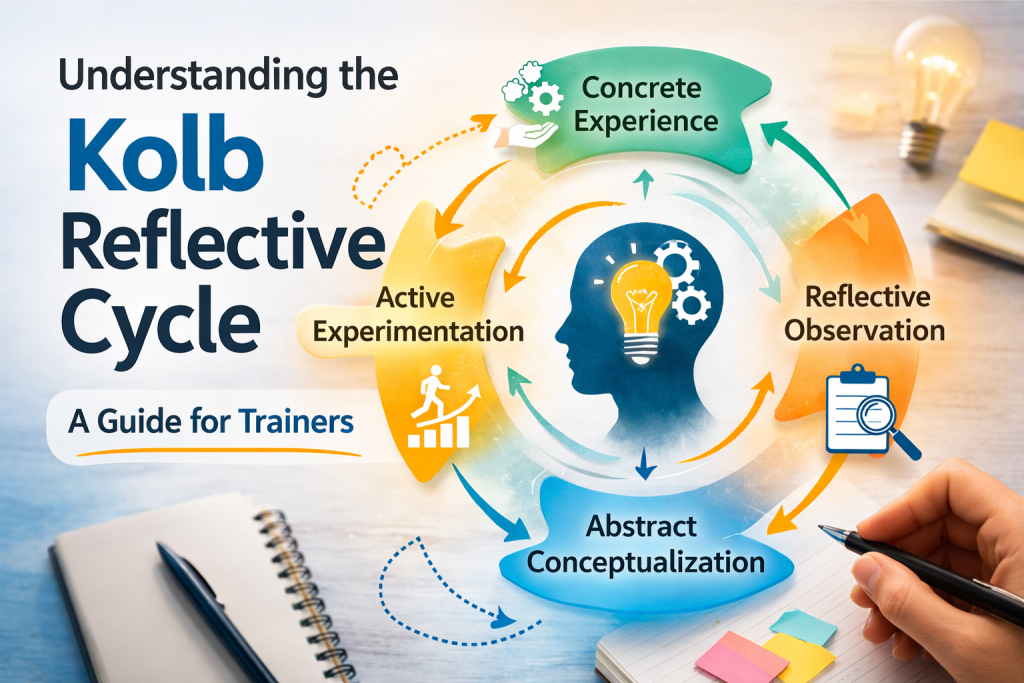
Although Honey and Mumford introduced their own learning style terminology, the framework closely aligns with Kolb’s experiential learning cycle.
| Learning Cycle Stage | Dominant Learning Style |
|---|---|
| Concrete Experience | Activist |
| Reflective Observation | Reflector |
| Abstract Conceptualization | Theorist |
| Active Experimentation | Pragmatist |
This cycle illustrates that effective learning involves moving through all four stages:
- Experience – engaging with a new activity
- Reflection – observing and analyzing what happened
- Conceptualization – building theoretical understanding
- Experimentation – applying insights in practice
While individuals may prefer one stage, the most effective learners develop flexibility across the entire cycle. This capability is often referred to as learning agility—the ability to learn quickly from experience and apply insights in new situations.
The Honey and Mumford Learning Styles Questionnaire (LSQ)
The Honey and Mumford Learning Styles Questionnaire (LSQ) is the primary tool used to identify an individual’s learning preferences. It typically contains 40 or 80 statements describing behaviors and attitudes toward learning. Participants respond by indicating whether they agree or disagree with each statement.
What the LSQ Measures
The questionnaire produces four scores, corresponding to:
- Activist
- Reflector
- Theorist
- Pragmatist
LSQ Scoring
Scores indicate the strength of preference for each learning style. For example:
- High Activist score → preference for action-based learning
- High Reflector score → preference for observation and analysis
The results are commonly used in:
- Leadership development programs
- Team-building workshops
- Training and development strategy
- Personal development plans (PDP)
The LSQ is not intended as a rigid diagnostic instrument but rather as a self-awareness tool that encourages reflection on learning habits.
Practical Applications: Using the Honey and Mumford Model in the Real World
The Honey and Mumford model is particularly useful in training design, management development, and personal growth. Here are practical ways to apply it.
For Trainers and Teachers
Effective instructional design incorporates activities that appeal to all four learning styles.
A balanced training session might include:
For Activists
- Simulations
- Role plays
- Group activities
For Reflectors
- Reflection exercises
- Journaling
- Debrief discussions
For Theorists
- Conceptual models
- Frameworks
- Research-based explanations
For Pragmatists
- Case studies
- Practical tools
- Action planning
The goal is not to match one style exclusively but to create a complete learning experience.
For Managers
Managers can use the model to improve team development and delegation.
For example:
- Activists excel in innovation projects
- Reflectors thrive in analysis and review roles
- Theorists perform well in strategic planning
- Pragmatists succeed in implementation tasks
Understanding these preferences helps leaders assign work more effectively and improve team dynamics.
For Personal Development
Individuals can use the model to strengthen their learning agility.
A useful exercise is identifying your least preferred style.
For example:
- Activists may benefit from structured reflection
- Reflectors may practice faster decision-making
- Theorists may experiment with rapid prototyping
- Pragmatists may deepen conceptual understanding
Expanding beyond your dominant style creates more adaptable learners and professionals.
Honey and Mumford vs. Kolb: A Critical Comparison
The Honey and Mumford model is heavily influenced by Kolb’s experiential learning theory, but the two frameworks differ in important ways.
| Feature | Kolb’s Model | Honey & Mumford’s Model |
|---|---|---|
| Focus | Internal cognitive processes | Observable learning behaviors |
| Learning Styles | Diverging, Assimilating, Converging, Accommodating | Activist, Reflector, Theorist, Pragmatist |
| Purpose | Academic theory of experiential learning | Practical workplace training tool |
| Application | Higher education and psychology research | Corporate training and management development |
| Accessibility | Conceptually complex | Easy to apply in training design |
In practice, Kolb provides the theoretical foundation, while Honey and Mumford translate the ideas into workplace-friendly language.
Criticism and Considerations
Despite its popularity, the Honey and Mumford learning styles model has faced criticism from researchers.
The primary concerns include:
1. Limited Empirical Evidence
Research has found little strong evidence supporting the “meshing hypothesis.”
This hypothesis claims that people learn better when instruction matches their preferred learning style. Many studies suggest that learning outcomes depend more on the content and instructional design than on style matching.
2. Risk of Pigeonholing
Another concern is that learners may become overly attached to labels such as:
- “I’m an Activist”
- “I’m a Reflector”
In reality, effective learning requires flexibility across multiple approaches.
3. Questionnaire Validity
Some academics have questioned the psychometric validity of the LSQ, particularly regarding reliability and consistency.
However, in workplace learning and development, the tool still holds value as a conversation starter and self-reflection exercise.
A Balanced Perspective
Most experienced trainers treat the model as:
- A framework for reflection
- A discussion tool
- A guide for designing varied learning experiences
Rather than a strict diagnostic instrument.
When used this way, the model remains highly useful in workplace psychology and instructional design.
Conclusion
The Honey and Mumford learning styles model remains one of the most widely used frameworks in corporate training and management development. By identifying four learning preferences—Activist, Reflector, Theorist, and Pragmatist—the model helps individuals understand how they engage with experience, reflection, theory, and action.
More importantly, it encourages learners to develop versatility across the entire learning cycle. For trainers, the model offers guidance for designing balanced learning experiences that combine activities, reflection, conceptual thinking, and real-world application.
For individuals, it provides a valuable opportunity for self-awareness and personal development. The most powerful insight is this:
Great learners are not defined by a single style—they develop the agility to learn in multiple ways.
Frequently Asked Questions
Related Articles

Vark Learning Styles
Kolb Reflective Cycle

![The Power of Storytelling in Corporate Training: Igniting Success and Inspiring Growth [2023]](https://trainercentric.com/wp-content/uploads/2023/06/storytelling-1024x576.jpg)