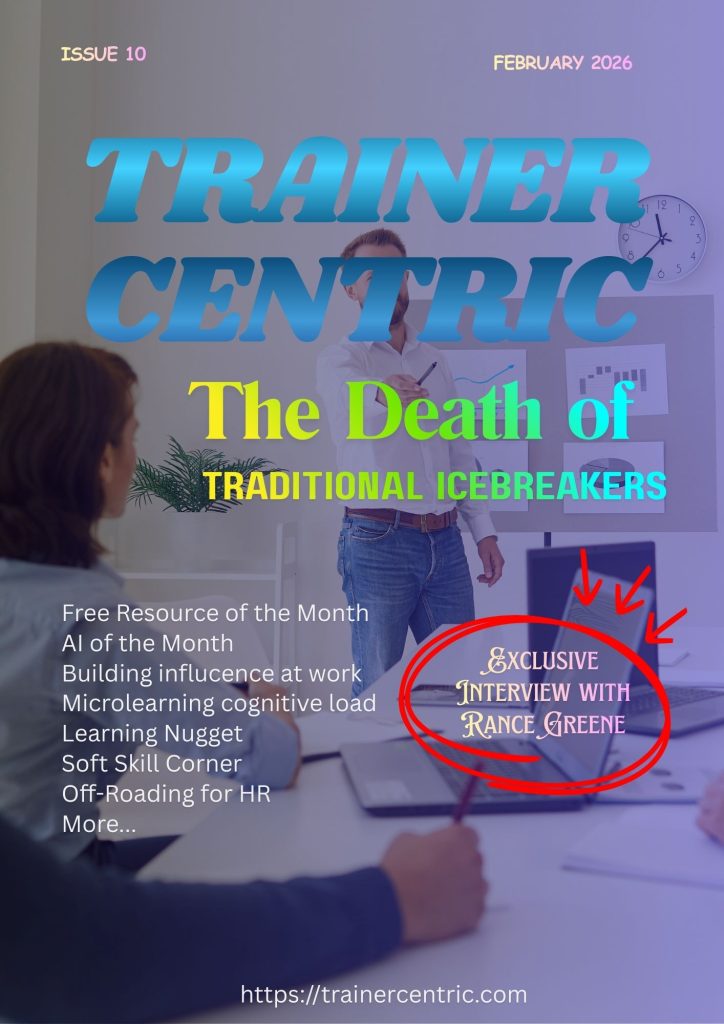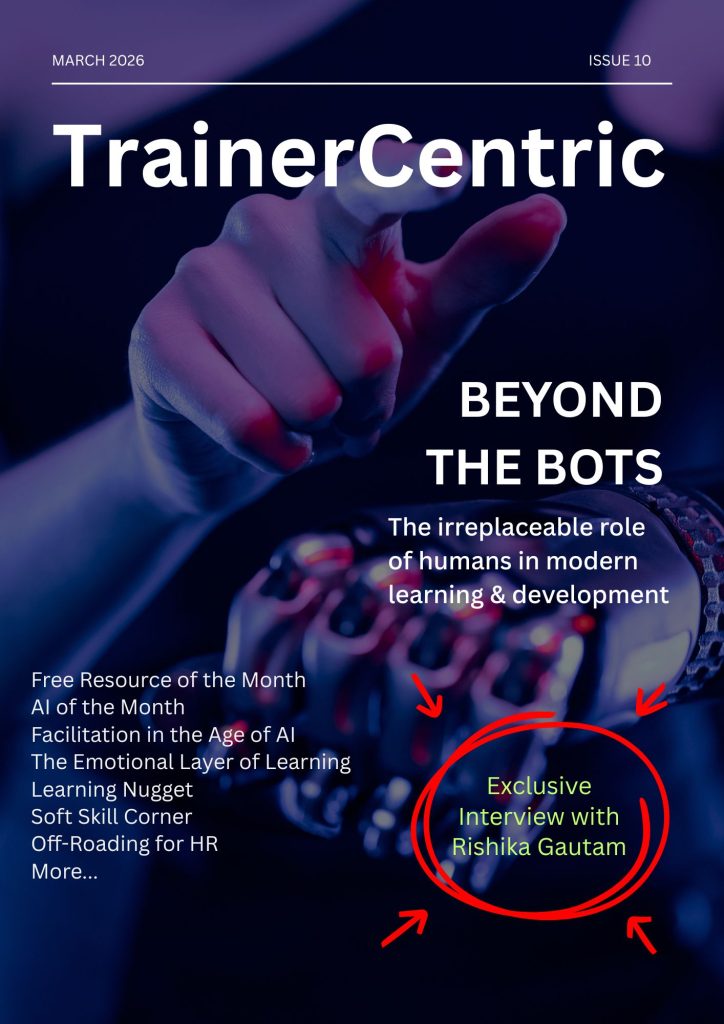
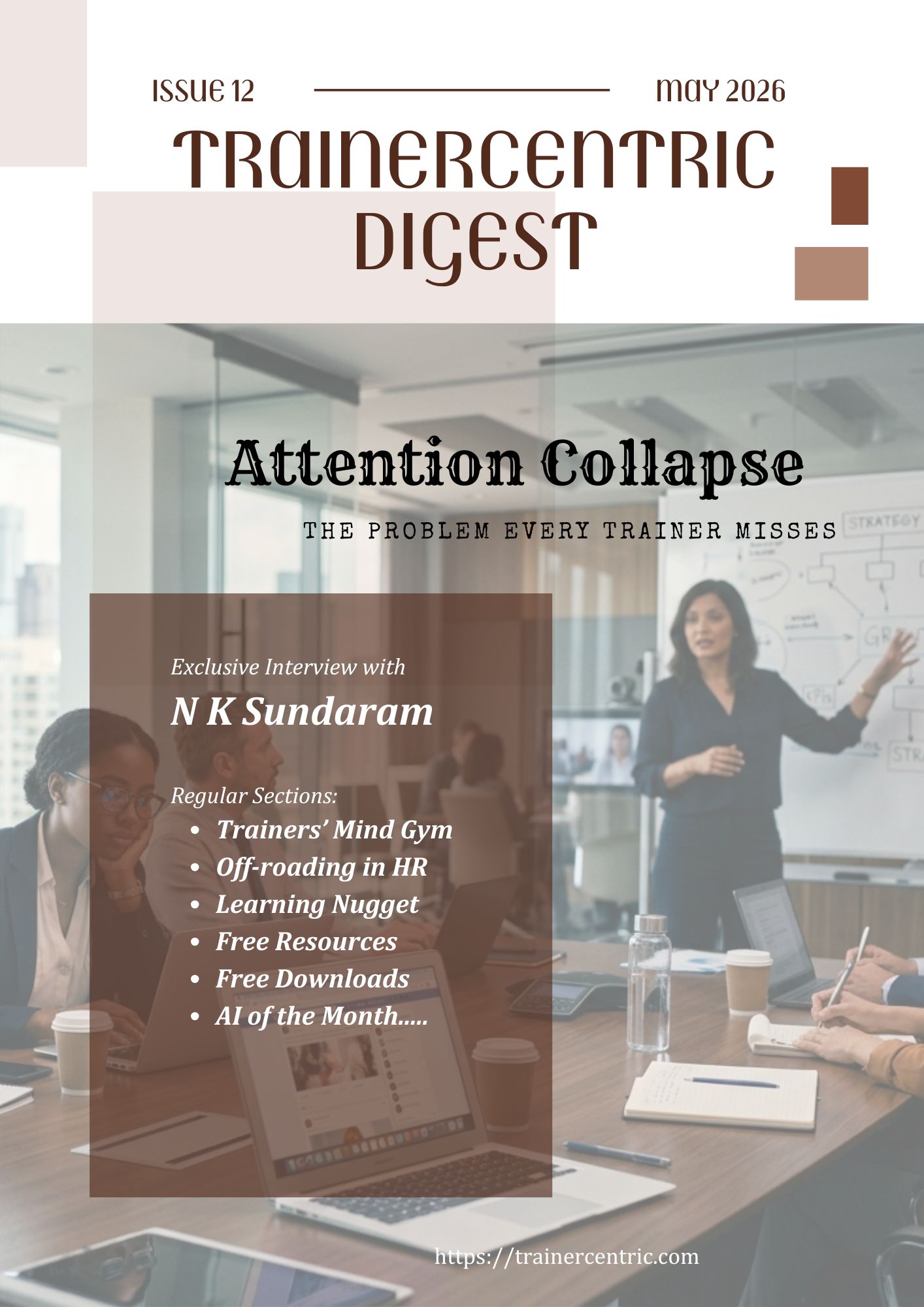
Welcome to the 12th issue of TrainerCentric Digest May 2026— the edition that dares to ask the uncomfortable questions. Why do learners mentally check out long before a session ends? Why do glowing feedback scores so often lead to zero behavior change? Inside these 32 pages, leading L&D voices including Anupama Mitra, Sumit Sinha, and NK Sundaram deliver straight answers and practical frameworks: the Attention Window, the ANCHOR Method, the REAL Framework for virtual training, and a hard look at the Feedback Illusion. Whether you design sessions, facilitate rooms, or lead learning strategy, this issue will change what you do — not just what you know. Download the full magazine for free and start designing training that actually sticks.
Attention Collapse
& The Feedback Illusion
The problem every trainer misses — plus powerful frameworks: ANCHOR, REAL, Attention Window. 32 pages of radical honesty, tools, and exclusive interviews.
— Arindam Mondal, Editor-in-chief
Inside the May Issue
Critical insights, research-backed models & trainer self-audit
Attention Collapse
Anupama Mitra
Why learners vanish cognitively — the Attention Window Framework (8–12 min resets), One-Idea Rule, Active Silence. Not a learner problem, a design problem.
The Feedback Illusion
Sumit Sinha
4.8 ⭐ ≠ behavior change. Introducing 3-layer feedback (intent, early application, sustained shift) — move from satisfaction to real performance impact.
ANCHOR Method™
Tulip Ghosh
Active · Name · Create decision · Hear room · One example · Reset. A rhythmic facilitation design that renews attention before it fades.
Designing for the Back Row
Pankaj Nandy
“Back Row First” questions, anonymous pulse checks, and inclusive tactics that turn silent disengagement into cognitive activation.
VILT: The REAL Framework
Pete Colantes
Reconnect · Elevate · Adapt · Lead. Fixing virtual training: 73% of orgs use VILT, only 27% find it highly effective. Here’s the solution.
Emotional Regulation
Subhra Basu
SPACE Response (Stop, Perceive, Acknowledge, Choose, Engage). Protects psychological safety. The hidden skill every facilitator needs.
N K Sundaram · 5 decades of wisdom
“Retirement is your second innings. Financial, mental, physical wellness — and grooming successors without insecurity. Empathy, not personal agenda, builds lasting teams.” Exclusive interview covers field-level feedback, healthcare empathy crisis, and why managers must enable coaching.
What Jazz Teaches Trainers
Miles Davis: “Play what’s not there.” Structure enables improvisation. Listen to silence, follow the room, adapt in real-time. The best facilitators compose live.
Rescue sessions with the Attention Window
Deliver → Anchor → Surface. Reset every 8-12 minutes. The Product Knowledge case study: 200 slides → 12-min anchored blocks → triple retention.
One-Idea Rule: don’t introduce next concept without anchoring current one. Temperature Check: “What are you connecting from your work?”
before cognitive reset
Action Mapping Toolkit
Cathy Moore’s free toolkit: design training around real-world actions, not information dumps. Includes performance analysis worksheets and scenario frameworks.
AI of the Month: Yoodli
AI speech coach that tracks filler words, pacing, rambling. Perfect for facilitator self-improvement & sales enablement. Real-time feedback for difficult conversations.
Whimsical · Tool of the Month
Visual collaboration for learning journeys, mind maps, and workshop flows. Prevents content-heavy designs and reduces cognitive overload.
Trainer’s Self-Checklist (20 points)
Industry Trends 2026
- 🔹 Skills architecture over job titles
- 🔹 Manager-as-coach mandatory
- 🔹 Psychological safety as learning condition
- 🔹 L&D measured by business outcomes
The complete May 2026 issue
32 pages of Attention Collapse fixes · Feedback Illusion · ANCHOR · REAL Framework · Jazz improvisation · NK Sundaram · Action Mapping · Yoodli AI · free checklist and downloads.
Download PDF — Free AccessISBN 9798196660603 · © TrainerCentric 2026 · No email required
“Attention is not something learners owe trainers. It is something trainers earn — and re-earn — through the quality of their design.”
— TrainerCentric Digest, May 2026