Every trainer has seen this. The session ends. The feedback forms come back. The scores are strong — four point three out of five. The comments say things like ‘very engaging’ and ‘the trainer was excellent.’
Two weeks later, nothing has changed.
This is the Feedback Illusion: the widespread belief among L&D professionals that positive post-session feedback is evidence that learning happened. It is not — and understanding the gap between training feedback effectiveness and actual behavior change is one of the most important shifts a trainer can make.

The Pattern Trainers Do Not See
Research from the Association for Talent Development found that only 12% of employees effectively apply new skills from training to their jobs. Yet most organizations keep measuring the thing that tells them nothing about that gap: end-of-session satisfaction scores.
Post-session feedback is measuring the wrong thing. It captures learner satisfaction at the moment of highest positivity — immediately after a session, when the experience is fresh, the trainer’s personality is still resonant, and the discomfort of application has not yet arrived.
What it does not capture is behavior change. It does not measure whether the customer conversation is happening differently, whether the report is structured more clearly, or whether the manager is having the coaching conversations they could not have before the program.
What trainers often don’t realize is that a 4.8 satisfaction score can coexist with zero performance change. In many organizations, it regularly does. This is the central problem with conventional training feedback effectiveness: the metric we optimize for is disconnected from the outcome we claim to produce.

Why Trainers Get Feedback Wrong
The incentive structure in L&D tends to reward delivery, not impact. Trainers are judged on how well they run sessions. HR leaders are measured on training completion rates and satisfaction scores. Neither of these metrics is meaningfully connected to behavior change.
So trainers optimize for what they are measured on. They make sessions engaging, energetic, and enjoyable. They design activities that feel valuable. They close with inspiring content. All of this produces good feedback scores.
None of it guarantees application.
The reframe is this: satisfaction is a hygiene metric, not an impact metric. It tells you whether the experience was tolerable or pleasant. It says almost nothing about whether anything will be different on Monday morning.
What Good Training Feedback Actually Looks Like
The hidden problem is not that trainers ask for feedback. The problem is that they ask the wrong questions. Most feedback forms ask:
- Was the content relevant?
- Was the trainer effective?
- Would you recommend this program?
These questions measure perception of the session. They do not measure proximity to change. If your goal is improving training feedback effectiveness, better questions look like:
- What is one thing you will do differently in the next 72 hours because of this session?
- What is the most significant obstacle you anticipate when trying to apply this?
- What support would help you follow through?
The difference is subtle but important. The first set asks learners to evaluate the session. The second set asks learners to commit to action. Commitment questions create accountability. Evaluation questions create data — but rarely the kind that drives change.

The Actionable Shift: A 3-Layer System for Training Feedback Effectiveness
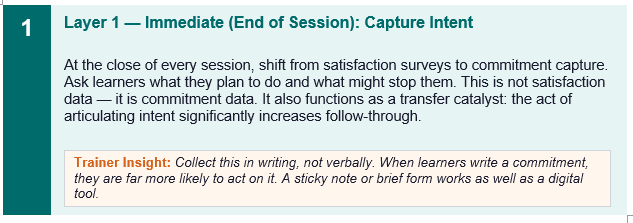
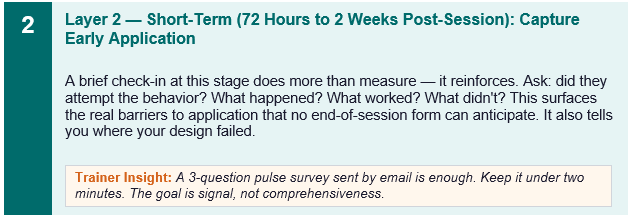
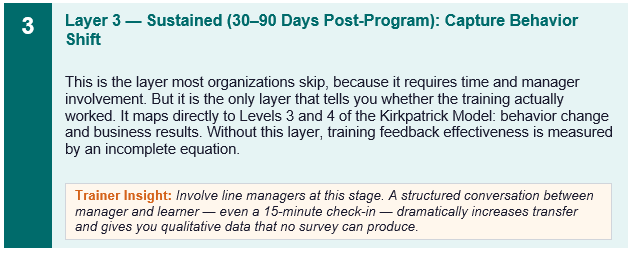
The most effective approach to measuring training feedback effectiveness works across three layers, captured at different points in the learning journey. Most organizations only use Layer 1. The real value sits in Layers 2 and 3.
What Not to Do: Common Mistakes That Undermine Feedback Effectiveness
- Don’t treat a 5-question satisfaction form as your only measurement tool.
- Don’t ask vague questions like ‘Was this useful?’ — they produce noise, not signal.
- Don’t collect feedback and then fail to act on it — learners notice, and it erodes trust.
- Don’t skip post-session follow-up because it feels like extra work — it is the work.
- Don’t rely on averages — a 4.3 average can hide the fact that 30% of learners found the session irrelevant.
- Don’t confuse enjoyment with learning — high engagement is a good sign, but it is not evidence of transfer.
The Shift Worth Making
Measuring training feedback effectiveness is harder than handing out a five-question form at the end of a session. But it is the difference between measuring the event and measuring the impact.
The 3-layer approach — immediate commitment capture, short-term application check-in, and sustained behavior shift measurement — will not only improve your data. It will improve your design, your follow-up, and your credibility as an L&D professional.
The feedback forms will still come back with good scores. But now you will know whether that actually means anything.

FAQ: Training Feedback Effectiveness — People Also Ask
Q: What is training feedback effectiveness?
A: Training feedback effectiveness refers to how well the feedback collected after a training session measures actual learning outcomes — particularly behavior change and on-the-job application — rather than just learner satisfaction or perceived enjoyment of the session.
Q: Why do good training feedback scores not mean learning happened?
A: Post-session satisfaction scores reflect how learners felt about the experience immediately after delivery, when positivity is highest. They do not capture whether learners applied new skills, changed behaviors, or improved performance. High scores and low transfer regularly coexist.
Q: What questions should I ask on a training feedback form?
A: Shift from evaluation questions (‘Was the trainer effective?’) to commitment questions (‘What will you do differently in the next 72 hours?’, ‘What barriers do you anticipate?’). Commitment questions increase accountability and generate actionable data for the trainer.
Q: What is the Kirkpatrick Model and how does it relate to training feedback?
A: The Kirkpatrick Model is a four-level framework for evaluating training effectiveness: Reaction, Learning, Behavior, and Results. Most organizations only measure Level 1 (Reaction) through satisfaction surveys. True training feedback effectiveness requires measuring Levels 3 and 4 — behavior change and business impact.
Q: How long after training should you collect follow-up feedback?
A: Effective follow-up happens in three windows: immediately post-session (commitment capture), 72 hours to 2 weeks later (early application check-in), and 30–90 days post-program (sustained behavior shift). Each window captures different and essential data.
Q: How do I measure behavior change after training?
A: Use a combination of learner self-report (structured pulse surveys), manager observation (brief structured check-ins), and where possible, performance data (output quality, error rates, conversation metrics). No single method is sufficient; triangulation across sources gives the clearest picture.
![The Power of Storytelling in Corporate Training: Igniting Success and Inspiring Growth [2023]](https://trainercentric.com/wp-content/uploads/2023/06/storytelling-1024x576.jpg)