
Why up to 90% of training spend is wasted — and the four-stage learning transfer strategy to fix it.
Introduction: Why Sarah’s Training Didn’t Stick
Effective learning transfer strategies are the holy grail of corporate L&D — yet most training programs are built in a way that almost guarantees they won’t work.
Meet Sarah. She’s a mid-level manager who completed a two-day leadership development program last quarter. The trainer was dynamic. The activities were well-designed. The post-event satisfaction scores were in the 90th percentile. Four weeks later, Sarah’s direct reports noticed no difference in how she ran meetings, gave feedback, or handled conflict.
Her manager noticed no change. The $1,400 per-seat program cost? Effectively wasted.
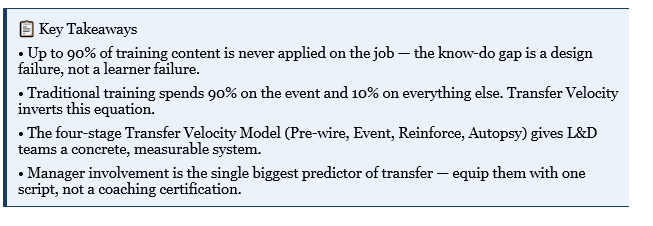
Sarah isn’t an outlier. Research consistently shows that up to 90% of newly acquired skills from training are never consistently applied back on the job — a phenomenon known as the know-do gap. We spend billions designing and delivering learning experiences, and then we let the forgetting curve win.
| “The problem is not that training doesn’t work. It’s that we’ve built an industry around the wrong part of the learning process.” |
This article introduces the Transfer Velocity Model — an original, four-stage framework designed to shift L&D from event-based learning to a continuous capability ecosystem. You’ll get the research rationale, concrete tactics, stage-by-stage metrics, and a 12-month roadmap to embed transfer culture into your organization.
Section A: The Research Deep Dive — Why Transfer Fails
The E-Learning Plateau
For a decade, the industry bet on technology to solve the engagement problem. Better animations. Adaptive learning paths. Mobile-first design. The investment has been enormous — and the returns, disappointing.
72% of L&D professionals now cite learner engagement as their single biggest obstacle to effective training — despite spending more per learner than ever before. The platforms got better. The transfer didn’t.
The reason is structural. Virtual and digital learning formats, however polished, still operate on the same flawed architecture: deliver content, test comprehension, issue completion certificate, move on. The learning science community has been clear for decades: this model does not produce durable behavior change.
The Dynamic Transfer Model (Blume, Ford, Surface & Olenick, 2019)
In their landmark meta-analysis, Blume and colleagues synthesized decades of transfer research to identify the factors that most reliably predict whether training leads to on-the-job application. Their Dynamic Transfer Model highlights three interacting systems:
- Individual characteristics (motivation, self-efficacy, goal orientation)
- Training design factors (relevance, practice opportunities, feedback quality)
- Work environment factors (supervisor support, peer climate, opportunity to perform)
Critically, the research found that work environment factors — particularly supervisor support — are often more predictive of transfer than training design itself. In other words, a mediocre program with strong manager reinforcement will outperform an excellent program without it.
The Time Problem
41% of employees cite lack of time for training as their biggest obstacle to participation and engagement, according to industry surveys. This isn’t laziness — it’s rational prioritization. When the daily operational environment pulls in one direction and training nudges gently in another, the operational environment wins every time.
The solution isn’t to demand more time. It’s to design learning that fits inside existing workflows — and to build the work environment support structures that make applying new skills feel worth the effort.
From Learning Events to Capability Ecosystems
Leading researchers and practitioners — including work by Blanchard and colleagues and insights from learning platform Disprz — have called for a shift in how organizations conceptualize learning: from discrete “events” to continuous “capability ecosystems.”
A capability ecosystem treats learning not as something that happens in a room (virtual or physical) but as an ongoing organizational process supported by leadership, peer networks, workflows, and technology. The learning event becomes a catalyst, not the container.
This is the conceptual foundation of the Transfer Velocity Model.
The Transfer Velocity Model: A Four-Stage Framework
Transfer Velocity reframes the training equation: instead of 90% effort on the learning event, we invest 90% in pre-work, reinforcement, and real-world application support. Here’s the complete model.
| Stage | Phase | Timeframe | Key Actions |
| 1 | Pre-wire & Prime | 1–2 wks before | Curiosity brief; baseline self-assessment; manager co-signs application goal |
| 2 | High-Impact Event | Day 0 | Scenario micro-sessions; retrieval openers; low-stakes peer practice; application commitment |
| 3 | Spaced Reinforcement Loop | Days 1–30 | Auto retrieval quizzes (Days 3,7,14,21); peer coaching; bi-weekly manager debrief |
| 4 | Application Autopsy | Day 30+ | 4-question reflection log; performance shift measurement; recalibrate 30-day goals |
Stage 1: Pre-Wire & Prime (1–2 Weeks Before)
The science: Expectancy-Value Theory (Eccles & Wigfield) demonstrates that adult learners invest cognitive effort only when they perceive both relevance and achievability. Pre-training priming activates prior knowledge networks, reduces cognitive load during the event, and most critically, gives learners a reason to care before they walk in the door.
The tactic: Send a one-page “curiosity brief” 10–14 days before the training event. Include two provocative questions that reveal a gap (“When did you last receive feedback from a direct report about your meetings — and what did it say?”) and a short 5-question baseline self-assessment. The final step is critical: the learner and their manager co-sign a specific, measurable application goal.
| Example application goal (poor): “Improve my feedback conversations.” Example application goal (good): “By Day 30, I will have conducted structured weekly one-on-ones with each of my 4 direct reports using the SBI feedback model at least once.” |
Metric: Pre-training goal completion rate. Target: 85%+ of learners arrive with a co-signed written application goal.
Stage 2: High-Impact Event (Day 0)
The science: The Retrieval Practice Effect (Roediger & Butler, 2011) consistently demonstrates that being tested on information — especially before receiving instruction — produces stronger long-term retention than re-reading or passive review. Pair this with the Desirable Difficulties framework (Bjork): learning that feels harder in the moment produces stronger durable memory.
The tactic: Restructure the learning event into 20-minute scenario-based micro-sessions. Each session opens with a retrieval challenge (“What do you already know about giving negative feedback in a performance review context?”), builds to a short input segment, and concludes with low-stakes peer practice using a real scenario from the learner’s work context. End each session with a one-sentence application commitment written in the learner’s own words.
Metric: End-of-session confidence score (1–5 self-report) + knowledge check pass rate. Target: 75%+ pass on first attempt; average confidence ≥ 3.5/5.
Stage 3: Spaced Reinforcement Loop (Days 1–30)
The science: Hermann Ebbinghaus’s Forgetting Curve (1885) showed that without review, we forget roughly 50% of new information within 24 hours and up to 90% within a week. The antidote is not repetition — it’s spaced retrieval. Retrieving information just before the point of forgetting strengthens the memory trace more than any other intervention.
The tactic: Schedule four automated 3-question retrieval quizzes via email or LMS on Days 3, 7, 14, and 21. Questions should require application (“Your team member just missed a deadline. Using the SBI model, write the opening sentence of your feedback conversation”), not recall (“What does SBI stand for?”). Layer in a 15-minute weekly peer coaching check-in using a structured question prompt, and a bi-weekly 10-minute manager debrief (see Section B script below).
Metric: Quiz completion rate + application attempt rate. Target: 80% completion rate; 60%+ of learners report at least one real on-the-job application attempt by Day 21.
Stage 4: Application Autopsy (Day 30+)
The science: Donald Schön’s work on Reflective Practice (1983) established that professionals who develop the habit of structured reflection after action develop expertise faster than those who simply accumulate experience. Without intentional analysis, experience calcifies rather than teaches.
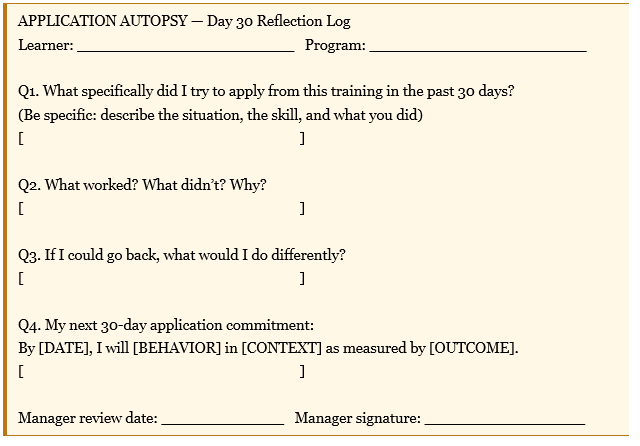
The tactic: At Day 30, send the Application Autopsy reflection log (see Section B). This is a structured four-question prompt: What did I try? What worked and what didn’t? What would I do differently? What is my next 30-day commitment? Schedule a 20-minute review conversation with the manager using the reflection log as the agenda.
Metric: Performance shift score: measurable change on at least one KPI directly tied to the original application goal, benchmarked against the Day 0 baseline self-assessment.
Section B: The Transfer Velocity Implementation Toolkit
The following templates are designed as PDF downloads to accompany your Transfer Velocity implementation. Each can be adapted for your organization’s context.
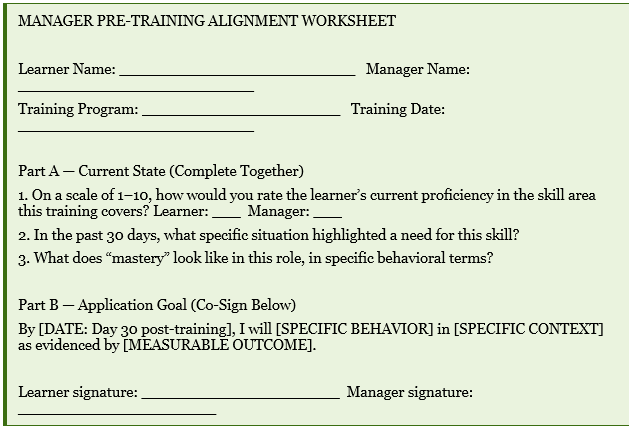
Template 1: Manager Pre-Training Alignment Worksheet
Purpose: To be completed by the manager and learner together, 10–14 days before the training event. Estimated time: 20 minutes.
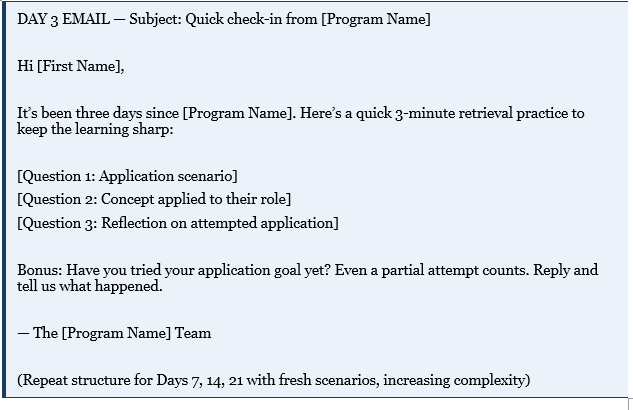
Template 2: Automated Spaced Repetition Email Sequence
Purpose: A four-email sequence sent automatically via LMS or email platform on Days 3, 7, 14, and 21 post-training.
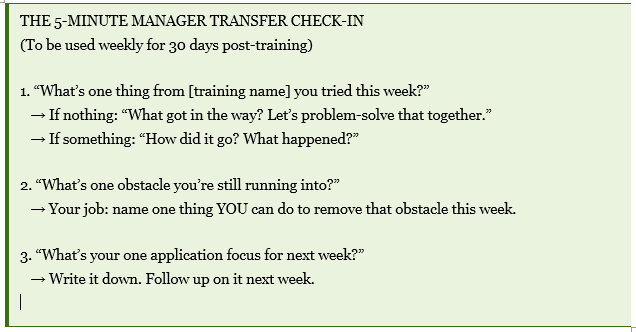
Template 3: The 5-Minute Weekly Transfer Check-In Script
Purpose: For direct managers to use in existing 1:1 conversations. Requires zero additional meeting time if embedded into a regular catch-up.
Remember: You’re not coaching here — you’re creating accountability and removing obstacles. That’s it.
Template 4: Application Autopsy Reflection Log
Section C: Real-World Results — What Transfer Velocity Looks Like in Practice
Case Study 1: Sales Team Increases Quota Attainment by 34%
Context: A 60-person B2B sales team had completed a consultative selling skills program. Post-training assessments showed strong knowledge retention, but 90-day quota attainment data showed no improvement.
Intervention: The L&D team redesigned the program using the Transfer Velocity Model, adding a manager pre-alignment worksheet, automated Day 3/7/14/21 retrieval quizzes with real prospect scenarios, and bi-weekly pipeline review calls that included a structured “skill application” question.
Result: Quota attainment in the cohort that went through the redesigned program increased by 34% compared to the previous quarter’s cohort. Manager survey data showed a 41% increase in confidence that the training had transferred. Time-to-competency for new hires dropped by 28%.
Case Study 2: Leadership Program Halves Time-to-Competency
Context: A financial services firm was running a 6-month high-potential leadership program. Despite strong content and experienced facilitators, 360 feedback data showed minimal behavioral change at the 6-month mark.
Intervention: Stage 1 was redesigned to include mandatory manager goal-setting conversations. Stage 3 introduced peer coaching triads with a structured weekly protocol. The Application Autopsy was embedded as a mandatory mid-program checkpoint, not just a final evaluation.
Result: Time-to-competency (defined as achieving a target 360 score on three key leadership behaviors) dropped from an average of 14 months to 7 months. Program NPS increased from 32 to 61. HR reported a 22% reduction in high-potential attrition in the 12 months following program completion.
Section D: Frequently Asked Questions
How do I sell the Transfer Velocity approach to my CFO?
Lead with the cost of the status quo, not the cost of the solution. If your average training spend is $1,000 per learner and 70% of that never transfers to performance, you’re already losing $700 per person. The Transfer Velocity Model adds minimal incremental cost (mostly design time and a lightweight tech setup for automated emails) but changes the ROI calculation fundamentally.
Frame it as: “We’re not spending more on training. We’re spending the same amount in a way that actually changes performance metrics.” Bring a pilot program proposal with three measurable business metrics you’ll track. CFOs respond to specificity.
What if my managers are uncooperative or too busy?
This is the most common objection, and it’s legitimate. The answer is threefold: make the manager’s time investment as small as possible (the 5-minute script requires no preparation), connect the transfer activity to something managers already care about (performance conversations, team results), and get executive sponsor alignment before you launch.
If a manager refuses to spend five minutes per week on a direct report’s development, that’s a management culture issue that training alone won’t solve. But the Transfer Velocity Model gives you the data to make that case clearly.
Can this work for compliance training?
Yes, with adaptation. Compliance training has unique constraints (regulatory pass rates, audit requirements, volume scale) but the transfer problem is often worse — because compliance content is perceived as irrelevant, and without Stage 1 priming, learners treat it as a checkbox exercise.
For compliance, Stage 1 should include “why this matters in your specific role” scenarios. Stage 3 can use micro-scenario quizzes tied to real regulatory situations. The Application Autopsy translates to a “compliance incident review” format. Completion rates and audit pass rates are not transfer metrics — track incident rates and near-miss reporting instead.
How does AI enhance the Transfer Velocity Model?
AI offers significant acceleration at Stages 1, 3, and 4. For Stage 1, AI can generate personalized curiosity briefs based on a learner’s role, tenure, and past training history. For Stage 3, AI-driven adaptive spaced repetition can optimize quiz timing and difficulty based on individual performance patterns, moving far beyond fixed Day 3/7/14/21 schedules.
For Stage 4, AI can analyze reflection log submissions at scale, surface patterns across cohorts (“73% of learners are citing time constraints as the reason they didn’t apply this skill”), and generate manager coaching prompts personalized to each learner’s autopsy responses. The result is a transfer system that improves with every cohort.
Section E: Measuring Transfer ROI — Kirkpatrick, Translated
The Kirkpatrick Four-Level Model is the most widely used evaluation framework in L&D. Levels 1 (Reaction) and 2 (Learning) are where most programs stop. Transfer Velocity is designed to drive Level 3 (Behavior) and Level 4 (Results) — and measure them.
| Kirkpatrick Level | What It Measures | Transfer Velocity Touchpoint | Sample Metric |
| Level 1: Reaction | Learner satisfaction | Post-event survey | NPS ≥50; Relevance score ≥4.0/5.0 |
| Level 2: Learning | Knowledge & skill acquisition | Day 0 knowledge check | 75%+ pass rate, first attempt |
| Level 3: Behavior | On-the-job application | Day 21 application attempt survey + manager observation | 60%+ application attempt rate |
| Level 4: Results | Business impact | Day 30 performance shift vs. baseline + business KPI delta | Measurable KPI movement in target direction |
Sample Dashboard Metrics
These five metrics, tracked across every program cohort, give you a complete transfer ROI picture:
- Pre-training goal completion rate (Stage 1 health check)
- Knowledge check pass rate, first attempt (Stage 2 effectiveness)
- Day 21 quiz completion rate (Stage 3 engagement)
- Application attempt rate at Day 21 (Stage 3 transfer indicator)
- Performance shift score: KPI delta vs. baseline at Day 30 and Day 60 (Stage 4 ROI)
Build a simple dashboard with these five numbers for each program. Present it quarterly to leadership. Training ROI conversations become significantly easier when you can show a performance shift score alongside a training cost figure.
Section F: The 12-Month Transfer Culture Roadmap
Shifting from an event-centric L&D model to a transfer-first capability ecosystem is a cultural change, not a program redesign. It requires executive alignment, manager capability building, and consistent measurement. Here is a month-by-month roadmap.
| Month | Focus Area | Key Actions |
| 1–2 | Diagnosis & Alignment | Audit top 5 programs for transfer gaps. Present ROI data to CLO/CHRO. Identify 1 pilot program. |
| 3–4 | Pilot Design | Redesign pilot program using Transfer Velocity. Build Templates 1–4. Identify manager champions. |
| 5 | Pilot Launch | Run pilot cohort. Track all 5 dashboard metrics from Day 1. |
| 6 | Pilot Review | Analyze results. Document wins and gaps. Prepare business case with data. |
| 7–8 | Manager Enablement | Run 2-hour “Manager as Transfer Coach” workshop for direct managers. Distribute 5-minute script. |
| 9–10 | Scale to Priority Programs | Apply Transfer Velocity to top 3 highest-cost / highest-impact programs. |
| 11 | Technology Integration | Implement automated quiz sequencing. Evaluate AI-enhanced personalization tools. |
| 12 | Culture Review & Recommit | Measure YOY change in application rates and performance shift scores. Publish internal case study. Reset goals. |
Closing: The Transfer Code Is Already Written
The research is not ambiguous. The know-do gap is not a learner motivation problem. It is a systems design problem — and it has a systems design solution.
The Transfer Velocity Model does not require a bigger budget. It does not require a new LMS. It requires a willingness to stop treating the learning event as the destination and start treating it as the starting line.
Stage 1 costs you a well-designed one-pager and a 20-minute manager conversation. Stage 3 costs you four automated emails and a committed peer network. Stage 4 costs you a reflection log and the discipline to actually look at the data.
What it gives back is training that changes performance — which is the only version of training your organization should be paying for.
| Your next step: Pick one program launching in the next 60 days. Add a Stage 1 curiosity brief and a co-signed application goal. Add a Day 7 and Day 14 retrieval quiz. Measure application attempt rate at Day 21. That’s Transfer Velocity in one program cycle. Then scale what works. |
Sources & Further Reading
- Blume, B.D., Ford, J.K., Surface, E.A., & Olenick, J. (2019). A dynamic model of training transfer. Human Resource Management Review, 29(2), 270–283.
- Roediger, H.L., & Butler, A.C. (2011). The critical role of retrieval practice in long-term retention. Trends in Cognitive Sciences, 15(1), 20–27.
- Bjork, R.A. (1994). Memory and metamemory considerations in the training of human beings. In J. Metcalfe & A. Shimamura (Eds.), Metacognition: Knowing About Knowing. MIT Press.
- Ebbinghaus, H. (1885/1913). Memory: A Contribution to Experimental Psychology. Teachers College, Columbia University.
- Schön, D.A. (1983). The Reflective Practitioner: How Professionals Think in Action. Basic Books.
- Kirkpatrick Model of Training Evaluation
![The Power of Storytelling in Corporate Training: Igniting Success and Inspiring Growth [2023]](https://trainercentric.com/wp-content/uploads/2023/06/storytelling-1024x576.jpg)