What is ADDIE?
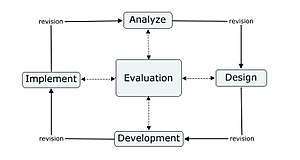
For the purpose of developing efficient training programs, educators and training specialists frequently use the ADDIE paradigm compared to other Instructional Designing methods such as the Kirk-Patrick method, SAM, Kemp Design model, etc. Analysis, Design, Development, Implementation, and Evaluation are referred to as ADDIE. Since its initial introduction in the 1970s, the paradigm has been utilized by training specialists. We will go over each stage analyze design development implementation and evaluation of this model and how it can be applied to creating efficient instructional goals in this piece.
Analysis Phase
The analysis is the first stage of the ADDIE paradigm. The training specialist determines the organization’s and the target audience’s training requirements during this phase. This entails assessing the audience’s abilities and information, spotting performance gaps, and figuring out what the training program should accomplish. Conducting a needs assessment, a procedure for gathering information to determine the organization’s training needs may also be part of the analysis step.

Design Phase
Design is the second stage of the ADDIE paradigm, where the training specialist creates a detailed blueprint for the training program. During this phase, the foundation established in Analysis is transformed into a practical roadmap for development.
First, the specialist defines specific, measurable learning objectives that state exactly what learners will be able to do after completing the training. These objectives guide all subsequent decisions.
Second, the specialist selects instructional strategies and techniques appropriate for both the content and the audience — such as lectures, group discussions, case studies, simulations, or hands-on practice.
Third, the specialist begins outlining training resources including slide decks, handouts, activities, and e-learning modules, though actual production occurs later in the Development phase.
Finally, the specialist creates assessment tools — such as quizzes, tests, rubrics, or performance checklists — that will measure whether learners have achieved the stated objectives. These assessments align directly with each learning objective to ensure valid measurement of success.
By completing these steps, the training specialist produces a clear, actionable blueprint that ensures consistency, quality, and alignment before any costly development begins.
Development Phase
Development is the third phase of the ADDIE model, following Analysis and Design, and preceding Implementation and Evaluation. During this critical stage, the training specialist transforms the blueprint created in the Design phase into tangible, ready-to-use training materials. This includes producing slide decks for instructor-led sessions, designing handouts and job aids for learners, creating e-learning modules using authoring tools like Articulate Storyline or Adobe Captivate, recording videos or podcasts, developing case studies and scenarios, building assessments and quizzes, and assembling any other resources required for delivery.
The Development phase is where instructional design becomes instructional product. A key activity within this phase is rigorous testing — often referred to as pilot testing, quality assurance, or user acceptance testing — to ensure that all materials function correctly, are free of errors, and most importantly, effectively support the intended learning objectives.
This testing may involve subject matter experts reviewing content for accuracy, a small group of representative learners trying out an e-learning module for usability, or a facilitator rehearsing a slide deck to identify timing or clarity issues. Based on feedback from these tests, the training specialist makes iterative revisions before the materials are finalized.
Only when the materials have been verified as efficient (easy to use, technically sound, and appropriately paced) and effective (proven to help learners meet the stated learning goals) does the process move forward to the Implementation phase. Skipping or rushing the testing stage in Development almost inevitably leads to problems during delivery — confused learners, technical failures, or failure to achieve learning outcomes — which are far more costly to fix after training has been launched.
Implementation Phase
Implementation is the fourth step of the ADDIE model, where the training program is delivered to the intended audience. During this phase, all the planning, design, and development work culminates in actual learning experiences.
The training may be delivered in person (such as classroom sessions, workshops, or on-the-job training) or online (including live virtual classrooms, self-paced e-learning modules, or blended learning combinations). A variety of instructional techniques may be utilized during delivery, such as lectures, group discussions, role-playing, case studies, demonstrations, hands-on practice, or interactive simulations.
Before full rollout, a pilot test is often conducted with a small representative group to identify any remaining issues with content, pacing, technology, or facilitation. Feedback from the pilot allows for final adjustments.
Key activities during Implementation include preparing facilitators, setting up technology platforms, communicating logistics to learners, tracking attendance and participation, and providing on-the-spot support. The trainer’s role shifts from designer to facilitator, ensuring that learners remain engaged, questions are answered, and the training environment is conducive to learning.
Evaluation Phase
Evaluation is the fifth and final stage of the ADDIE model, where the training specialist assesses the training program’s overall efficacy. This phase determines whether the training successfully achieved its intended learning outcomes and delivers value to the organization.
Evaluation occurs at two levels. Formative assessments takes place throughout the earlier phases, gathering feedback during development and pilot testing to make improvements before full implementation. Summative assessments occurs after implementation, measuring the final results.
Key activities include analyzing the outcomes of assessment tools created during the Design phase — such as comparing pre-test and post-test scores, reviewing practical demonstration results, or examining certification pass rates. Additionally, the specialist collects audience input through satisfaction surveys, focus groups, or interviews to capture learner reactions and suggestions for improvement.
Beyond learning outcomes, evaluation may also examine whether learners have transferred new skills to the workplace and what business impact has resulted (reduced errors, increased productivity, etc.). Findings from the Evaluation phase feed directly into future training cycles, making ADDIE a truly continuous improvement process rather than a one-time linear event.
Advantages of ADDIE
- Flexible and efficient
- A flexible and efficient instrument for creating training programs is the ADDIE model. Since it can be applied in many different situations and sectors, training specialists frequently choose it.
- A comprehensive training course that takes audience and organization requirements into account
- The ADDIE model ensures that the training program addresses the needs of both the audience and the organization. This comprehensive approach helps to ensure that the training program is relevant and effective.
- Consistent and organized training curriculum delivery
- The ADDIE model provides a systematic and consistent approach to delivering training programs. This helps to ensure that the audience understands and learns the material. It helps in creating a continuous improvement method to a learning objective and targeted approach to the entire learning environment.
- A cyclical procedure enables ongoing development over time
- The ADDIE model is a cyclical process, which means that the training program can be evaluated and improved over time. This helps to ensure that the training program remains relevant and effective.
- Can be used in a variety of sectors and training programs.
- The ADDIE model can be used for different types of training, including in-person training, e-learning, and blended learning. It can also be applied to different industries, making it a versatile tool for training professionals.
Disadvantages of ADDIE
- Time-consuming and expensive to implement
- The ADDIE model requires a lot of planning and development, which can be time-consuming and expensive. This can be a barrier for some organizations that have limited resources.
- The linear process may be problematic if changes are needed during the implementation
- The ADDIE model is a linear process, which means that each phase must be completed before moving on to the next phase. This can be problematic if changes need to be made during the implementation phase.
- A rigid and inflexible approach may not be suitable for all training contexts
- The ADDIE model provides a framework for creating a training program, but it may not be suitable for all training contexts. In some cases, training professionals may need to use a more flexible approach that allows for more experimentation and adaptation.

How to implement the ADDIE method using tools and software?
When applying this model, using software tools like Trello, Asana, or Microsoft Project might be useful because they offer a digital platform for managing the many phases of the project. Here are some applications for each of these tools:
Trello: Trello is a tool for managing projects visually. It employs boards, lists, and cards to group and rank tasks. Using lists and cards, you may track progress, assign tasks, and engage with team members on a board for each step of the ADDIE model. Create a board for the analysis phase, for instance, with lists for the various activities like “Gather Data,” “Analyse Data,” and “Create Report.” Then you may make cards for every assignment, assign them to team members, specify due dates, and include comments and attachments.
Asana: Asana is a project management program that enables you to make tasks, distribute them to team members, and monitor their development. The ADDIE paradigm can be managed using Asana by establishing a project and segmenting it into tasks for each step. The Asana dashboard may then be used to assign tasks to team members, establish due dates, and monitor progress. Asana enables team collaboration by allowing you to add comments, attachments, and tags to documents.
Microsoft Projects: You may develop project plans, schedules, and timeframes with Microsoft Project, a tool for project management. The ADDIE paradigm can be managed using Microsoft Project by developing a project plan for each phase and decomposing it into tasks and subtasks. The Gantt chart view can then be used to assign resources, create deadlines, and monitor progress. Microsoft Project also allows for the sharing of the project schedule and work delegation with team members.
Comparison Between ADDIE and SAM
ADDIE (Analysis, Design, Development, Implementation, Evaluation) and SAM (Successive Approximation Model) are two prominent instructional design models that differ fundamentally in their approach to course development, flexibility, and responsiveness to change. ADDIE follows a linear, step-by-step waterfall methodology where each phase must be substantially completed before moving to the next — Analysis informs Design, which guides Development, followed by Implementation, and finally Evaluation. This traditional approach works well for large-scale, stable projects with clear requirements, regulatory compliance needs, or fixed budgets, but its rigidity means that discovering a flaw during Development often requires costly backtracking through earlier phases.
SAM, in contrast, embraces an agile, iterative process built on repeated cycles of design, prototyping, evaluation, and refinement. Instead of waiting until the end to test a finished product, SAM encourages instructional designers to create rough prototypes early, gather continuous feedback from stakeholders and learners, and make incremental improvements throughout the development process. While ADDIE’s linear structure provides clarity, predictable milestones, and thorough documentation, SAM’s iterative nature offers greater flexibility, faster problem detection, and more learner-centered outcomes — though it can feel less structured to teams accustomed to traditional project management.
In practice, many instructional designers use a hybrid approach: applying ADDIE’s macro-level planning and evaluation framework while incorporating SAM’s iterative prototyping and rapid feedback loops during the Design and Development phases. Ultimately, ADDIE is best suited for projects with stable requirements and extended timelines, whereas SAM excels in dynamic environments where requirements may evolve, stakeholder input is readily available, and speed to market with continuous improvement is a priority.
Comparison Table: ADDIE vs. Kirkpatrick vs. SAM vs. Gagné’s Nine Events
| Criteria | ADDIE | Kirkpatrick Model | SAM (Successive Approximation Model) | Gagné’s Nine Events of Instruction |
|---|---|---|---|---|
| Primary Focus | Instructional design lifecycle | Training evaluation and effectiveness measurement | Agile, iterative instructional design | Moment-to-moment lesson structure and learning psychology |
| Type of Model | Linear (waterfall) / Systematic | Evaluation framework | Iterative / Agile | Instructional / Lesson planning |
| Number of Phases/Steps | 5 phases | 4 levels | 3 main phases (with multiple iterations) | 9 events |
| Phases / Steps | 1. Analysis 2. Design 3. Development 4. Implementation 5. Evaluation | Level 1: Reaction Level 2: Learning Level 3: Behavior Level 4: Results | 1. Preparation 2. Iterative Design 3. Iterative Development | 1. Gain attention 2. Inform objectives 3. Recall prior learning 4. Present content 5. Provide guidance 6. Elicit performance 7. Provide feedback 8. Assess performance 9. Enhance retention/transfer |
| When to Use | Large-scale, stable projects with clear requirements; regulatory compliance | After training delivery to measure effectiveness and ROI | Dynamic environments with evolving requirements; rapid development needs; stakeholder feedback available | During lesson delivery; classroom or e-learning session planning |
| Flexibility | Low to moderate — linear process makes changes difficult and costly | Moderate — can be applied to any training type | High — embraces continuous feedback and iteration | Moderate — events can be reordered or adapted based on context |
| Best Suited For | Compliance training, academic courses, government/military training | Corporate training evaluation, ROI demonstration, L&D assessment | Software training, product launches, fast-paced industries, e-learning development | Classroom instruction, onboarding sessions, skill-based workshops, e-learning modules |
| Learner Involvement | Moderate — needs assessed but learners not involved in design | Low — learners provide feedback but not involved in evaluation design | High — continuous learner feedback during prototyping | High — active engagement required at each event |
| Strengths | Thorough, documented, structured, comprehensive | Industry standard for evaluation; links training to business results | Fast, flexible, learner-centered, error-catching early | Psychologically sound; based on how people learn; practical and actionable |
| Weaknesses | Time-consuming, expensive, rigid, difficult to backtrack | Does not prescribe how to design training; only measures after the fact | Can feel unstructured; requires constant stakeholder availability; less documentation | Does not address macro-level project management; assumes instructor-led delivery |
| Output | Fully developed training program | Evaluation data and ROI report | Working prototype → refined final product | A well-structured, engaging lesson or learning session |
| Historical Origin | 1970s (U.S. military) | 1950s (Donald Kirkpatrick) | 2010s (Michael Allen) | 1960s (Robert Gagné) |
| Can It Work With Other Models? | Yes — often paired with Kirkpatrick for evaluation or SAM for prototyping | Yes — used within ADDIE’s Evaluation phase | Yes — often used within ADDIE’s Design & Development phases | Yes — used within ADDIE’s Implementation phase |
| Project Management Style | Waterfall / Traditional | Measurement / Analytical | Agile / Scrum-like | Instructional / Pedagogical |
Conclusion
In conclusion, the ADDIE model is a tested and real instructional design method that can be applied to develop skills training courses. Training experts can ensure that their training programs are effective according to the five stages of the ADDIE model and the needs of both the organization and the potential audience. Due to its ability to adapt to different training contexts and audiences, the ADDIE model is a useful tool for educators and training experts.
![The Power of Storytelling in Corporate Training: Igniting Success and Inspiring Growth [2023]](https://trainercentric.com/wp-content/uploads/2023/06/storytelling-1024x576.jpg)