
Let me ask you something.
When was the last time you sat through a virtual training session and thought, wow, that was just as good as being in the same room?
Take your time. I’ll wait.
If you’re struggling to answer that question, you’re not alone and you’re not imagining it. The reason why Virtual instructor-led training fails has a very real and very widespread quality problem. And the frustrating part? It is entirely fixable.
I know this because I spent six years fixing it, session after session, from a webcam for a Fortune 50 logistics organization. What I learned in those six years became the foundation of everything I now teach through the REAL Framework.
But before we get to the solution, let’s spend a moment with the problem. Because understanding why virtual training fails is the first step toward making sure yours never does again.
The Problem Nobody Is Talking About why Virtual Instructor-led Training Fails
Picture this.
A facilitator with fifteen years of experience. Confident. Prepared. A track record of standing ovations in training rooms across the country.
Then one day — a Zoom link.
Same content. Same facilitator. Same energy.
Completely different result.
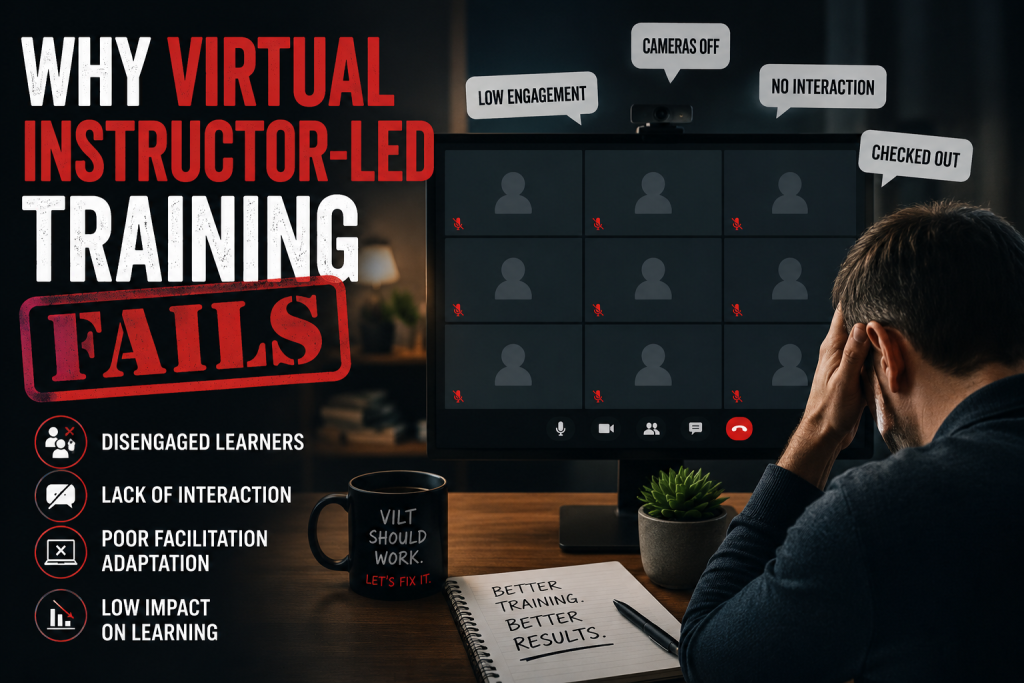
Cameras are all off, and the chat remains silent. Participants who once hung around after sessions to continue the conversation are now clicking “leave meeting” before the last slide loads.
What happened?
Nothing changed about the facilitator, but everything changed about the environment. And nobody (not one person) gave that facilitator the tools to bridge that gap.
The numbers tell a sobering story. VILT now represents over 40% of all instructor-led training hours delivered, up from just 15% before the pandemic (ATD, 2023). 94% of L&D professionals now use VILT as part of their training process, and large companies use it 39% of the time, making it their preferred training method (Training Industry Report, 2024).
And yet, here is the statistic that should stop every training professional in their tracks.
VILT is a staple for 73% of organizations, but poor learner engagement contributes to only 27% of organizations considering VILT highly effective (Class Technologies, 2025).
Read that again. Nearly three quarters of organizations are delivering virtual training. But fewer than one in three believe it’s actually working.
51% of organizations felt that their new digital offerings were somewhat or much less effective than their face-to-face offerings, with the top areas identified for improvement being learner engagement, social interaction, and more learning touch points (Ken Blanchard Companies, 2021).
Organizations invested heavily in the technology. They forgot to invest in the people delivering it.
The result is predictable: participants show up physically but check out mentally, disappearing behind a screen of black boxes. The chat goes quiet five minutes in. Training ends and leaves nothing behind because it never felt real to begin with.
When speed became the priority, quality was the casualty.
And somewhere in the middle of all of this, a very important truth got lost.
Although it’s virtual, let’s treat it as if it were in person.
That one sentence changed everything for me. And it’s the entire foundation of the REAL Framework.
Meet the REAL Framework
After seventeen years of facilitation experience — six of which were spent proving that virtual training could be just as powerful as in-person delivery for a Fortune 50 logistics organization — I developed a framework specifically designed to close the gap between what virtual training looks like and what it’s actually capable of being.
I call it the REAL Framework.
Four pillars. One standard. A completely different virtual experience.
R — Reconnect: Bring the Human Element Back
Stop starting virtually. Start connecting.
Before any learning can happen, connection must happen first.
Too often, virtual sessions fail before they even begin. Facilitators jump straight into content with slides loaded and screens shared, but they neglect to first pause and genuinely connect with the people on the other side of the screen.
The Reconnect pillar is a deliberate and intentional reminder that the most important technology in any virtual session is not Zoom; it’s the human relationship between a facilitator and their participants.
Here is what Reconnect looks like in practice.
Open with your story, not a corporate icebreaker or a trivial poll asking everyone to select their favorite color. Your actual story — why you are here, why this topic matters, and why the people in that virtual room deserve your very best today.
Name every participant. Before the session begins, ask participants to update their Zoom display name to their preferred name. Then use those names throughout the session, weaving them naturally into the content.
“This is the step where Maria hits enter and sees this screen. When James does the same thing, he might notice this difference instead.”
Nobody was put on the spot. But Maria and James both just sat up a little straighter.
There is actual brain science behind this. Hearing your own name triggers a neurological response that sharpens attention and increases presence. It signals to the participant, I see you. You matter here. And that feeling of being seen is one of the most underrated and underutilized engagement strategies in virtual facilitation.
The Reconnect pillar also draws on the science of proxemics — the study of how physical space affects human interaction and communication. In a virtual environment, your camera distance, your framing, and your spatial awareness all communicate something to your participants before you say a single word.
Stand up. Position your camera at a natural conversational distance — the kind that feels like two colleagues talking across a desk. That one physical adjustment alone changes your energy, your presence, and how connected your participants feel to you from the very first moment of the session.
And lay off the script. Participants can feel the difference between a facilitator who is reading and a facilitator who is present. Presence is what creates connection. And connection is what makes everything else in the REAL Framework possible.
E — Elevate: Raise the Standard of Virtual Training
The science is clear. Are your sessions?
Elevate is about bringing the research — the actual brain science of how people learn — into every decision you make as a virtual facilitator.
Done right, VILT delivers 80 to 90% of the learning outcomes of in-person training at 30 to 40% of the cost. Done wrong, it is an expensive webinar that nobody remembers (ATD / Training Industry).
The difference between those two outcomes is almost entirely in the delivery.
The Elevate pillar introduces what the REAL Framework calls sticky learning — activities specifically designed to make content adhere to the brain long after the session ends.
Try this in your next session. Instead of asking learners to type their answer in the chat, ask them to grab a pen and write it on paper. Then share. This one simple shift does three things simultaneously. It creates physical movement. It increases retention through the act of handwriting. And it fills their hands with something that is not their phone.
Other methods to encourage sticky learning are just as effective. The Fill in the Blank exercise keeps minds actively engaged throughout your delivery. The Data Hunt creates purpose-driven engagement by asking participants to find a specific piece of information within the material and report back to the group. The Stretch and Think activity asks participants to physically stand, stretch, and formulate their response before sharing — combining movement and cognition in a way that simultaneously energizes the room and deepens learning.
Movement creates energy. Energy drives focus. And focus is exactly what you are competing for in a virtual environment where every distraction known to mankind is within arm’s reach of your participant.
The Elevate pillar also addresses platform mastery. Share only the application window you need participants to see — never your entire screen. One surprise calendar notification in the middle of your session and your credibility takes a hit that no amount of great content can fully recover from.
Setting the tone is the final and perhaps most underestimated component of the Elevate pillar. Start on time. Every time. If you say break ends at 9:15 — start at 9:15. Small promises kept consistently build the kind of trust that makes participants lean in rather than check out.
A — Adapt: Pivot, Adjust, and Respond in Real Time
Read the virtual room. Then move with it.
This is the pillar that separates good virtual facilitators from great ones.
In a physical training room, adaptation is natural. You see a participant struggling and you slow down. You feel the energy dropping and you shift gears. You notice confusion on a face, and you address it before it spreads.
Virtually? Those signals are harder to read. But they are still there — if you know what to look for.
Research shows that facilitators should plan a learner interaction every five to seven minutes. If a facilitator talks for more than seven minutes without asking learners to do something, engagement is dropping. In a classroom, you can hold attention for fifteen minutes because physical presence keeps people attentive. On screen, you have half that time before learners start checking email (ATD Research).
The Adapt pillar trains facilitators to read the virtual room in real time and make intentional adjustments that keep the session moving forward effectively.
Zoom’s nonverbal feedback feature is one of the most powerful and underused adaptation tools available as accepted by most instructional designers. It allows for real-time participant communication without interrupting the session’s flow: Yes. No. Go faster. Go slower. By watching and responding to that feedback, you’re demonstrating something rare and powerful — I am paying attention to you.
The Spotlight feature directs the entire room’s attention to one participant at a time, creating focused peer-learning moments that mirror the best in-person workshop experiences.
The Adapt pillar also introduces three of the most effective learning activities for virtual delivery. Mime the Steps forces deep cognitive engagement by asking participants to physically act out a process or procedure without words. Fix the Mistakes sharpens critical thinking by presenting a deliberately flawed example for participants to identify and correct. Practice the Thing — not a simulation of the skill, but actual practice of the exact task participants will need to perform when they return to their work.
And when technical difficulties happen — because they will — the Adapt pillar prepares you for exactly that moment. What to say. How to maintain composure and credibility. And how to turn what could be a session-derailing disruption into a moment that actually strengthens participant trust rather than undermining it.
L — Lead: Guide Every Session Worth Showing Up For
Don’t just facilitate. Lead an experience.
The final pillar of the REAL Framework is the one that brings everything together — and the one that most distinguishes a memorable virtual session from a forgettable one.
Leadership in the virtual space is not about authority. It’s about intention. It’s about showing up for every participant in that virtual room as if their time, their learning, and their experience genuinely matter to you. Because they do.
The Lead pillar closes every session with the same intentionality that Reconnect opened it with.
The Letter to Yourself exercise asks participants to write — by hand — a personal commitment to one specific thing they will do differently because of the session. That physical act of commitment dramatically increases the chances of real behavior change happening after the session ends — which is, after all, the entire point of training.
Teach it Back is one of the most powerful retention strategies available, since teaching something requires a fundamentally deeper level of understanding. One participant explains a key concept back to the group in their own words and the entire room benefits from the cognitive processing that happens in that moment.
The Chat Waterfall is a Lead pillar favorite for a reason. Every participant types their response simultaneously — but nobody hits enter until you give the signal. Then everyone sends at the same moment. With the flood of responses comes a spike of energy and every single participant feels equally seen and equally heard.
Priming — setting up questions and activities in advance so participants arrive mentally prepared rather than caught off guard — is the final facilitation note in the Lead pillar. A primed participant is an engaged participant. And an engaged participant is one whose brain is already working on the answer before the question is even fully asked.
The Lead pillar ends with a commitment — not from your participants, but from you. Evaluate your session after it ends. Compare it to your last one. Commit to one specific tweak before your next session begins. Because the REAL Framework is not a checklist you complete once and file away. It is a practice. And practice done consistently and intentionally is how great virtual facilitators are made.
The Standard That Changes Everything
Reconnect. Elevate. Adapt. Lead.
Four pillars working together to create virtual sessions that stop feeling like virtual sessions — and start feeling like the real learning experiences your participants came for.
Organizations delivering VILT saved 28% of their total training budget without compromising learning quality in 2024 (Training Orchestra). The financial case for virtual training has never been stronger. But financial savings mean nothing if the learning is not landing.
That is the gap that the REAL Framework was built to close.
Although it’s virtual, let’s treat it as if it were in person.
That isn’t a tagline. It’s the entire philosophy behind the REAL Framework. It’s the standard that separates a forgettable virtual session from one that actually changes behavior long after the Zoom call ends.
Because here is what I know after seventeen years — six of which were spent proving this from a webcam for a Fortune 50 organization — virtual training does not fail because of the platform.
It fails because of the delivery.
And delivery, with the right framework, is something every facilitator can learn, practice, and master.
The virtual room is waiting. Show up like you mean it.
*To learn more about the REAL Framework and how to bring the Virtually In Person standard into your organization or your own facilitation practice, visit VirtuallyInPerson.net
![The Power of Storytelling in Corporate Training: Igniting Success and Inspiring Growth [2023]](https://trainercentric.com/wp-content/uploads/2023/06/storytelling-1024x576.jpg)