
How to maintain learner attention in training — and what happens when design fails the brain.
| “If your learners are still in the room but their minds have left, the session has already failed. The body is not the learner. The attention is.” |
It happens around the forty-minute mark. Sometimes sooner. The trainer is still talking. The slides are still advancing. The participants are still seated. But something has shifted. The questions stopped. The energy dipped. The eyes are open, but unfocused.
This is the Attention Collapse — not a single dramatic exit, but a slow, quiet withdrawal of cognitive presence from the training room. And it is the most under-discussed design problem in corporate learning.
What trainers often miss is that maintaining learner attention in training is not a personality challenge or a motivation issue. It is a structural one. Attention does not collapse because learners are lazy or distracted. It collapses because the training was designed in a way that makes collapse inevitable.
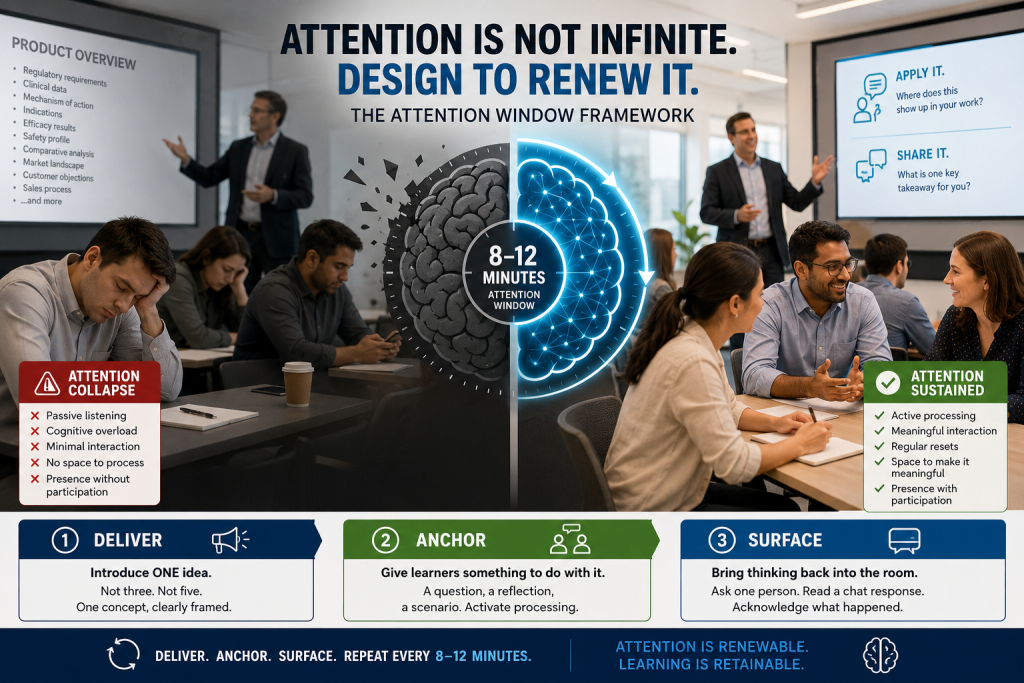
What the Attention Collapse Looks Like
The signs are predictable, if you know how to read them. Responses slow down. Questions get shorter or stop entirely. Participants who were engaged ten minutes ago are now scrolling discreetly or staring at nothing in particular. The chat goes quiet in virtual sessions. Eyes glaze in physical ones.
The trainer feels it — but often misreads it. They assume boredom, resistance, or fatigue. So they do what most trainers do: they speed up, add more energy, throw in an unplanned activity, or push through faster. Each of these responses makes the collapse worse.
Speeding up adds cognitive load. More energy adds noise. Unplanned activities without clear purpose confuse instead of re-engage. Pushing through signals to learners that their disengagement has not been noticed — which confirms that their presence is passive, not participatory.
The Hidden Trigger: Cognitive Saturation
The brain can only hold a limited amount of new information in working memory at once. This is not a weakness — it is how cognition works. When the input rate exceeds processing capacity, the brain does what any overloaded system does: it begins to shut non-essential processes down.
Learning is an effortful process. It requires active construction of meaning, not passive reception of content. When training is structured as a series of consecutive concepts with minimal processing time, learners hit cognitive saturation fast. The attention does not collapse because the content is not interesting. It collapses because there is no space to make it meaningful.
This shows up most visibly in sessions with slide-heavy delivery, expert-driven monologues, and minimal interaction design. The trainer is working hard. The learners are not — and that is the problem.
| “Attention does not collapse because the content is boring. It collapses because there is no space to make it meaningful.” |
Why Trainers Miss the Signs
Most trainers are trained to watch for visible disengagement — crossed arms, closed laptops, direct refusal. But the Attention Collapse is invisible disengagement: the kind that looks exactly like compliance.
Learners have learned to perform attention. They have been in enough sessions to know how to look engaged without being engaged. They nod. They make eye contact at the right moments. They do not disrupt.
This is why post-session feedback is not always reliable. Learners who were mentally absent for forty minutes will still rate the session a four out of five if the trainer was likeable and the room was comfortable. Trainers are measuring satisfaction when they should be measuring presence.
The Attention Window Framework
The most effective way to maintain learner attention in training is not to deliver more compelling content — it is to design around the brain’s natural attention cycle. The human attention window in a learning context runs approximately eight to twelve minutes before it needs a reset. Not a break. A reset.
The Attention Window Framework operates in three phases:
| PHASE | ACTION | PURPOSE |
| DELIVER | Introduce one idea | Not three. Not five. One concept, clearly framed. |
| ANCHOR | Give learners something to do with it | A question, a reflection, a scenario. Activate processing. |
| SURFACE | Bring thinking back into the room | Ask one person. Read a chat response. Acknowledge what happened. |
This is not a formula. It is a rhythm: Deliver. Anchor. Surface. Every eight to twelve minutes, the loop resets. Attention is not infinite — but it is renewable. Most trainers do not know how to renew it.
Real Training Scenario: The Product Knowledge Session
A pharmaceutical company runs a two-day product knowledge program for its field sales team. The content is dense — regulatory requirements, clinical data, competitor comparisons, customer handling scenarios. The trainer is an expert. The slides number over two hundred.
By the afternoon of day one, the room has collapsed. Participants are physically present, but the energy has drained. The trainer pushes harder — more slides, more detail, more explanation. By day two morning, absenteeism has quietly climbed.
The problem is not the content. The content is necessary. The problem is that the design treats attention as unlimited. The fix is not to remove content — it is to restructure delivery: break the two hundred slides into twelve-minute blocks, each anchored to a specific application scenario. Insert processing moments every session block. Design for saturation, not just coverage.
Here is an interesting article that talks about how Teachers are taking brain breaks in order to fight the attention collapse.
The same content. Completely different result.
| “The problem is not that there is too much content. The problem is that there is too little space to process it.” |
4 Practical Strategies to Maintain Learner Attention in Training
| 01 The One-Idea Rule Do not introduce your next concept until you have anchored the current one. Ask yourself: have learners done something with this idea yet? A concept delivered but not processed is a concept not learned. If learners haven’t interacted with it, stop delivering and start anchoring. Trainer insight: Before advancing to your next slide, pause and ask: ‘Can someone give me one example of where this shows up in their work?’ Wait for the answer. Then move forward. |
| 02 The Temperature Check Every twenty minutes, pause and ask a connection question — not a comprehension question. ‘What is one thing you are connecting to from your own work right now?’ This surfaces processing in real time and signals to learners that their thinking matters, not just their recall. Trainer insight: Avoid asking ‘Does everyone understand?’ It measures compliance. Ask ‘What is landing for you right now?’ It measures engagement. |
| 03 The Active Silence Technique Stop talking. Give learners thirty seconds to write. Do not fill the silence. The silence is where processing happens. Trainers who are uncomfortable with silence are usually the ones whose sessions collapse fastest. Silence is not dead air — it is active cognitive work. Trainer insight: Announce it explicitly: ‘I’m going to give you sixty seconds of silence right now. Use it to write one thing you want to remember from the last ten minutes.’ Then actually wait. |
| 04 The Teach-Back Loop At the end of each block, have pairs briefly explain the concept to each other in their own words. Explaining forces retrieval. Retrieval deepens retention. Two minutes of teach-back is worth twenty minutes of passive listening. Trainer insight: Pairs work better than groups for this. Groups allow passengers. Pairs require both people to participate. |
WHAT NOT TO DO
- Speed up when the room goes quiet. Acceleration adds cognitive load. It signals anxiety, not energy.
- Insert an unplanned ‘energiser’ activity. Activities without clear anchoring purpose confuse more than they re-engage.
- Ask ‘Is everyone okay?’ or ‘Are we good?’ These questions measure comfort, not cognition. They invite polite lies.
- Treat post-session feedback scores as proof of learning. Satisfaction and presence are not the same metric.
- Assume engagement means eye contact. Learners have been trained to perform attention. Watch for cognitive output, not body language.
The Deeper Point
Attention is not something learners owe trainers. It is something trainers earn — and re-earn — through the quality of their design. If learners are collapsing, the session is not giving them a reason to stay present.
Every concept explained without application is an invitation to drift. Every question answered by the trainer that could have been answered by a learner is a missed activation.
The Attention Collapse is a signal. It is the room telling you something about your design. The trainers who listen to that signal — and adjust — are the ones whose sessions actually change behaviour.
| “Design for the attention cycle, not just the content clock. The clock does not care if anyone is thinking. The learner does.” |
| If this article resonates with you, here are a few resources that you might be interested in: 1. Check out our Activities page for the energizers that you can introduce to reduce cognitive load. 2. Check out the article on Cognitive Load to understand how you can reduce it by restructuring your entire session. |
Frequently Asked Questions about Attention Collapse in the Classroom
These are the questions L&D professionals most commonly ask about managing learner attention in training.
How long can adult learners actually maintain attention in training?
Research on attention in learning contexts consistently points to eight to twelve minutes as the functional window before cognitive load requires a reset. This is not a fixed biological limit — it varies by individual, topic complexity, and session design — but it is a reliable design benchmark. Trainers who structure sessions around this window see measurably better retention and engagement than those who deliver in long, unbroken sequences.
What causes learner attention to collapse during training?
The primary cause is cognitive saturation: the input rate exceeds the brain’s working memory capacity, and active processing shuts down. This is compounded by passive delivery structures — slide-heavy monologues, minimal interaction, and no built-in processing time. The Attention Collapse is almost always a design problem, not a learner problem.
How do I re-engage learners once attention has already collapsed?
Stop delivering and start anchoring. Ask a connection question (‘What is one thing from the last ten minutes that connects to your current role?’), call for a sixty-second written reflection, or run a quick teach-back in pairs. The goal is not to energise the room — it is to activate cognitive processing. Enthusiasm without structure does not reverse saturation.
Is the Attention Window Framework suitable for virtual training as well?
Yes — and it is arguably more important in virtual sessions, where competing stimuli are highest and performance of attention is easiest. In virtual training, the Anchor phase becomes critical: use the chat function, polls, or breakout rooms as processing mechanisms. The Deliver-Anchor-Surface rhythm works regardless of delivery format.
How do I know if learners are genuinely engaged or just performing attention?
Watch for cognitive output, not body language. Are learners generating original responses, making connections to their own work, asking questions that build on what was just said? These are indicators of genuine presence. Eye contact and nodding are compliance signals. Design activities that require cognitive production — brief writes, verbal summaries, peer explanations — and the difference becomes immediately visible.
How should I restructure a content-heavy programme to prevent the Attention Collapse?
Break the content into twelve-minute blocks anchored to specific application scenarios. Identify the single most important idea in each block and lead with that. Insert processing moments (reflection prompts, pair discussions, teach-backs) between every block. Remove content that cannot be anchored — if learners cannot do anything with a piece of information in the session, it probably does not belong in the session. Design for saturation, not just coverage.
![The Power of Storytelling in Corporate Training: Igniting Success and Inspiring Growth [2023]](https://trainercentric.com/wp-content/uploads/2023/06/storytelling-1024x576.jpg)