
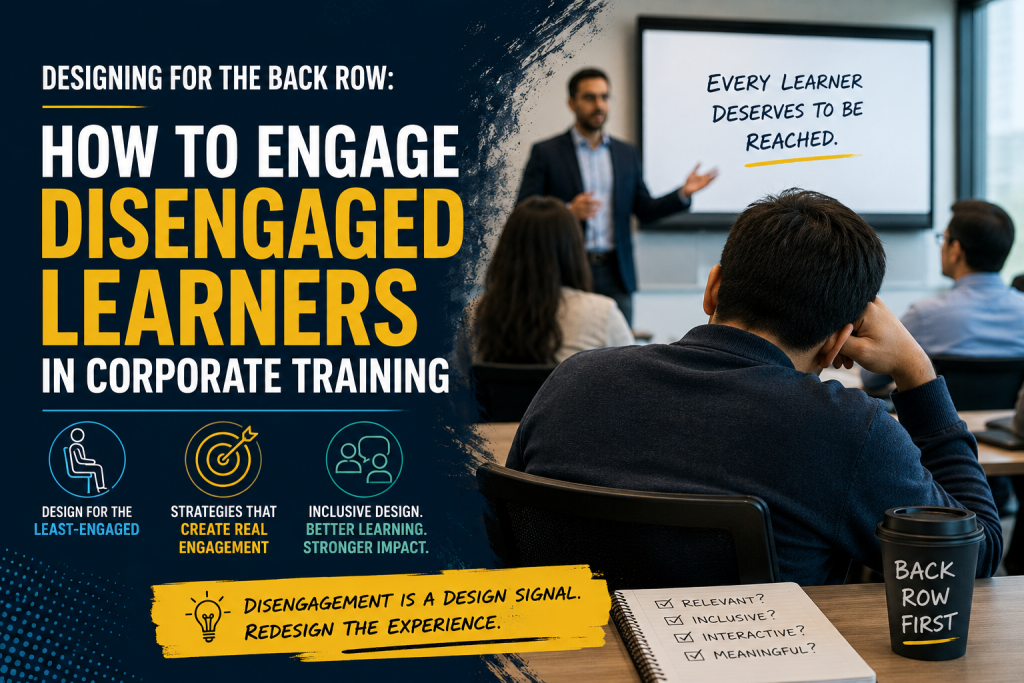
Picture the back row of any training room.
The participant who arrived on time but mentally left ten minutes in. The one scrolling discreetly beneath the table. The one whose eyes are open — but whose presence is somewhere else entirely.
We have all seen this. Many of us have been this person in someone else’s session.
But here is the insight that changes everything: a disengaged learner is not a behaviour problem. They are a design signal.
Designing for the back row does not mean moving the problem closer to the front. It means building training sessions where the back row never becomes a refuge in the first place. It is a proactive philosophy — one that treats disengagement not as a learner failure, but as a prompt to look at the session itself.
| Build the session for the least-engaged person in the room, and the most-engaged person will still be served. The reverse is never true. |
What Disengagement in Training Actually Looks Like?
Before we can address how to engage disengaged learners, we need to correctly identify what disengagement is — because it is not one thing.
Behavioural Disengagement
This is the visible kind. The participant who stops contributing, avoids eye contact, or physically withdraws from the group. It is easy to spot — but it is often the last stage, not the first.
Cognitive Disengagement
This is subtler and far more common. The participant appears present, nods at the right moments, but is not actually processing the content. They are performing attention — going through the motions of engagement without the substance of it.
Emotional Disengagement
This is the deepest layer. It is driven by a learner’s history — with the subject matter, with training itself, or with the organisation running the session. A participant who has failed at this topic before, or who has sat through years of irrelevant training, arrives carrying that history into the room.
People sit in the back row for reasons that have nothing to do with laziness or resistance. Prior failure with the subject. Anxiety about being called on. A passive learning habit built over years of sessions that did not ask them to think.
The back row is not a character flaw. It is a response to conditions. And conditions can be redesigned.
Stop Rearranging Chairs. Start Redesigning the Experience.
The natural instinct when facing a disengaged back row is environmental — move people, rearrange the room, change the seating. These adjustments feel productive. They rarely fix anything.
The problem is not physical. It is structural. The session itself — its pacing, its demands on learners, its design for participation — is what creates or prevents the back row.
| The learner who sits farthest from you is not the hardest to reach. They are the most important one to design for. |
This is what we call the Back Row First Question: instead of designing your session for the most engaged participant in the room, design it for the one least likely to feel safe, relevant, or capable. Every other learner will still benefit. But this learner — the one you might otherwise lose — will finally be included.
5 Strategies to Engage Disengaged Learners That Actually Work
These are not motivational tricks or participation gimmicks. They are structural decisions — design choices that change the conditions of the room before disengagement has a chance to take hold.
| 1 | Anonymous Pulse Checks |
| Polling tools or simple note cards allow disengaged learners to participate without the social risk of being seen to participate. Anonymous contributions lower the stakes enough that reluctant learners engage — and the trainer receives genuine data about where the room actually is, not where it appears to be. Trainer insight: Use anonymous responses at the start of a new concept, not just at the end of the session. Early honest data helps you adjust in real time. | |
| 2 | Reverse the Role — Ask Them to Judge |
| Give passive learners something to evaluate rather than something to produce. Asking someone to rank two approaches, or identify the strongest argument in a scenario, feels lower-stakes than open contribution — but requires exactly the same cognitive depth. Judgment is engagement. Trainer insight: Frame evaluation tasks clearly: ‘Your job right now is not to produce an answer — it’s to decide which of these two is stronger, and why.’ This reframe works especially well with experienced learners who resist being taught. | |
| 3 | Predictable Unpredictability |
| Vary your activity modalities in ways learners can anticipate structurally, but cannot predict experientially. They know a processing moment is coming — they do not know if it will be a written reflection, a pair discussion, or a stand-up activity. This pattern keeps the attention system alert without creating anxiety. Trainer insight: Signal the structure without revealing the format: ‘We’re about to do a processing activity — take a moment to gather your thoughts.’ Then choose the format based on the energy in the room. | |
| 4 | Signal for Help Without Shame |
| Create a low-visibility way for learners to flag confusion or discomfort — coloured cards in physical rooms, specific chat emojis in virtual ones. The crucial design point: normalise these signals from the very start of the session, not as a remediation tool, but as standard professional practice. Trainer insight: Introduce the signal system in your opening: ‘If at any point you need me to slow down or revisit something, here’s how to do that without interrupting the room.’ When it is normalised, it gets used — and you get real information. | |
| 5 | The Back Row First Question |
| Instead of taking the first volunteer who raises their hand, deliberately invite someone who has not yet spoken — framed as genuine curiosity, not a cold call. The back row has learned to expect invisibility. Being noticed without being ambushed creates a fundamentally different quality of attention. Trainer insight: Use curiosity framing, not accountability framing. ‘I’d love to hear from someone I haven’t heard from yet — what’s coming up for you on this?’ is very different from ‘You in the back — what do you think?’ | |
What Not to Do: Three Common Mistakes That Make Disengagement Worse
1. Cold Calling to Shame
Calling on a visibly disengaged learner without preparation or choice produces compliance — not engagement. The learner may answer. But the emotional cost is real, and the rest of the room notices. It creates a climate where the safest strategy is invisibility.
2. Layering on Gamification
Points, leaderboards, and badge systems treat engagement as a motivational problem solvable by external reward. They rarely address the emotional roots of disengagement — and they can actively alienate learners who already feel out of place, by adding a competitive dynamic to a space where they already feel exposed.
3. Mistaking Silence for Understanding
A quiet room is not a learning room. Silence is information. It is telling you something about the design. The most dangerous assumption a trainer can make is that no questions means no confusion.
When a session ends and no one asks anything, the instinct is to feel satisfied. The better instinct is to ask: what made it feel unsafe to ask?
Why Inclusive Training Design Is Better Training Design
Designing for the back row is not a remedial strategy. It is an inclusive one — and an honest one.
It asks trainers to stop designing sessions that require learners to arrive already motivated, already confident, and already engaged in order to benefit. Most learners in most corporate training rooms do not arrive that way. They arrive distracted, time-pressured, uncertain of relevance, and carrying previous experiences of training that did not serve them.
When you design for those learners, you design better for everyone. The strategies that reach disengaged learners — lower-stakes participation, structured processing moments, genuine curiosity over accountability pressure — also deepen engagement for learners who were already on board.
| The back row will always exist. The question is whether your design leaves it empty — or quietly fills it, one activation at a time. |
Want to go deeper?
Explore these TrainerCentric resources to build on what you’ve read here:
- ANCHOR Method Article — A 6-step facilitation framework designed around how learner attention actually works
- Instructional Designing Methods 101: A comprehensive guide that help you design better and engaging content
- How to design a course using ADDIE: Learn to use ADDIE methods to create a course online and easy.
A Final Thought
The back row is not the problem. It is the mirror.
It reflects the parts of our session design that ask too little, explain too much, or create too few reasons for a learner to bring their real thinking into the room. Redesign those parts — and the back row begins to move forward on its own.
Frequently Asked Questions About Engaging Disengaged Learners in Training
What causes learner disengagement in corporate training?
Disengagement in corporate training has three main forms: behavioural (visible withdrawal), cognitive (performing attention without processing), and emotional (driven by prior negative experiences with learning or the subject). Most disengagement is a response to session design — not a reflection of the learner’s motivation or character.
How do you reach disengaged learners without calling them out?
The most effective approach is designing participation into the session structure so that engagement does not require public risk-taking. Anonymous pulse checks, evaluation tasks, and curiosity-framed invitations all create ways for disengaged learners to re-enter the conversation without feeling exposed or singled out.
What is the Back Row First design philosophy?
Back Row First is an approach to training design that asks facilitators to build sessions for the least-engaged, least-confident learner in the room — rather than for the most engaged. When you design for that learner, you create conditions that serve everyone. A session that requires learners to arrive already motivated will always leave someone behind.
Does gamification help with learner disengagement?
Gamification can create surface-level activity but rarely addresses the emotional roots of disengagement. Leaderboards and point systems can actually increase anxiety for learners who already feel out of place, adding competitive pressure to a space where they are already uncomfortable. Structural design changes — lower-stakes participation, processing moments, genuine curiosity — tend to be more durable.
How do I know if my training session has a disengagement problem?
Silence is one of the most common signals — but it is easy to misread as comprehension. Other signs include first-volunteer dependency (only one or two people consistently contributing), low question volume at the end of sessions, and the pattern of the same learners always responding. If your session only works when certain people show up, the design is relying on engagement rather than creating it.
Can these strategies be used in virtual training?
Yes — and in many ways they are more important in virtual environments, where disengagement is both easier and less visible. Anonymous pulse checks translate directly to polls and chat responses. Predictable unpredictability works well with breakout rooms, chat bursts, and shared whiteboards. The Back Row First question applies equally to the participant who has their camera off and has not typed in the chat.

![The Power of Storytelling in Corporate Training: Igniting Success and Inspiring Growth [2023]](https://trainercentric.com/wp-content/uploads/2023/06/storytelling-1024x576.jpg)